Salta al contenuto principale

User account menu

  • Accedi
  • Join ISSUP

Lingue

  • English
  • Français
  • Português
  • Español
  • العربية
  • Pусский

Navigazione principale

  • About ISSUP

    • 10 Years of ISSUP
    • ISSUP Rationale
    • Membership
      • Membership Criteria
      • Code of Ethics
      • Who is ISSUP for?
    • News
      • Newsletters
    • ISSUP Events
    • International Partners
    • Governance
    • ISSUP Scientific Council
    • Friends of ISSUP (USA)
    • ISSUP Awards
      • Evidence-Based Award
      • Local Initiative Award
      • Services Award
      • Excellence in Training Provision
      • Outstanding Contribution to ISSUP Award
    • In Memoriam
    • Acknowledgements
    • ISSUP Website Guides
    • Contact ISSUP
    • FAQs - Frequently Asked Questions
    • Donate to ISSUP
  • Professional Development

    • ISSUP Academy
      • What is ISSUP Academy?
    • Universal Curricula (UC)
      • Currículo de Prevenção Universal
      • Currículo de Tratamento Universal
      • Universal Recovery Curriculum
      • UTC Self Led Courses
    • Resources
      • Drug Data Hub
      • Your Professional Hub
      • The ISSUP Exchange
      • ISSUP Webinars
      • Glossary
      • IEP
      • INEP Plus
      • Prevention Insights Video Series
      • Prevention Lists
      • Recovery Support
      • Quality in Treatment
      • ICAP certification
      • HealthEKnowledge
    • Jobs and Opportunities
  • Knowledge Share

    • Search in the Knowledge Share
    • ADDICTOLOGY Journal
      • Latest Issue
  • National Chapters

    • Africa
      • ISSUP Botswana
      • ISSUP Côte d’Ivoire
      • ISSUP Egypt
      • ISSUP Ethiopia
      • ISSUP The Gambia
      • ISSUP Ghana
      • ISSUP Kenya
      • ISSUP Liberia
      • ISSUP Mauritius
      • ISSUP Morocco
      • ISSUP Namibia
      • ISSUP Nigeria
      • ISSUP South Africa
      • ISSUP Tanzania
      • ISSUP Togo
      • ISSUP Uganda
      • ISSUP Zambia
    • The Americas
      • ISSUP Argentina
      • ISSUP The Bahamas
      • ISSUP Barbados
      • ISSUP Brazil
      • ISSUP Chile
      • ISSUP Colombia
      • ISSUP Ecuador
      • ISSUP El Salvador
      • ISSUP Guatemala
      • ISSUP Mexico
      • ISSUP Panama
      • ISSUP Paraguay
      • ISSUP Peru
      • ISSUP United States
    • Asia
      • ISSUP Afghanistan
      • ISSUP Bangladesh
      • ISSUP India
      • ISSUP Indonesia
      • ISSUP Kazakhstan
      • ISSUP Korea
      • ISSUP Lebanon
      • ISSUP Malaysia
      • ISSUP in Pakistan
      • ISSUP Philippines
      • ISSUP Qatar
      • ISSUP Singapore
      • ISSUP Sri Lanka
      • ISSUP Thailand
      • ISSUP Türkiye
      • ISSUP United Arab Emirates
      • ISSUP Uzbekistan
      • ISSUP Vietnam
    • Europe
      • ISSUP Bosnia & Herzegovina
      • ISSUP Czech Republic
      • ISSUP Greece
      • ISSUP Italy
      • ISSUP Spain
      • ISSUP Ukraine
      • ISSUP United Kingdom
    • Oceania
      • ISSUP Australia
      • ISSUP Fiji
      • ISSUP New Zealand
    • How to Become a National Chapter
    • ISSUP National Chapters' Advisory Committee
    • ISSUP National Chapter Spotlight
  • Events

    • Search through all events
    • ISSUP Events
      • ISSUP 2026
      • Indonesia 2025
      • Thessaloniki 2024
      • Buenos Aires 2023
      • Manila 2022
      • Abu Dhabi 2022
      • Virtual 2021
      • Africa 2020
      • Vienna 2019
      • Nairobi 2018
      • Cancún 2017
      • Campinas 2016
      • Bangkok 2015
  • Networks

    • A–Z
  • My ISSUP

    • Member Directory
    • Apply for membership

Recovery Research

Recovery Research

Moderators

Profile picture for user livia.edegger
Livia
ISSUP
Profile picture for user MoralesBA
Brian Morales
U.S. Department of State
DiscussionsFileImmaginiVideosCollegamentiEventsKnowledge ShareTutti
Goodman Sibeko

Adults with Problematic Opioid Use Released from Jail: Mutual Help Groups and Medication Support Contribute to a Greater Likelihood of Opioid Abstinence

Shared by Goodman Sibeko - 14 October 2026
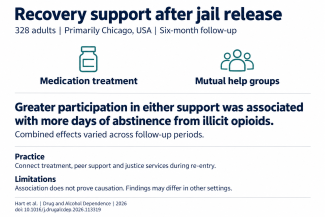
Infographic summarising a study of 328 adults after jail release: medication treatment and mutual help participation were associated with more days of abstinence from illicit opioids. It encourages coordinated treatment, peer support and justice services, while noting that association does not establish causation and findings may differ across settings.
Format
Scientific article
Published by / Citation
Hart MK, Galanter M, Grella C, Passetti LL, White W, Dennis ML. Adults with problematic opioid use released from jail: Mutual help groups and medication support contribute to a greater likelihood of opioid abstinence. Drug Alcohol Depend. 2026 Oct 1;287:113319. doi: 10.1016/j.drugalcdep.2026.113319. Epub 2026 Aug 13. PMID: 42607585; PMCID: PMC13614506.
A recent study found that medication treatment and mutual help group participation were each associated with more days of abstinence from illicit opioids after jail release. Their combined benefits were less clear and varied across follow-up periods. For ISSUP practitioners, the findings highlight the value of connecting treatment, recovery support and justice services during re-entry. The study does not establish causation, and findings from this US sample may not apply equally in other settings.

  • Per saperne di più su Adults with Problematic Opioid Use Released from Jail: Mutual Help Groups and Medication Support Contribute to a Greater Likelihood of Opioid Abstinence
  • ISSUP members can join Networks to comment – Sign in or become a member
Rasha Abi Hana

Connecting Evidence, Prevention, Law Enforcement and Community Action: Key Insights from ISSUP 2026

Shared by Rasha Abi Hana (ISSUP staff) - 14 October 2026
Format
Reading List

How do we go about translating evidence into effective action, strengthen prevention, address drug-related crime, improve access to treatment and recovery support, and build safer, healthier communities?

This age-old question was explored during ISSUP's 2026 Virtual Conference, held on 22–23 September 2026 under the theme Connecting Sectors, Creating Impact: A United Response on Drugs.

Bringing together researchers, practitioners, policymakers, law enforcement professionals and community representatives from different regions, the conference provided an opportunity to exchange evidence...

  • Per saperne di più su Connecting Evidence, Prevention, Law Enforcement and Community Action: Key Insights from ISSUP 2026
  • ISSUP members can join Networks to comment – Sign in or become a member
Rasha Abi Hana

Faith-Based Approaches: The Role of Faith and Religious Institutions in Addressing Substance Use 

Shared by Rasha Abi Hana (ISSUP staff) - 12 October 2026
Format
Report

Faith, spirituality and faith-based organisations can play an important role in addressing substance use, supporting recovery and responding to related vulnerabilities as well as crime. Across different cultural and community settings, they can provide identity, belonging, hope and sustained relationships, while often reaching individuals and families in ways that formal services cannot. 

But recognising this potential also raises important questions. How can faith communities ensure that the support they provide is informed by evidence? How can faith leaders be equipped with the knowledge...

  • Per saperne di più su Faith-Based Approaches: The Role of Faith and Religious Institutions in Addressing Substance Use 
  • ISSUP members can join Networks to comment – Sign in or become a member
Rasha Abi Hana

Addressing Youth Substance Use and Crime: Risk Factors and Strategies

Shared by Rasha Abi Hana (ISSUP staff) - 12 October 2026
Format
Report

Protecting young people from substance use and crime: building safer communities and pathways to support

Young people's involvement in substance use and crime cannot be understood without considering the environments in which they grow up. Family circumstances, social connections, exposure to violence and access to opportunities can influence vulnerability, while supportive relationships, education and community engagement can help protect young people and create pathways towards healthier futures.

These issues were explored during Addressing Youth Substance Use and Crime: Risk Factors and...

  • Per saperne di più su Addressing Youth Substance Use and Crime: Risk Factors and Strategies
  • ISSUP members can join Networks to comment – Sign in or become a member
Rasha Abi Hana

From Evidence to Practice: Advances in Substance Use Disorder Care

Shared by Rasha Abi Hana (ISSUP staff) - 12 October 2026
Format
Report

Evidence-based interventions can improve prevention, treatment and recovery outcomes, but knowing what works does not guarantee that people will benefit. Effective responses depend on trained professionals, supportive systems, coordinated services and the ability to translate research into everyday practice. Even when appropriate interventions exist, gaps in implementation, access and continuity of care can limit their impact.

These challenges were at the centre of From Evidence to Practice: Advances in Substance Use Disorder Care, held on 22 September during ISSUP’s 2026 virtual conference...

  • Per saperne di più su From Evidence to Practice: Advances in Substance Use Disorder Care
  • ISSUP members can join Networks to comment – Sign in or become a member
Rasha Abi Hana

2027 Virtual NIDA International Forum—Call for Plenary Session Proposals

Shared by Rasha Abi Hana (ISSUP staff) - 8 October 2026
NIDA
Location
Online
Event Date
22 Novembre 2026

Call for Plenary Session Proposals

Help shape the scientific dialogue at the 2027 NIDA International Forum!

The National Institute on Drug Abuse (NIDA) International Program invites plenary session proposals for the virtual 2027 NIDA...

  • Per saperne di più su 2027 Virtual NIDA International Forum—Call for Plenary Session Proposals
  • ISSUP members can join Networks to comment – Sign in or become a member
Rasha Abi Hana

A scoping review of spirituality in relation to substance use disorders: Psychological, biological, and cultural issues

Shared by Rasha Abi Hana (ISSUP staff) - 24 September 2026
Format
Scientific article
Published by / Citation
Galanter, M., White, W. L., Khalsa, J., & Hansen, H. (2024). A scoping review of spirituality in relation to substance use disorders: Psychological, biological, and cultural issues. Journal of Addictive Diseases, 42(3), 210–218. https://doi.org/10.1080/10550887.2023.2174785

This scoping review explores the role of spirituality in substance use disorders (SUD) across psychological, biological and cultural dimensions. It reviews research on topics including spiritual awakening, drug craving, psychedelic-assisted psychotherapy, biological and neurological aspects of spiritual experiences, and the ways spirituality is understood across different cultural settings.

The review also considers the distinction between spirituality and religion and the role of spirituality in building recovery capital. While existing research points to several potentially important...

  • Per saperne di più su A scoping review of spirituality in relation to substance use disorders: Psychological, biological, and cultural issues
  • ISSUP members can join Networks to comment – Sign in or become a member
Rasha Abi Hana

From Darkness to Light: Spiritual Turning Points in Recovery among Former Substance Users in Norway

Shared by Rasha Abi Hana (ISSUP staff) - 24 September 2026
Format
Scientific article
Published by / Citation
Yri, M., Brattgjerd, M. & Koefoed, A. From Darkness to Light: Spiritual Turning Points in Recovery among Former Substance Users in Norway. J Relig Health (2026). https://doi.org/10.1007/s10943-026-02695-2

This qualitative study explores how spiritual experiences contribute to recovery from substance use disorders among 24 people who completed Christian faith-based rehabilitation programmes in Norway. Participants described experiencing loss of identity, hopelessness, and emotional distress before entering rehabilitation.

Within faith-based communities, experiences of forgiveness, belonging, and unconditional acceptance were described as important spiritual turning points. Participants associated these experiences with renewed meaning, dignity, and a changed sense of identity. The study...

  • Per saperne di più su From Darkness to Light: Spiritual Turning Points in Recovery among Former Substance Users in Norway
  • ISSUP members can join Networks to comment – Sign in or become a member
Rasha Abi Hana

A mosque-based methadone maintenance treatment strategy: Implementation and pilot results

Shared by Rasha Abi Hana (ISSUP staff) - 24 September 2026
Format
Scientific article
Published by / Citation
Rusdi Abd Rashid, Khosrow Kamali, Mohammad Hussain Habil, Mohamed Hatta Shaharom, Tahereh Seghatoleslam, Majid Yoosefi Looyeh, A mosque-based methadone maintenance treatment strategy: Implementation and pilot results, International Journal of Drug Policy, Volume 25, Issue 6, 2014, Pages 1071-1075, ISSN 0955-3959, https://doi.org/10.1016/j.drugpo.2014.07.003.

This study describes an Islamic-inspired methadone maintenance treatment programme delivered in a mosque setting for 36 Muslim men who used heroin. The programme combined methadone treatment with peer support and religious counselling, exploring whether mosques could provide an accessible community setting for substance use treatment and longer-term recovery support.

After 12 months, the programme had an 80% retention rate, and all but one participant tested negative for opioids and other substances. Participants also reported reductions in substance use and improvements in general health and...

  • Per saperne di più su A mosque-based methadone maintenance treatment strategy: Implementation and pilot results
  • ISSUP members can join Networks to comment – Sign in or become a member
Rasha Abi Hana

The Role of Faith Communities in Addressing Substance Use and Crime – Reading List (Part 2)

Shared by Rasha Abi Hana (ISSUP staff) - 20 July 2026
Format
Reading List

In this second reading list, we continue exploring the growing evidence on the role and contribution of faith communities and faith-based organisations in addressing substance use and crime, with a particular focus on treatment engagement, recovery, rehabilitation, and criminal justice. While Part 1 highlighted the contribution of faith communities to prevention, community resilience, and violence reduction, this collection examines how spirituality and religiosity may influence help-seeking, substance use outcomes, abstinence, recidivism, and successful reintegration into society.

Faith...

  • Per saperne di più su The Role of Faith Communities in Addressing Substance Use and Crime – Reading List (Part 2)
  • ISSUP members can join Networks to comment – Sign in or become a member
Rasha Abi Hana

Spirituality and Harmful or Hazardous Alcohol and Other Drug Use

Shared by Rasha Abi Hana (ISSUP staff) - 20 July 2026
Format
Scientific article
Published by / Citation
Koh HK, Frederick DE, Balboni TA, O'Reilly SM, Kelly JF, Humphreys K, Botticelli M, Mathur MB, Psimopoulos CS, Long KNG, VanderWeele TJ. Spirituality and Harmful or Hazardous Alcohol and Other Drug Use: A Meta-Analysis of Longitudinal Studies. JAMA Psychiatry. 2026 Apr 1;83(4):363-378. doi: 10.1001/jamapsychiatry.2025.4816. PMID: 41706493; PMCID: PMC12917744.

This meta-analysis synthesises evidence from 55 longitudinal studies involving more than 540,000 participants to examine the relationship between spirituality and harmful or hazardous alcohol and other drug (AOD) use. The findings demonstrate a consistent protective association, with spirituality linked to a 13% reduction in the risk of alcohol and other drug use across prevention and recovery outcomes. Among individuals who regularly participated in spiritual or religious communities, the protective effect increased to an 18% reduction in risk.

The review found that nearly all included...

  • Per saperne di più su Spirituality and Harmful or Hazardous Alcohol and Other Drug Use
  • ISSUP members can join Networks to comment – Sign in or become a member
Rasha Abi Hana

During, After, or Both? Isolating the Effect of Religious Support on Recidivism During Reentry

Shared by Rasha Abi Hana (ISSUP staff) - 20 July 2026
Format
Scientific article
Published by / Citation
Mowen TJ, Stansfield R, Boman JH 4th. During, After, or Both? Isolating the Effect of Religious Support on Recidivism During Reentry. J Quant Criminol. 2018 Dec;34(4):1079-1101. doi: 10.1007/s10940-017-9366-5. Epub 2017 Sep 20. PMID: 32382211; PMCID: PMC7205271.

This study examines how religious support during and after incarceration influences substance use and recidivism among people returning to the community. Using data from the Serious and Violent Offender Reentry Initiative, the authors distinguish between individuals' initial levels of religious support while incarcerated and changes in religious support after release.

The findings show that increases in religious support during reentry are associated with lower levels of substance use after release. While baseline religious support alone did not reduce substance use or offending, individuals...

  • Per saperne di più su During, After, or Both? Isolating the Effect of Religious Support on Recidivism During Reentry
  • ISSUP members can join Networks to comment – Sign in or become a member
Rasha Abi Hana

Religion, Crime, and Criminal Justice

Shared by Rasha Abi Hana (ISSUP staff) - 20 July 2026
Shutterstock
Format
Book
Published by / Citation
Johnson, Byron R., and Curtis S. Schroeder, 'Religion, Crime, and Criminal Justice', Oxford Handbook Topics in Criminology and Criminal Justice (2012; online edn, Oxford Academic, 2 June 2014), https://doi.org/10.1093/oxfordhb/9780199935383.013.005, accessed 20 July 2026.

This chapter reviews the evidence on the relationship between religion, crime, and the criminal justice system. It highlights a growing body of research showing a consistent inverse association between religiosity and criminal behaviour, suggesting that higher levels of religious involvement are often linked to lower levels of offending.

The authors also discuss how these findings can inform crime prevention strategies and criminal justice policy. They argue that collaboration between faith communities and criminal justice systems may strengthen prevention efforts and contribute to more...

  • Per saperne di più su Religion, Crime, and Criminal Justice
  • ISSUP members can join Networks to comment – Sign in or become a member
Rasha Abi Hana

Youth Narratives Concerning Drug Trafficking in Sinaloa: Joining, Risks, and Plans

Shared by Rasha Abi Hana (ISSUP staff) - 13 July 2026
Shutterstock
Format
Scientific article
Published by / Citation
Valdez Bátiz, J. E., Esparza Bernal, V. H., & Burgos Dávila, C. J. . (2023). Narrativas juveniles sobre el narcotráfico en Sinaloa: ingreso, riesgos y planes a futuro. Frontera Norte, 35. https://doi.org/10.33679/rfn.v1i1.2306

This qualitative study explores the experiences of young people involved in drug trafficking in Culiacán, Sinaloa, Mexico. Based on interviews with 16 young adults, the research examines why they joined drug trafficking, how they perceived the risks, and how they viewed their future within and beyond criminal networks.

The findings suggest that many participants were attracted by the prospect of financial gain, social acceptance, recognition, and the hope of achieving a successful future. For many, drug trafficking was viewed not only as a source of income but also as a pathway for personal...

  • Per saperne di più su Youth Narratives Concerning Drug Trafficking in Sinaloa: Joining, Risks, and Plans
  • ISSUP members can join Networks to comment – Sign in or become a member
Rasha Abi Hana

Measuring gang membership in England and Wales: A latent class analysis with Eurogang survey questions

Shared by Rasha Abi Hana (ISSUP staff) - 24 June 2026
Format
Scientific article
Published by / Citation
Medina, Juanjo & Aldridge, Judith & Shute, Jon & Ross, Andy. (2013). Measuring gang membership in England and Wales: A latent class analysis with Eurogang survey questions. European Journal of Criminology. 10. 591-605. 10.1177/1477370813475393.

This study examines how gang membership is measured among young people using the Eurogang Network’s survey approach. Drawing on nationally representative data from England and Wales, the researchers used statistical analysis to identify different types of peer groups and assess whether commonly used survey questions accurately distinguish gang-involved youth.

The findings suggest that the Eurogang measures successfully identified a group of young people involved in more frequent and serious offending. However, the same measures also classified another group whose primary behaviour was...

  • Per saperne di più su Measuring gang membership in England and Wales: A latent class analysis with Eurogang survey questions
  • ISSUP members can join Networks to comment – Sign in or become a member
Rasha Abi Hana

The Association Between Religiosity and Substance Use Patterns Among Women Involved in the Criminal Justice System

Shared by Rasha Abi Hana (ISSUP staff) - 18 June 2026
Format
Scientific article
Published by / Citation
Jones AA, Webb FJ, Lasopa SO, Striley CW, Cottler LB. The Association Between Religiosity and Substance Use Patterns Among Women Involved in the Criminal Justice System. J Drug Issues. 2018 Jul 1;48(3):327-336. doi: 10.1177/0022042618757208. Epub 2018 Feb 19. PMID: 33814600; PMCID: PMC8015967.

This study explores the relationship between religiosity and substance use patterns among women involved in the criminal justice system. Using data from women participating in a drug court programme in the United States, the researchers found that higher levels of religiosity were associated with a lower likelihood of cocaine use, either alone or in combination with cannabis.

The findings suggest that religiosity may serve as a protective factor for some forms of substance use, although the same association was not observed for cannabis use alone. Other factors linked to substance use...

  • Per saperne di più su The Association Between Religiosity and Substance Use Patterns Among Women Involved in the Criminal Justice System
  • ISSUP members can join Networks to comment – Sign in or become a member
Rasha Abi Hana

Religiosity and crime: Evidence from a city-wide shock

Shared by Rasha Abi Hana (ISSUP staff) - 18 June 2026
Format
Scientific article
Published by / Citation
Religiosity and crime: Evidence from a city-wide shock, Journal of Economic Behavior & Organization, Volume 232, 2025, 106934, ISSN 0167-2681,

This study examines the relationship between religiosity and crime using data from the 2015 visit of Pope Francis to Philadelphia. By analysing daily crime reports before, during, and after the visit, the researchers found a significant reduction in less serious crimes, particularly drug-related offences, during the week of the visit and for several weeks afterward.

The effects were strongest in historically Christian neighbourhoods, suggesting that increased religious engagement or community cohesion may have influenced behaviour. The study also compared the findings with President Obama’s...

  • Per saperne di più su Religiosity and crime: Evidence from a city-wide shock
  • ISSUP members can join Networks to comment – Sign in or become a member
Rasha Abi Hana

European Drug Report 2026: Trends and Developments

Shared by Rasha Abi Hana (ISSUP staff) - 9 June 2026
Format
Report
Published by / Citation
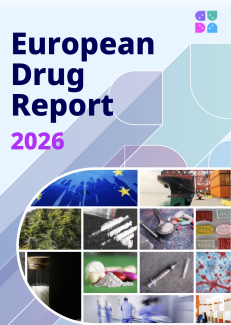
European Union Drugs Agency (2026), European Drug Report 2026: Trends and Developments, https://www.euda.europa.eu/publications/european-drug-report/2026_en

The European Drug Report 2026: Trends and Developments provides the latest overview of the drug situation across Europe, drawing on data from EU Member States, Türkiye, and Norway. The report examines patterns of drug use, drug-related harms, drug supply, treatment services, and other interventions, offering a comprehensive picture of developments up to the end of 2025.

Using data collected through national monitoring systems and European research networks, the report highlights emerging trends and supports evidence-informed responses to drug-related challenges. It also emphasises the...

  • Per saperne di più su European Drug Report 2026: Trends and Developments
  • ISSUP members can join Networks to comment – Sign in or become a member
Rasha Abi Hana

Faith-Based Addiction Recovery

Shared by Rasha Abi Hana (ISSUP staff) - 8 June 2026
Format
Website
Published by / Citation
Addictionhelp.com

This article explores how faith-based recovery programs combine spiritual support with evidence-based addiction treatment to help people achieve and maintain recovery. These programs integrate religious beliefs and practices with services such as detoxification, counselling, behavioural therapies, rehabilitation, and aftercare.

Faith-based approaches may provide additional benefits through shared values, community support, accountability, and opportunities to address feelings of shame and stigma often associated with substance use disorders. The article also highlights a range of faith...

  • Per saperne di più su Faith-Based Addiction Recovery
  • ISSUP members can join Networks to comment – Sign in or become a member
Rasha Abi Hana

Spirituality and Harmful or Hazardous Alcohol and Other Drug Use

Shared by Rasha Abi Hana (ISSUP staff) - 8 June 2026
Format
Scientific article
Published by / Citation
Koh HK, Frederick DE, Balboni TA, O'Reilly SM, Kelly JF, Humphreys K, Botticelli M, Mathur MB, Psimopoulos CS, Long KNG, VanderWeele TJ. Spirituality and Harmful or Hazardous Alcohol and Other Drug Use: A Meta-Analysis of Longitudinal Studies. JAMA Psychiatry. 2026 Apr 1;83(4):363-378. doi: 10.1001/jamapsychiatry.2025.4816. PMID: 41706493; PMCID: PMC12917744.

This meta-analysis reviewed 55 longitudinal studies involving more than 540,000 participants to examine the relationship between spirituality and harmful or hazardous alcohol and other drug use. The findings show that spiritual and religious involvement is associated with a 13% reduction in the risk of substance use and related harms, with even stronger protective effects among individuals who regularly participate in religious communities.

The protective association was observed across alcohol, tobacco, cannabis, and other illicit drugs, and was linked to both prevention of substance use and...

  • Per saperne di più su Spirituality and Harmful or Hazardous Alcohol and Other Drug Use
  • ISSUP members can join Networks to comment – Sign in or become a member

Paginazione

  • Pagina attuale 1
  • Pagina 2
  • Pagina 3
  • Pagina 4
  • Pagina 5
  • Pagina 6
  • Pagina successiva Next ›
  • Ultima pagina Last »

Upcoming Events

There aren't any upcoming events
All Events
Contact Us

Stay Connected

Newsletter

Subscribe to the ISSUP Newsletter

ISSUP is funded by the U.S. Department of State via the Bureau of International Narcotics and Law Enforcement Affairs (INL). INL works to keep Americans safe by countering crime, illegal drugs, and instability abroad.

Copyright © International Society of Substance Use Professionals Privacy Policy