Ana içeriğe atla

User account menu

  • Giriş yapın

Diller

  • English
  • Français
  • Português
  • Español
  • العربية
  • Pусский

Ana gezinti menüsü

  • About ISSUP

    • 10 Years of ISSUP
    • ISSUP Rationale
    • Membership
      • Membership Criteria
      • Code of Ethics
      • Who is ISSUP for?
    • News
      • Newsletters
    • ISSUP Events
    • International Partners
    • Governance
    • ISSUP Scientific Council
    • Friends of ISSUP (USA)
    • ISSUP Awards
      • Evidence-Based Award
      • Local Initiative Award
      • Services Award
      • Excellence in Training Provision
      • Outstanding Contribution to ISSUP Award
    • In Memoriam
    • Acknowledgements
    • ISSUP Website Guides
    • Contact ISSUP
    • FAQs - Frequently Asked Questions
  • Professional Development

    • Online Learning Hub
      • How to Register
      • UTC Self Led Courses
    • Universal Curricula (UC)
      • Currículo de Prevenção Universal
      • Currículo de Tratamento Universal
      • Universal Recovery Curriculum
    • Resources
      • Drug Data Hub
      • Glossary
      • The ISSUP Exchange
      • ISSUP Webinars
      • IEP
      • INEP Plus
      • Prevention Insights Video Series
      • Prevention Lists
      • Recovery Support
      • Quality in Treatment
      • ICAP certification
      • HealthEKnowledge
    • Jobs and Opportunities
  • Knowledge Share

    • Search in the Knowledge Share
    • ADDICTOLOGY Journal
      • Latest Issue
  • National Chapters

    • Africa
      • ISSUP Botswana
      • ISSUP Côte d’Ivoire
      • ISSUP Egypt
      • ISSUP Ethiopia
      • ISSUP The Gambia
      • ISSUP Ghana
      • ISSUP Kenya
      • ISSUP Liberia
      • ISSUP Mauritius
      • ISSUP Morocco
      • ISSUP Namibia
      • ISSUP Nigeria
      • ISSUP South Africa
      • ISSUP Tanzania
      • ISSUP Togo
      • ISSUP Uganda
      • ISSUP Zambia
    • The Americas
      • ISSUP Argentina
      • ISSUP The Bahamas
      • ISSUP Barbados
      • ISSUP Brazil
      • ISSUP Canada
      • ISSUP Chile
      • ISSUP Colombia
      • ISSUP Ecuador
      • ISSUP El Salvador
      • ISSUP Guatemala
      • ISSUP Mexico
      • ISSUP Panama
      • ISSUP Paraguay
      • ISSUP Peru
      • ISSUP United States
    • Asia
      • ISSUP Afghanistan
      • ISSUP Bangladesh
      • ISSUP India
      • ISSUP Indonesia
      • ISSUP Kazakhstan
      • ISSUP Korea
      • ISSUP Lebanon
      • ISSUP Malaysia
      • ISSUP in Pakistan
      • ISSUP Philippines
      • ISSUP Qatar
      • ISSUP Singapore
      • ISSUP Sri Lanka
      • ISSUP Thailand
      • ISSUP Türkiye
      • ISSUP United Arab Emirates
      • ISSUP Uzbekistan
      • ISSUP Vietnam
    • Europe
      • ISSUP Bosnia & Herzegovina
      • ISSUP Czech Republic
      • ISSUP Greece
      • ISSUP Italy
      • ISSUP Spain
      • ISSUP Ukraine
      • ISSUP United Kingdom
    • Oceania
      • ISSUP Australia
      • ISSUP Fiji
      • ISSUP New Zealand
    • How to Become a National Chapter
    • ISSUP National Chapters' Advisory Committee
    • ISSUP National Chapter Spotlight
  • Events

    • Search through all events
    • ISSUP Events
      • Accra 2026
      • Indonesia 2025
      • Thessaloniki 2024
      • Buenos Aires 2023
      • Manila 2022
      • Abu Dhabi 2022
      • Virtual 2021
      • Africa 2020
      • Vienna 2019
      • Nairobi 2018
      • Cancún 2017
      • Campinas 2016
      • Bangkok 2015
  • Networks

    • A–Z
  • My ISSUP

    • Member Directory
    • Apply for membership

Drug Supply Reduction

ISSUP’s website serves as a dynamic hub for the latest evidence-based knowledge in the field of drug supply reduction, supporting professionals involved in law enforcement, policymaking, border control, and public health.

Moderators

Profile picture for user rasha_abihana
Rasha Abi Hana
ISSUP
Profile picture for user luciana.bruno
Luciana Bruno
ISSUP
Profile picture for user livia.edegger
Livia
ISSUP
Profile picture for user halanajm
Hala Najm
ISSUP
Profile picture for user goodman.sibeko
Goodman Sibeko
ISSUP
DiscussionsDosyalarResimlerVideosBağlantılarEtkinliklerKnowledge ShareTümü
Luciana Bruno

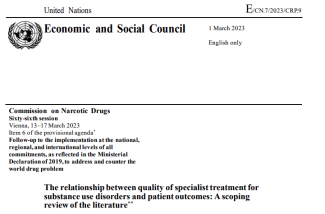
The Relationship Between Quality of Specialist Treatment for Substance Use Disorders and Patient Outcomes: A Scoping Review of the Literature

Shared by Luciana Bruno - 9 September 2025
COver of The Relationship Between Quality of Specialist Treatment for Substance Use Disorders and Patient Outcomes: A Scoping Review of the Literature
Format
Scientific article
Published by / Citation
UNODC - E/CN.7/2023/CRP.9

This Discussion Paper, prepared by UNODC, aligns with key international policy frameworks, including Commission on Narcotic Drugs (CND) resolutions 59/4 and 64/3. These resolutions emphasise the development and dissemination of international standards for the treatment of drug use disorders, as well as the promotion of scientific, evidence-based, affordable, and high-quality approaches to drug prevention, treatment, sustained recovery , and related support services. The paper builds on these mandates to provide an in-depth overview of current knowledge and practice in the field of substance use...

  • The Relationship Between Quality of Specialist Treatment for Substance Use Disorders and Patient Outcomes: A Scoping Review of the Literature hakkında daha fazla oku
  • ISSUP members can join Networks to comment – Sign in or become a member
Luciana Bruno

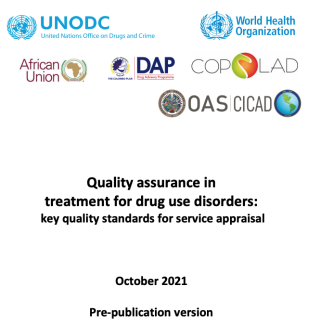
Quality Assurance In Treatment For Drug Use Disorders: Key Quality Standards For Service Appraisal

Shared by Luciana Bruno - 9 September 2025
cover of Quality Assurance In Treatment For Drug Use Disorders: Key Quality Standards For Service Appraisal
Format
Toolkit
Published by / Citation
UNODC- PTRS

Improving the quality and coverage of treatment for drug use disorders is a global health priority, highlighted in the United Nations Sustainable Development Goals. To support this, the Key Quality Standards for Drug Use Disorder Treatment Services were developed through broad international collaboration, drawing on the UNODC/WHO International Standards for the Treatment of Drug Use Disorders and other regional frameworks. These standards reflect a consensus on what is most essential to ensure safe, effective and ethical services, and are designed for policymakers, funders, evaluators and...

  • Quality Assurance In Treatment For Drug Use Disorders: Key Quality Standards For Service Appraisal hakkında daha fazla oku
  • ISSUP members can join Networks to comment – Sign in or become a member
Luciana Bruno

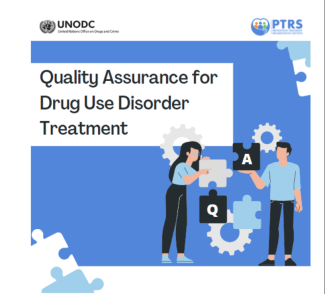
Quality Assurance for Drug Use Disorder Treatment

Shared by Luciana Bruno - 9 September 2025
Cover of Toolkit Quality Assurance for Drug Use Disorder Treatment
Format
Toolkit
Published by / Citation
UNODC

Over 38 million people worldwide are living with drug use disorders, yet only a fraction have access to appropriate treatment . These disorders place a heavy burden on individuals, families and communities, and their wider social costs – from health care to justice systems – are significant. Investing in evidence-based treatment is not only vital for recovery and well-being, but also for reducing crime, protecting public health and supporting sustainable development.

To address this, UNODC and WHO developed the International Standards for the Treatment of Drug Use Disorders. These Standards...

  • Quality Assurance for Drug Use Disorder Treatment hakkında daha fazla oku
  • ISSUP members can join Networks to comment – Sign in or become a member
Luciana Bruno

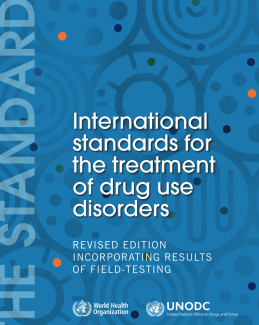
International Standards for the Treatment of Drug Use Disorders

Shared by Luciana Bruno - 9 September 2025
Cover of Guide : International Standards for the Treatment of Drug Use Disorders
Format
Guide
Published by / Citation
International standards for the treatment of drug use disorders: revised edition incorporating results of field-testing. Geneva: World Health Organization and United Nations Office on Drugs and Crime; 2020. License: CC BY-NC-SA 3.0 IGO.

The International Standards for the Treatment of Drug Use Disorders, developed by UNODC and WHO, provide guidance for countries to strengthen evidence-based, ethical and effective treatment systems. They are designed for policymakers, health professionals and service providers, offering a framework to improve the organisation, delivery and quality of care for people living with drug use disorders. The Standards outline essential components of treatment, emphasising approaches that mirror the care of other chronic health conditions, and highlight the importance of progressive quality...

  • International Standards for the Treatment of Drug Use Disorders hakkında daha fazla oku
  • ISSUP members can join Networks to comment – Sign in or become a member
Luciana Bruno

Substance Control Ecosystem

Shared by Luciana Bruno - 3 September 2025
Substance Control Ecosystem - Page photo
Format
Guide
Published by / Citation
World Health Organization

Psychoactive substances are regulated under three key United Nations conventions, agreed by Member States to safeguard public health and prevent illegal drug production:

  • 1961 Single Convention on Narcotic Drugs – focused on substances such as cannabis, cocaine and opium.

  • 1971 Convention on Psychotropic Substances – introduced controls on newer psychoactive drugs, including amphetamine-type stimulants (e.g. MDMA), barbiturates, benzodiazepines and hallucinogens like LSD.

  • 1988 Convention against Illicit Traffic in Narcotic Drugs and Psychotropic Substances – targeted the...

  • Substance Control Ecosystem hakkında daha fazla oku
  • ISSUP members can join Networks to comment – Sign in or become a member
Luciana Bruno

UN Toolkit on Synthetic Drugs

Shared by Luciana Bruno - 3 September 2025
UN Toolkit on Synthetic Drugs photo
Format
Toolkit
Published by / Citation
United Nations

The 2024 Feedback Survey gathered valuable insights from users of the UN Toolkit on Synthetic Drugs. Running from January to December 2024, it assessed user experiences, explored how Toolkit resources are applied, and identified areas for growth.

This year saw record participation, with 323 respondents from 63 countries—a small but meaningful share of the Toolkit’s 300,000+ unique users. Increased response rates were driven by targeted engagement, including early access to new modules, multilingual outreach, interactive demonstrations, and direct communication with the Toolkit team.

Building...

  • UN Toolkit on Synthetic Drugs hakkında daha fazla oku
  • ISSUP members can join Networks to comment – Sign in or become a member
Luciana Bruno

Multilingual Dictionary of Precursors and Chemicals Frequently Used in the Illicit Manufacture of Narcotic Drugs and Psychotropic Substances under International Control

Shared by Luciana Bruno - 3 September 2025
Cover Image to the Guide - Multilingual Dictionary of Precursors and Chemicals Frequently Used in the Illicit Manufacture of Narcotic Drugs and Psychotropic Substances under International Control
Format
Guide
Published by / Citation
United Nations

Similar to controlled narcotic drugs and psychotropic substances, precursors and chemicals often appear under a wide range of names in commerce and technical literature. This makes the work of national and international drug control authorities more complex. To support these efforts, a series of multilingual dictionaries have been developed.

The first multilingual list of controlled substances was published in 1958, focusing only on narcotic drugs. In 1983, the first edition of the Multilingual Dictionary of Narcotic Drugs and Psychotropic Substances under International Control (MLD) was...

  • Multilingual Dictionary of Precursors and Chemicals Frequently Used in the Illicit Manufacture of Narcotic Drugs and Psychotropic Substances under International Control hakkında daha fazla oku
  • ISSUP members can join Networks to comment – Sign in or become a member

Sayfalama

  • İlk sayfa « First
  • Önceki sayfa ‹ Previous
  • Sayfa 1
  • Sayfa 2
  • Şu an kullanılan sayfa 3

Upcoming Events

There aren't any upcoming events
All Events
Contact Us

Stay Connected

Newsletter

ISSUP is funded by the U.S. Department of State via the Bureau of International Narcotics and Law Enforcement Affairs (INL). INL works to keep Americans safe by countering crime, illegal drugs, and instability abroad.

Copyright © International Society of Substance Use Prevention and Treatment Professionals Privacy Policy