Cerca
 Treatment
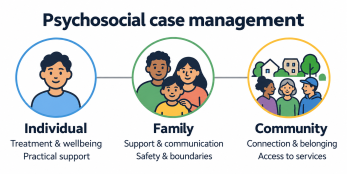
The range of medical, psychological, and social services designed to help individuals reduce or stop substance use and manage substance use disorders. Treatment may include assessment, counselling and behavioural therapies, medication-assisted treatment, withdrawal management, and support for co-occurring mental or physical health conditions. Effective treatment is typically person-centred and evidence-informed, and may be provided in outpatient, community, or residential settings. Treatment aims to improve health and functioning, reduce substance-related harms, and support individuals in moving toward recovery and long-term wellbeing.



Reducción de la mortalidad mediante una mejor detección de la hipertensión y los problemas con el alcohol en atención primaria de salud en España
Resumen
Se estudian mediante una simulación los potenciales beneficios que puede comportar una mejora en la detección y tratamiento de la hipertensión y de los problemas relacionados con el alcohol. Los resultados muestran que si el 50% de...
Contribution of Alcohol Use Disorders to the Burden of Dementia in France 2008–13
Summary
Background
Dementia is a prevalent condition, affecting 5–7% of people aged 60 years and older, and a leading cause of disability in people aged 60 years and older globally. We aimed to examine the association between alcohol use...
Mujeres y Tratamiento de Drogas
Guía de asesoría clínica para programas de tratamiento y rehabilitación en drogas en población específica de mujeres adultas.
Are you an ISSUP member? If not, you can join ISSUP by registering here: https://www.issup.net/membership/apply
...
Is Smoking a Risk Factor for Tinnitus? A Systematic Review, Meta-Analysis and Estimation of the Population Attributable Risk in Germany
Abstract
Objective: To assess the epidemiological association of smoking status and tinnitus with a systematic review and meta-analysis and to estimate the population attributable risk in Germany.
Data sources: A systematic literature...
Certification of Addiction Professionals in Africa: An Overview of the Process in Kenya
Abstract
This paper focuses on Kenya’s course of action to address the drug problem, specifically, treatment and rehabilitation of persons with Substance Use Disorders (SUDs). Treatment and rehabilitation of persons with SUDs was formally...
Extent and Patterns of Drug Use among Persons with Disabilities in Kenya
Abstract
Background: Although some data existed suggesting that there was high prevalence of drug use among the general population in Kenya with 39-48% of 15-65 year olds having used alcohol and at least one other substance, there was a...
Supervised Dosing with a Long-Acting Opioid Medication in the Management of Opioid Dependence
Trials challenge the need for the widely accepted policy of making opioid-dependent patients take their methadone or other opioid substitutes at the clinic or pharmacy, but ‘no difference’ findings may be due to the limitations of the...
Recommendations for NIDA's Cannabis Policy Research Agenda
The National Institute on Drug Abuse (NIDA) has released a new report Recommendations for NIDA's Cannabis Policy Research Agenda.
The document has been prepared by the National Advisory Council on Drug Abuse Workgroup which was formed in...
The Winding Road to Relapse: Forging a New Understanding of Cue-Induced Reinstatement Models and their Associated Neural Mechanisms
In drug addiction, cues previously associated with drug use can produce craving and frequently trigger the resumption of drug taking in individuals vulnerable to relapse. Environmental stimuli associated with drugs or natural reinforcers...
Alcohol and Drugs Prevention, Treatment and Recovery: Why Invest?
Estimates show that in the UK the social and economic costs of alcohol related harm amount to £21.5bn, while harm from illicit drug use costs £10.7bn. These include costs associated with deaths, the NHS, crime and, in the case of alcohol...
Una guía de bolsillo: Indagación del abuso del alcohol y una intervención breve
Esta guía de bolsillo fue resumida de la guía de 34 páginas del NIAAA, Ayudando a Pacientes que Beben en Exceso: Una Guía Clínica. Los materiales incluyen:
- Folletos educativos para pacientes
- Notas de progreso ya formateadas
- Diapositiva...

Guida per gli operatori sanitari - Aiutare i pazienti che bevono eccessivamente
Linee guida per gli operatori sanitari per lavorare con persone che consumano alcol in modo eccessivo
Questa guida è stata scritta per i professionisti delle cure primarie e della salute mentale. È stato prodotto dal National Institute on...

Dual Disorders in Individuals under Treatment for both Alcohol and Cocaine
Abstract
Introduction: Descriptive data about co-occurrence of alcohol and cocaine consumption is scarce, despite its important prevalence. Dual disorders show high prevalence in clinical samples, and patients report worse evolution and...
Mentor lancia il marchio di qualità per l'educazione su alcol e droghe
Mentor UK,un'organizzazione focalizzata sulla prevenzione e l'educazione alla droga, ha lanciato un marchio di qualità per l'educazione all'alcol e alle droghe.
Il marchio di qualità è stato sviluppato in aggiunta a una serie di standard...

In alternativa, il recettore mu oppioide C Termini spliced influisce sulle diverse azioni della morfina
Astratto
L'ampio splicing alternativo 3′ del gene del recettore mu oppioide OPRM1 crea più varianti di giunzione C-terminale. Tuttavia, la loro rilevanza comportamentale rimane sconosciuta. Il presente studio ha generato 3 modelli murini...
Comprendere il processo dei pazienti per utilizzare la marijuana medica: un progetto di coinvolgimento della comunità del New Jersey meridionale
Astratto
Data la necessità di comprendere meglio il processo che i pazienti devono attraversare per cercare un trattamento tramite marijuana medica, questo studio indaga su questo processo per comprendere meglio questo fenomeno. In...
Il modello internazionale dei danni e delle politiche dell'alcol
L'Istituto canadese per la ricerca sull'uso di sostanze presso l'Università di Victoria ha pubblicato il modello internazionale dei danni e delle politiche dell'alcol .
Composta da una serie di linee guida, metodi e strumenti, questa...

Stima della copertura del trattamento per le persone con disturbi da uso di sostanze: un'analisi dei dati delle indagini mondiali sulla salute mentale
Astratto
L'uso di sostanze è una delle principali cause di disabilità a livello globale. Ciò è stato riconosciuto nei recenti obiettivi di sviluppo sostenibile delle Nazioni Unite (SDG), in cui la copertura del trattamento per i disturbi...
Uno studio sul modello di consumo di alcol tra gli uomini sposati nelle zone rurali del Tamil Nadu, India - Implicazioni politiche
Astratto
Il modello di consumo di alcol in India varia notevolmente da molti altri paesi. In India, la maggior parte degli uomini sono astemi (dal 70% al 90%) mentre meno del 2% delle donne usa alcol. Tuttavia, gli uomini che usano alcol...
Utilizzo di strumenti terapeutici basati sulla tecnologia nei servizi di salute comportamentale
Per chiunque sia interessato agli interventi comportamentali sulla salute digitale, questo manuale di SAMHSA si rivelerà interessante. Esplorare come può essere implementata l'assistenza assistita dalla tecnologia, il valore delle...