

Psychosocial case management: connecting treatment, relationships and community recovery
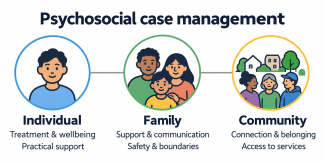
We recently shared a resource on recovery support for people leaving custodial settings. It prompted me to revisit a broader question: what should the psychosocial components of comprehensive case management look like if we want treatment gains to translate into sustained recovery? And, by extension, what might this teach us about prevention planning?
The study behind that resource offers a useful starting point. Among 328 adults followed after jail release, medication treatment and mutual help participation were each associated with more days of abstinence from illicit opioids. However, their combined effects varied across follow-up periods. These findings encourage us to consider clinical treatment alongside recovery support, while reminding us that an association does not establish causation or prove that combining interventions necessarily produces an additional benefit. Hart and colleagues, 2026.
For me, this raises an important practical distinction: making several services available is only the beginning. We also need to understand how those services address the person’s needs, how they connect, and whether the person can realistically use them.
Case management can help establish those connections. A meta-analysis of randomised trials found that its clearest benefits were improved linkage to services and retention in treatment. Effects on personal functioning, including substance use outcomes, were much smaller and did not clearly differ from usual care when pooled. This supports a measured expectation: case management can help people reach and remain connected to care, but sustained recovery also depends on the effectiveness and accessibility of the care and support provided. Vanderplasschen and colleagues, 2019.
What should we bring together?
There are encouraging examples of integrating behavioural treatment with other elements of care. In people receiving medication for opioid use disorder, a systematic review and meta-analysis of 74 randomised trials found that contingency management, providing agreed incentives for objectively verified behaviours, improved several outcomes, including treatment attendance, medication adherence and abstinence from particular substances. This is a concrete example of a psychosocial intervention supporting medication-based treatment. It’s important to note though, that it does not establish that every psychosocial addition is necessarily equally useful. Bolívar and colleagues, 2021.
The wider evidence also requires attention to which outcome we mean by “effective”. A 2024 Cochrane review of 64 trials involving adults with stimulant use disorder found that psychosocial interventions reduced treatment dropout. Compared with no intervention, they also improved some measures of substance use and continuous abstinence during treatment, but longer-term abstinence findings were less certain. Contingency management was the most studied and promising approach. These distinctions matter when we communicate what treatment can achieve and decide what support should follow it. Minozzi and colleagues, 2024.
Continuity is another important component. A review of continuing care found generally small average benefits, with more consistently positive findings for longer-duration approaches that actively maintained engagement. It also emphasised reassessment and adaptation as people’s circumstances changed. A reasonable implication for practice is that the care plan should remain active after discharge, with a clear route back into more intensive support when (and where) needed. McKay, 2021.
Whose recovery needs are we considering?
The transition from custody to community brings this question into sharp focus. There are useful parallels with leaving residential rehabilitation or another structured treatment setting: daily routines, relationships, access to substances and responsibility for managing care may change substantially. However, residential treatment and incarceration are different experiences, and findings from one setting cannot automatically be transferred to the other.
At an individual level, I would want the care plan to connect treatment goals with the circumstances in which recovery must take place. Where will the person live? Can they reach appointments? Are mental health needs being addressed? Who can they contact when difficulties arise? What opportunities exist for meaningful activity, income and belonging?
Housing illustrates why these questions deserve their own attention. A systematic review of case management among people experiencing homelessness found improvements in housing outcomes, but no clear pooled benefit for substance use. Securing housing is a valuable outcome in its own right; it should not be assumed to resolve a substance use disorder without appropriate treatment. Weightman and colleagues, 2023.
The immediate support system also has needs of its own. Family members may be managing distress, financial strain, disrupted relationships or concerns about safety. A systematic review found encouraging effects of psychosocial interventions on affected family members’ depression, distress and coping, although small samples and methodological weaknesses limited confidence in the findings. This supports offering families care in their own right, alongside considering their possible contribution to recovery. Rushton and colleagues, 2023.
Community Reinforcement and Family Training, or CRAFT, provides a further example. A systematic review found that it improved treatment entry compared with comparison conditions, although results varied considerably across delivery formats and studies. Its relevance is specific: helping concerned relatives develop skills that may encourage treatment engagement. Treatment entry should not be confused with evidence of sustained recovery. Archer and colleagues, 2020.
In applying these findings, family involvement should follow the person’s preferences, consent and safety needs. Where relationships involve violence, coercion or exploitation, joint work may be inappropriate. A trusted support person may also be a friend, peer or another chosen person rather than a relative.
Community support extends this circle further. A 2025 systematic review found growing evidence that peer recovery support can improve treatment engagement and retention, while evidence for direct improvements in substance use remained preliminary and inconclusive. Peer workers may therefore make an important contribution to connection and continuity, with appropriate training, supervision and clearly defined roles. Eddie and colleagues, 2025.
Where substance-related behaviour has harmed others, their safety, support and opportunity to heal also deserve attention. We should avoid assuming that everyone with a substance use disorder has committed an offence, or that families and communities are obliged to reconcile. The literature considered here does not establish a single community-healing intervention that reliably improves recovery. My practical interpretation is to plan support for affected people alongside reintegration, respecting boundaries and making any restorative engagement voluntary.
How do we choose the combination?
The evidence does not identify one universally effective package covering the individual, their support system and the wider community. It offers stronger support for particular interventions and outcomes than for a single comprehensive model.
A practical approach is to develop a shared formulation: what is maintaining substance use or harm, what strengths already exist, and what is preventing access to care? Each proposed intervention should address an identified need and have an agreed purpose. Medication, behavioural treatment, housing assistance, family support and peer connection may all belong in the plan, but their inclusion should be purposeful and feasible.
I would translate this into five questions for care planning:
- What matters most to the person, and what requires immediate attention?
- Which intervention has evidence relevant to this need and population?
- Who will deliver it, and what could prevent access?
- How will the person and team recognise meaningful progress?
- When will the plan be reviewed, and what will trigger a change?
This is a practice framework drawn from the evidence, rather than a validated intervention package. Its value lies in making coordination accountable. A referral becomes more useful when someone checks whether the connection occurred. Progress becomes more meaningful when we consider safety, housing, relationships, wellbeing and participation alongside substance use.
What does this mean for prevention?
The extension to prevention is compelling, but it requires its own evidence. Effective treatment components cannot simply be repackaged as universal prevention.
ISSUP’s prevention resources emphasise the UNODC–WHO International Standards, which place interventions within developmental stages and family, school and community settings. This encourages us to ask which risks and protective factors matter locally, and which evidence-based responses fit them. International Standards on Drug Use Prevention, shared by ISSUP.
The Communities That Care trial illustrates this approach. Communities used local information to select and implement tested prevention programmes. Follow-up through age 21 found benefits for some measures of substance-use initiation and other behaviours, but no clear effect on current substance use at that age. The lesson is encouraging and qualified: coordinated, locally informed prevention can produce lasting benefits, while effects differ across outcomes. Oesterle and colleagues, 2018.
Across prevention and recovery, I find myself returning to the same responsibility: understanding people within their relationships and circumstances, selecting interventions for a clear reason, and checking whether they help. Comprehensive psychosocial case management gives us a way to organise that work. Its promise depends on whether the connections we create become accessible, sustained and meaningful in everyday life.


