

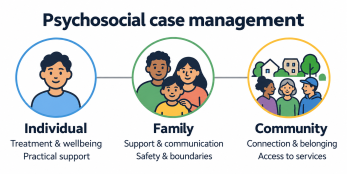
Ara
 Treatment
The range of medical, psychological, and social services designed to help individuals reduce or stop substance use and manage substance use disorders. Treatment may include assessment, counselling and behavioural therapies, medication-assisted treatment, withdrawal management, and support for co-occurring mental or physical health conditions. Effective treatment is typically person-centred and evidence-informed, and may be provided in outpatient, community, or residential settings. Treatment aims to improve health and functioning, reduce substance-related harms, and support individuals in moving toward recovery and long-term wellbeing.


Crack Cocaine Users Views Regarding Treatment with Contingency Management in Brazil
Abstract
Background
Contingency management (CM) has recently shown efficacy in promoting abstinence and retention in treatment among crack cocaine users in Brazil. However, partially because of unawareness and resistance among health care...
Drug and Alcohol Treatment in England 2016/17
Updating the previous year’s “really brilliant analysis” (Professor Susanne MacGregor, London School of Hygiene and Tropical Medicine), our analysis of the performance of England’s drug and alcohol treatment system up to 2016/17. With the...

Does Trait Mindfulness Level Affect Quitting Cannabis Use? A Six Week Follow-Up Study
Abstract
Background: Only 29% of cannabis dependent individuals seek treatment, yet significant decreases in cannabis use are seen in 31-36% of individuals that seek treatment. Follow-up studies have found that over 60% in substance use...
La política de drogas y el bien público
El uso de drogas tiene un impacto significativo en la salud publica a través de la enfermedad, discapacidad y problemas sociales, y los tomadores de decisión están cada vez más interesados en desarrollar políticas de drogas basados en...
Efficacy Indicators of Four Methods in Outpatient Addiction Treatment
Abstract
Background: In Portugal, as far as we know, there are no recent studies that evaluated the comparative efficacy of therapeutic modalities in addiction problems by reference to a holistic and psychosocial model of effectiveness.
...Clinical Guidance for Treating Pregnant and Parenting Women with Opioid Use Disorder and their Infants
This Clinical Guide provides comprehensive, national guidance for optimal management of pregnant and parenting women with opioid use disorder and their infants. The Clinical Guide helps healthcare professionals and patients determine the...
Parent Management Training-Oregon Model in Mexico City: Integrating Cultural Adaptation Activities in an Implementation Model
Abstract
This article describes the process of cultural adaptation at the start of the implementation of the Parent Management Training intervention-Oregon model (PMTO) in Mexico City. The implementation process was guided by the model...
FREE Opioid Training Course from Harvard
Harvard University has launched a free online training course via edX.org. Suitable for those looking for an introduction to understanding opioids and the current "crisis" facing many nations through high rates of drug related deaths. The...

The Addiction Technology Transfer Center (ATTC) Network
The Addiction Technology Transfer Center (ATTC) Network is an international, multidisciplinary resource for professionals in the addictions treatment and recovery services field. The ATTC has been working since 1993 to improve the clinical...

A Novel Text Message-Based Motivational Interviewing Intervention for College Students Who Smoke Cigarettes
ABSTRACT:
Introduction:
Tobacco use disorder is critical among people aged 16 to 25 years. College campuses are prime locations for smoking cessation interventions for young adults. The vast majority of the smoking research with college...
Manual del Tratamiento Breve para Usuarios de Cocaína
El Tratamento Breve para Usuarios de Cocaína es una intervención cognitiva conductual dirigido a adultos consumidores de cocaína (polvo y crack). Con el objetivo de enseñar a los usuarios estrategias para dejar el consumo de la cocaína.
Es...
Evaluation of the Psychometric Properties of Self-Reported Measures of Alcohol Consumption
Abstract
Purpose
To review studies about the reliability and validity of self-reported alcohol consumption measures among adults, an area which needs updating to reflect current research.
Methods
Databases (PUBMED (1966-present)...
Smoking Cessation Support for Regular Smokers in Hungarian Primary Care
Abstract
Objectives: Our study aimed to evaluate the effectiveness of general practitioners’ (GPs’) smoking cessation support (SCS).
Study design: We carried out a cross-sectional study between February and April 2016.
Setting and...
Cost-Effectiveness Study of Interventions to Prevent Alcohol Abuse in Mexico
Abstract
Introduction
In Mexico, alcohol abuse involves overhead costs in terms of premature mortality caused by their related health problems. It is estimated that by itself it implies 9% of the total burden of disease in the country...
Effectiveness Bank Matrix Cell: Treatment Systems, Unintended Consequences and Shaky Rationales
Key studies on local systems for effectively and cost-effectively providing drug addiction treatment. Commentary focuses on payment-by-results funding mechanisms (do they impede recovery by paying for it?), crime-reduction as a...
Commissioning Impact on Drug Treatment
Based on research, financial data and stakeholder surveys and testimonies, the UK government’s official drug policy advisers warn that without significant efforts to protect investment and quality, in England “loss of funding will result in...
A Meta-Analysis of the Efficacy of Bupropion Sustained-Release for Smoking Cessation in Heavy Smokers
Cigarette smoking damages just about every organ in the body and reduces overall health. Even with the prevalence of accessible nicotine replacement therapies and behavioral counseling, there remains a need for alternative therapies to...
The Role of Adenosine Receptors in Psychostimulant Addiction
Adenosine receptors (AR) are a family of G-protein coupled receptors, comprised of four members, named A1, A2A, A2B, and A3 receptors, found widely distributed in almost all human body tissues and organs. To date, they are known to...
Effects of Prefrontal Transcranial Direct Current Stimulation and Motivation to Quit in Tobacco Smokers
Transcranial direct current stimulation (tDCS) applied over the dorsolateral prefrontal cortex (DLPFC) has been shown to reduce cravings in tobacco addiction; however, results have been somewhat mixed. In this study, we hypothesized that...
Associations between Substance Use and Type of Crime in Prisoners with Substance Use Problems
Aim: The present study aimed to study the associations between substance use patterns and types of crimes in prisoners with substance use problems, and specifically whether substance use patterns were different in violent offenders.
Metho...