
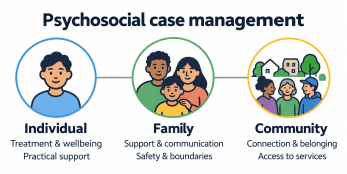
Ara
 Treatment
The range of medical, psychological, and social services designed to help individuals reduce or stop substance use and manage substance use disorders. Treatment may include assessment, counselling and behavioural therapies, medication-assisted treatment, withdrawal management, and support for co-occurring mental or physical health conditions. Effective treatment is typically person-centred and evidence-informed, and may be provided in outpatient, community, or residential settings. Treatment aims to improve health and functioning, reduce substance-related harms, and support individuals in moving toward recovery and long-term wellbeing.



Toward a Theory of Motivational Interviewing
Abstract
The widely-disseminated clinical method of motivational interviewing (MI) arose through a convergence of science and practice. Beyond a large base of clinical trials, advances have been made toward “looking under the hood” of MI...
Using motivational interviewing in substance use disorder treatment
Effective substance use disorder (SUD) treatment requires providers to understand what an individual genuinely needs to do to change substance use behaviours. An essential element in motivational SUD interventions is helping people who...
UNODC promotes the dialogue on drug demand reduction across Central Asia at ISSUP Abu Dhabi 2022 Conference
Within the framework of UNODC global project GLOJ71”Treating drug dependence and its health consequences: Treatnet II” UNODC ROCA in collaboration with Prevention, Treatment and Rehabilitation Section (PTRS) HQ supported participation of 19...

Motivational Interviewing: Reading List
Motivational interviewing is a counselling approach that aims to harness an individual’s motivation to change and promote autonomy in decision making.
Motivational Interviewing Videos
The Motivational Interviewing Network of Trainers (MINT) has gathered a selection of videos to demonstrate core skills and techniques that are used within motivational interviewing.
You can view the collection of videos here.
Motivational interviewing for substance abuse
Motivational interviewing (MI) is a client‐centred, semi‐directive method for enhancing intrinsic motivation to change by exploring and resolving ambivalence. The intervention is used widely, and therefore it is important to find out...
The Essentials of ... Series: Motivational Interviewing
The Essentials of.... is a series developed by the Canadian Centre on Substance Use and Addiction (CCSA) that offers evidence-based guidance and practical information to enhance practice in the substance use field.
Here, you can find out...
Motivational Interviewing in Africa Webinar Series
In this webinar series, hosted by the South Africa International Technology Transfer Centre in collaboration with MI & Beyond, William Miller and Stephen Rollnick, co-founders of Motivational Interviewing engage with clinicians and...

New Psychoactive Substances (NPS): Synthetic Hallucinogens/ Synthetic Depressants
The Second Webinar was hosted by ISSUP Pakistan and focus on Synthetic Hallucinogens/ Synthetic Depressants.
Awareness Lecture and Workshop on Risky Behaviors & Substance Use in an International Family Medicine Conference, Avari Hotel, Lahore Pakistan
Two days International Family Medicine Conference has been arranged at Avari Hotel in Lahore Pakistan on May 21 and 22, 2022. The organizers were the team members of WONCA SAR. The guest speaker/trainer invited to grace these initiatives...

Factores de riesgo que influyen en la recaída de consumo de drogas lícitas e ilícitas en adolescentes atendidos en el Instituto sobre Alcoholismo y Farmacodependencia
Resumen:
El objetivo de la presente investigación fue determinar los factores de riesgo asociados con las recaídas en el consumo de drogas en adolescentes que han recibido tratamiento en el IAFA. Metodología: Estudio cuantitativo, con...
Deterioro cognitivo y dependencia alcohólica, implicaciones clínicas
A modo de conclusión podría decirse que el daño cerebral producido por el consumo excesivo de alcohol (ARBD) es dimensional, desde un deterioro leve hasta un cuadro de demencia. En cualquier caso, el ARBD empeora la respuesta al tratamiento...
Changes in Alcohol Use in Denmark during the COVID-19 Pandemic
Abstract
Introduction: The year 2020 was marked by the COVID-19 pandemic. Policy responses to COVID-19 affected social and economic life and the availability of alcohol. Previous research has shown an overall small decrease in alcohol use...
Using Adolescent Development to Inform Prevention Practice
Participants will review major social and biological factors of adolescent development and implications for ways to approach substance use prevention/intervention.
Objectives Include:
- Describe prevalence rates for adolescent...
Building resilience in survivors of sexual exploitation: The role of children in activities implemented by NGOs in Uganda
Abstract
Children are increasingly affected by sexual exploitation (SEC), and the subsequent hardships arising out threaten their lives. Resilience is the process of adapting well in the face of trauma or other significant sources of...
Associations of common mental disorder with alcohol use in the adult general population
Abstract
Background and Aims
Research has shown that alcohol use and common mental disorders co-occur; however, little is known about how the global prevalence of alcohol use compares across different common mental disorders. The aim of...
Intentions and Attempts to Quit Smoking Among Sexual Minoritized Adult Smokers After Exposure to the Tips From Former Smokers Campaign
Abstract
Importance Significant disparities exist in smoking behaviors by sexual minority status in the US.
Objective To examine potential differences in the associations between exposure to the Tips From Former Smokers (Tips) campaign...
Call for Papers- Drug Addiction Research in China
Drug addiction has been a major public health problem bringing a heavy burden to patients, families and society in China historically and contemporarily. In the recent two decades, animal and clinical research on mechanisms, trajectories...
Applied Prevention Science International Celebrate Prevention Week
May the 8th-14th is National Prevention Week!
Every day APSI will be highlighting one of their Prevention Nuggets, Prevention Talks and Prevention Portraits, all focused on one specific prevention theme.
Head on over to APSI website to...