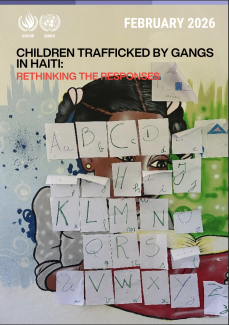
This joint report by the United Nations Integrated Office in Haiti (BINUH) and the Office of the United Nations High Commissioner for Human Rights (OHCHR) examines the trafficking and exploitation of children by gangs in Haiti. It highlights how poverty, displacement, social exclusion and limited access to education increase children’s vulnerability, particularly among children living on the streets, in displacement sites or in highly marginalised communities.
The report documents how gangs recruit children through threats and violence, but also through offers of money, material support...
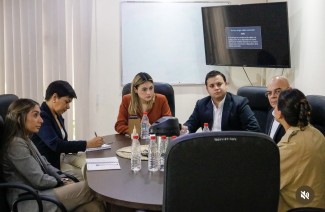
Empowering young people to take an active role in their communities was at the centre of discussions between Paraguay’s Minister of Youth, Salma Agüero, and representatives of ISSUP.
Bárbara Correa, ISSUP’s National Chapters Regional Coordinator for Latin America and Spain, and Francisco Javier Giménez Duarte, Director of ISSUP Paraguay, joined the Minister to discuss opportunities to support youth leadership in substance useprevention.
The discussion focused on equipping young people with knowledge and skills to lead community initiatives, encourage healthy lifestyles among their peers...
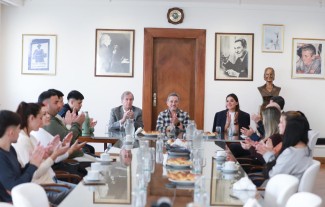
On Wednesday, September 2, 2026, a certificate presentation ceremony was held at the headquarters of the Unión Ferroviaria (Railway Union) for those who completed training under the project "Addiction Prevention and Union Youth: Training Key Figures for a Culture of Care in the Workplace." The training consisted of the "Introduction to Evidence-Based Prevention" (INEP) course—developed by Charles University in the Czech Republic and led by the Forum Vitae Institute of the *Obra Social Ferroviaria* (Railway Workers' Health Plan)—with the support of the Unión Ferroviaria, SEDRONAR, ISSUP...
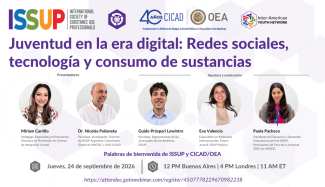
ISSUP Global y la Red Juvenil de ISSUP, en colaboración con CICAD y la Red Juvenil, presentan un seminario web sobre Juventud en la era digital: Redes sociales, tecnología y consumo de sustancias.
ISSUP Global and the ISSUP Youth Network, in collaboration with CICAD and the Youth Network, present a webinar on Youth in the Digital Age: Social Media, Technology and Substance Use
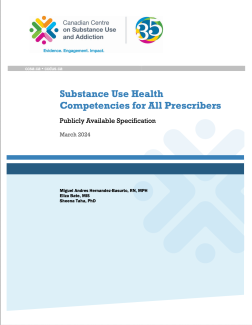
Developed by the Canadian Centre on Substance Use and Addiction (CCSA), the Workforce Competencies provide an evidence-informed framework outlining the knowledge, skills, values and behaviours needed by professionals working in substance use health. The resource includes technical and behavioural competencies across different proficiency levels, alongside practical tools to support recruitment, performance management, professional development and competency-based workforce planning.
It is a useful resource for practitioners, managers, educators and organisations looking to strengthen...
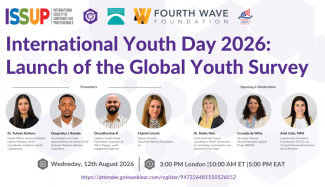
ISSUP Global Youth Network, in collaboration with Drug Free America Foundation, World Federation Against Drugs and Fourth Wave Foundation, presented a webinar to celebrate International Youth Day on 12 August.
ISSUP Global Youth Network, in collaboration with Drug Free America Foundation, World Federation Against Drugs and Fourth Wave Foundation, presents a webinar to celebrate International Youth Day on 12 August. Join us as we mark International Youth Day with the launch of the Global Youth Survey, an initiative designed to better understand the needs, strengths, challenges, and aspirations of young people and early career professionals working in substance use and related fields.
ISSUP Nigeria would like to invite you to the 34th session of its bi-monthly webinar in the Knowledge Update Series. This webinar will focus on the topic 'Behavioural Addiction among Youths: Patterns and Innovative strategies for Prevention'.
Valdez Bátiz, J. E., Esparza Bernal, V. H., & Burgos Dávila, C. J. . (2023). Narrativas juveniles sobre el narcotráfico en Sinaloa: ingreso, riesgos y planes a futuro. Frontera Norte, 35. https://doi.org/10.33679/rfn.v1i1.2306
This qualitative study explores the experiences of young people involved in drug trafficking in Culiacán, Sinaloa, Mexico. Based on interviews with 16 young adults, the research examines why they joined drug trafficking, how they perceived the risks, and how they viewed their future within and beyond criminal networks.
The findings suggest that many participants were attracted by the prospect of financial gain, social acceptance, recognition, and the hope of achieving a successful future. For many, drug trafficking was viewed not only as a source of income but also as a pathway for personal...
Medina, Juanjo & Aldridge, Judith & Shute, Jon & Ross, Andy. (2013). Measuring gang membership in England and Wales: A latent class analysis with Eurogang survey questions. European Journal of Criminology. 10. 591-605. 10.1177/1477370813475393.
This study examines how gang membership is measured among young people using the Eurogang Network’s survey approach. Drawing on nationally representative data from England and Wales, the researchers used statistical analysis to identify different types of peer groups and assess whether commonly used survey questions accurately distinguish gang-involved youth.
The findings suggest that the Eurogang measures successfully identified a group of young people involved in more frequent and serious offending. However, the same measures also classified another group whose primary behaviour was...
ISSUP Global, in collaboration with UNODC, present 'Youth Voices for Prevention: Creative Pathways to Address Violence, Crime, and Build Safer Communities.'
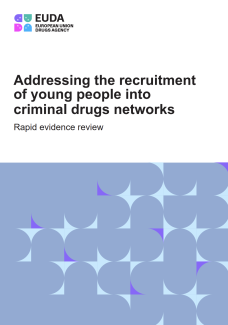
European Union Drugs Agency (2026), Addressing the recruitment of young people into criminal drugs networks, Publications Office of the European Union, Luxembourg.
This report examines how and why young people are recruited into criminal drug networks across Europe. It highlights the range of factors that can increase vulnerability to recruitment, including social and economic disadvantage, peer influence, family circumstances, and community environments.
Drawing on international evidence, the report identifies several promising approaches to prevention, including family-based support, school-based interventions, community engagement, digital prevention initiatives, and targeted efforts to disrupt criminal networks. It also emphasizes the importance of...
Maguire, Edward & Gordon, C.. (2015). Faith-Based Interventions for Reducing Gang Violence in the Caribbean: Reflections from a Professor and a Priest
This book chapter explores the role of faith-based interventions in preventing and reducing gang violence in Trinidad and Tobago. Drawing on the experiences of a criminologist and a religious leader, it argues that gang violence should be viewed not only as a criminal justice issue but also as a community challenge that requires coordinated responses from multiple sectors.
The chapter describes faith-based initiatives implemented in a community affected by gang violence and highlights how religious organizations can contribute through community engagement, social support, mentorship, and...
ISSUP Global, in collaboration with UNODC, present 'Youth Voices for Prevention: Creative Pathways to Address Violence, Crime, and Build Safer Communities.'
The second edition of F.O.C.U.S. – Future-Oriented Careers in Understanding Substance Use, is now live!
This special edition newsletter is created for early-career professionals and students stepping into the field of substance use.
In this edition, we’re spotlighting something you’ll feel quickly as you step into this work: the substance use field is truly multi-sectoral. It’s shaped by parents and teachers, schools and healthcare teams, recovery communities and people with lived experience, researchers and community organisations, law enforcement and policymakers, courts and governments...