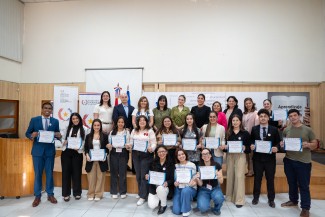
ISSUP Guatemala, in collaboration with Glasswing International, has officially launched the “Prevention Agents”programme, an initiative designed to train and strengthen young community leaders who are committed to promoting the prevention of social risks.
The programme aims to equip youth with the knowledge, skills, and leadership tools needed to address key social challenges affecting their communities, including organized crime, substance use, delinquency, and life on the streets. Throughout 2026, participants will engage in educational, cultural, recreational, and leadership activities...
The Strong Families Initiative is a family-based program implemented by Girls Against Drug Liberia in partnership with the Ministry of Health, Republic of Liberia with support from the United Nations Office on Drugs and Crime (UNODC). The program was conducted over a period of three weeks and...
On 18 February 2026, the ISSUP Lagos State Branch carried out a school-based substance use prevention outreach at Onike Junior High School, Sabo-Yaba, as part of its ongoing commitment to youth-focused prevention and early intervention.
The interactive session was designed to educate students about the risks associated with drug abuse, strengthen informed decision-making, and reinforce the importance of staying focused on their academic and personal goals. Through open and engaging discussions, students were encouraged to ask questions and share their experiences, particularly around peer...
Sitařová, P. & Obereignerů, R. (2025). Towards Comprehensive Sexuality Education in the Czech Republic: A Qualitative Study of Practitioners‘ Perspectives on Key Themes and Methods. Adiktologie, 25(4), 191–204
INTRODUCTION: This study explores the perspectives of Czech practitioners on sexuality education (SE) for upper primary school students (ISCED level 2). It focuses on the topics they consider relevant, including those currently underrepresented in school curricula as well as the approaches and methods they apply in practice. The framework of Comprehensive Sexuality Education (CSE) is used as a lens for interpreting their experiences and practices.
METHODS: Fourteen practitioners participated in two semi-structured focus groups (n = 4 per group, 8 in total) and six individual interviews...
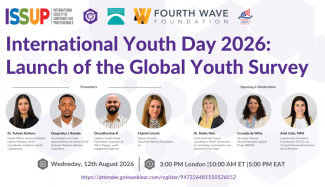
Young people are shaping drug prevention from community action to global policy spaces. Join this interactive youth dialogue bringing together voices from Uganda and Japan ahead of CND 2026.
Marchand, K., Liu, G., Hastings, K.G. et al. The multidimensional social ecological needs and service utilization patterns of youth using non-medical prescription opioids: an observational study of routinely collected data in a provincial integrated youth services initiative. Subst Abuse Treat Prev Policy 20, 51 (2025). https://doi.org/10.1186/s13011-025-00682-6
This study examined how non-medical prescription opioid use (NMPOU) among youth aged 12–24 is linked to their health, social needs, and use of services within an integrated youth services network in British Columbia, Canada. Data from over 6,000 youth showed that 4% reported recent NMPOU. Youth who used prescription opioids non-medically were more likely to report poor physical health, mental health challenges, polydrug use, and recent exposure to violence. Despite these greater needs, their use of services was similar to youth who did not report NMPOU. The findings suggest that integrated...
Jimena Kalawski, Chief of the Demand Reduction Unit of the Inter-American Drug Abuse Control Commission (CICAD) of the Organization of American States (OAS), and Barbara Correa, Regional Coordinator of the International Society of Substance Use Professionals (ISSUP), offered welcoming remarks at the closing of a training for young leaders based on the Universal Prevention Curriculum (UPC).
Twenty-seven youth from nine Latin American Member States participated in this online training, developed within the framework of the priority that the CICAD Executive Secretariat gives to youth prevention...
This multicentre randomised controlled study evaluated a 3-year intersectoral intervention designed to reduce alcohol, tobacco, and cannabis use among adolescents in a tri-border region of Brazil, Argentina, and Paraguay. The intervention brought together 23 institutions from education, community, and social sectors and involved 880 adolescents, with treatment and control groups randomly assigned. Students in the treatment group were actively involved in co-developing prevention activities, while both groups later participated in the implemented activities.
Nivishe Foundation successfully launched “Understanding Emotions,” the first chapter in its groundbreaking Brainwaves Comic Book Series, one of Africa’s first comic books dedicated to mental health education.
The series uses relatable storytelling and vibrant illustrations to help young people understand emotions, break mental health stigma, and build resilience. It transforms complex psychological concepts into simple, accessible lessons that speak directly to the realities of adolescents and youth in Kenya’s informal settlements.
Since its launch in Nairobi, the comic has reached over 2...
The United Nations Youth Office launched the flagship initiative on Youth Mental Health and Wellbeing! The initiative promotes an ecosystem model for youth mental health and wellbeing, using a whole-of-society approach.
The initiative was launched at the Second World Summit for Social Development in Doha. The launch video is available here
This flagship initiative by the UN Youth office reframes the conversation to a broader vision grounded in care, connection and community. This effort bridges policy leadership with youth-led movements across the world centering young people as equal...
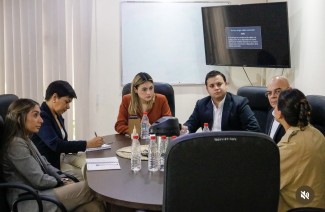
The AUC convened a Drug Control Technical Experts Meeting in Maputo to review progress under the AUPA 2019–2025 and shape the next continental drug strategy. ISSUP, represented by Joanna Travis-Roberts and A/Prof Goodman Sibeko, contributed to discussions on strengthening both drug supply and demand reduction. Delegates highlighted persistent challenges, including limited capacity, weak data systems, and uneven access to treatment across Member States. The draft AU Drug Strategy 2026–2033 proposes ten strategic pillars centred on public health, data integration, youth engagement, coordinated governance, and addressing harms related to substance use disorders. ISSUP reaffirmed its commitment to capacity building, youth and community engagement, network strengthening, and improved data collection through tools such as the Web App ASSIST.
The Canadian Centre on Substance Use and Addiction (CCSA) transforms complex data into insights that reflect real human experiences. Every aspect of the Canadian Substance Use Cost and Harms (CSUCH) project represents individuals with lived or living experience of substance use, along with their families, workplaces, and communities.
A new resource highlights these journeys and the human cost of substance use through illustrated stories from people with lived experience and their families. The illustrations cover three key areas of the CSUCH project: healthcare, lost productivity, and...
Streimann, K., Vilms, T., Erm, R. et al. Becoming a Member of the Prevention Club: Development of Interdisciplinary Prevention Terminology. J of Prevention (2025). https://doi.org/10.1007/s10935-025-00858-7
Introduction
Prevention science is interdisciplinary, drawing upon multiple fields of research and practice to develop integrated knowledge. A challenge facing the field is the proliferation of different terms with the same meaning, and of terms with different meanings. This can create confusion in communication, affect evaluation standards, and ultimately also affect the implementation of preventive interventions. Contributing to the development of evidence standards for preventive interventions, this article describes the process and results of interdisciplinary prevention terminology...
Al Khouri, I., Fulajtarova, M., & Iannaccone, B. (2024). The Association Between Substance Use Prevalence and Youth Mortality: A Comparative Study of Selected EU Countries. Adiktologie 24(4), pp-pp
INTRODUCTION: Psychoactive substance use constitutes a significant determinant of morbidity and mortality among adolescent and emerging adult populations across European Union member states. This study aims to examine associations between substance use prevalence and drug-induced mortality rates, with a focus on age- and gender-specific disparities and spatiotemporal patterns across selected EU countries.
METHODS: The research design employed a quantitative descriptive-comparative analysis of EMCDDA and EUDA datasets spanning the years 2010–2022, complemented by predictive modelling using...
More than 100 million people — including at least 15 million children — are now using e-cigarettes, according to the World Health Organisation (WHO).
Children are nine times more likely than adults to vape, raising serious concerns about early nicotine dependence. WHO officials warn that e-cigarettes, often marketed as “harm reduction,” are in fact hooking a new generation on nicotine and undermining decades of progress in tobacco control.
While traditional tobacco use continues to decline globally, vaping is rapidly increasing, especially in high-income countries. Yet by the end of 2024, 62...
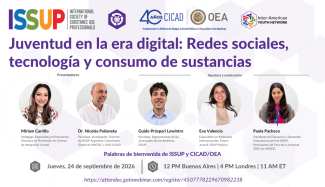
ISSUP Colombia lo invita cordialmente a participar en su seminario web sobre Evaluación de Programas de prevención en Colombia: evidencia, resultados y lecciones para la prevención del consumo de sustancias en jóvenes.