


Cerca

Psychoactive Prescription Drug Abuse: Selected Psychological Symptoms and Quality of Life in Addiction Treatment. Study Protocol
BACKGROUND: The abuse of psychoactive prescription drugs has become increasingly common in the Czech Republic. These drugs include sedatives, hypnotics, anxiolytics (benzodiazepines and Z-hypnotics), and opioids. Patients with an addiction...
AddictologyIssue 4/2022
The COVID-19 Global Pandemic and Changes in Preference and Behaviour Regarding Selected Anabolic Androgenic Substances and Steroids – A Comparative Study
BACKGROUND: The SARS-CoV-2 virus (COVID-19) and the ensuing global public health emergency situation have led to restrictions, changes, and measures in the daily life of society as a whole. The situation culminated in a global pandemic. A...
AddictologyIssue 4/2022
Test di impulsività nell'adolescenza
L'adolescenza è una delle fasi più importanti della vita umana. Questo periodo è pieno di stimoli e tipi di influenza diversi: da parte dei genitori, dei coetanei e della società. È correlato a una maggiore suscettibilità a comportamenti...
AddictologyIssue 3/2022
Online Instructor-Led Pilot Course on Monitoring and Evaluation of Substance Use Prevention Interventions and Policies: Experiences and Perceptions of International Participants
INTRODUCTION: As the prevalence of substance use continues to rise all over the world amidst the ongoing pandemic, substance use prevention professionals are challenged to find alternative ways to enhance their knowledge and competence to...
AddictologyIssue 3/2022
Nature and Course of Clinician and Self-Rated Depressive Features in Persons with Alcohol Use Disorders: A Preliminary Prospective Study among Men Seeking Treatment
INTRODUCTION: The trajectory and nature of depression in patients with alcohol use disorder as they enter treatment needs to be understood better. This study assessed the nature and course of depressive features among male patients with...
AddictologyIssue 3/2022
Risk Behaviour of Adolescents Aged 10–15 in Slovakia. Relation to Sex, Age, and Body Mass Index
BACKGROUND: As a theoretical base we used Jessor’s concept of the Syndrome of Risk Behaviour in Adolescence, the self-concept, and the concept of body image.
AIM: The main aim of the contribution was research on the relations between the...
AddictologyIssue 3/2022
Drug use and associated factors in a North Eastern region of Tanzania: a cross-sectional study
The article ‘Drug use and associated factors in a North Eastern region of Tanzania: a cross-sectional study’ published in the PanAfrican Medical Journal’ on 11/10/2022 by a number of authors coordinated by Dr Harrieth Peter and Castory...
Moving towards a continuum of safer supply options for people who use drugs: A qualitative study exploring national perspectives on safer supply among professional stakeholders in Canada
Background
Novel public health interventions are needed to address the toxic drug supply and meet the needs of people who use drugs amidst the overdose crisis. Safer supply – low-barrier distribution of pharmaceutical grade substances –...
Evitamento, ansia verso i genitori e auto-accettazione degli adolescenti nel sistema di istruzione secondaria superiore
SFONDO:
Una stretta relazione tra un genitore e un bambino e l'accettazione dei genitori possono mediare l'appropriata auto-accettazione di un adolescente, che è una variabile importante legata alla personalità e un pilastro della salute...
AddictologyIssue 2/2022
General Principles of Contingency Management for Smoking Cessation
Contingency management (CM) is a psychological treatment based on operant conditioning. It consists of providing incentives in exchange for achieving a target behaviour such as abstinence or other treatmentrelated variables (e.g. session...
AddictologyIssue 2/2022
Effect of Propylene Glycol and Vegetable Glycerine Ratio in E-Liquid on Aerosol Formation: Overview of Relevant Properties
BACKGROUND:
Electronic nicotine delivery systems (ENDS) generate an aerosol by vaporising e-liquids that usually consist of propylene glycol (PG), vegetable glycerine (VG), and other ingredients (water, nicotine, and flavours). The...
AddictologyIssue 2/2022
Substance Use and the Role of Families. Results of a Cross-Country Study in Pakistan, Kazakhstan, and Ukraine
BACKGROUND:
In many countries families have rarely been involved in addressing treatment and interventions for family members with substance use disorders (SUDs). The aims of this study were to measure the influence of substance use on...
AddictologyIssue 2/2022
Contribution of SocioDemographic and Structured Leisure Activities’ Characteristics to Adolescents’ Alcohol Use
BACKGROUND:
Leisure can be a context that can promote positive adolescent development, but it can also be a context that contributes to adolescents engaging in risk behaviours.
AIMS:
The aim of this study is to determine the extent to...
AddictologyIssue 2/2022
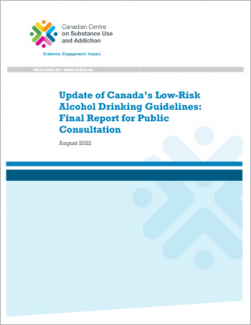
Update of Canada’s Low-Risk Alcohol Drinking Guidelines: Final Report for Public Consultation
Canada’s Low-Risk Alcohol Drinking Guidelines were originally published by CCSA in November 2011 and were the result of the work of alcohol research experts in Canada. Since then, substantial new research on the association between alcohol...
European Web Survey on Drugs 2021: Emerging findings in Lebanon
The European Web Survey on Drugs1 collected data during March and May 2021 from people who use drugs, are aged 18 or older, and live in 21 EU and 9 non-EU countries including Lebanon. In this period, the populations in many European and...
The effects of opioid policy changes on transitions from prescription opioids to heroin, fentanyl and injection drug use: a qualitative analysis
Background
Beginning in the 1990s, non-medical use of prescription opioids (POs) became a major public health crisis. In response to rising rates of opioid dependence and fatal poisonings, measures were instituted to decrease the...
Combining the European Prevention Curriculum (EUPC) and Universal Treatment Curriculum (UTC) in a Master’s Degree in Addictions
INTRODUCTION:
The European Prevention Curriculum (EUPC) and The Universal Treatment Curriculum (UTC) are paradigms of the efforts to achieve an international standardised training for drug demand reduction. Both curricula are based on...
AddictologyIssue 1/2022
‘Ten Years Later’ – Developing Institutional Mechanisms for Drug Demand Reduction and Addictology Education in Georgia – A Case Study
BACKGROUND:
During the last ten years, Georgia made several important accomplishments in responding to the country’s drug problem. Specifically, in 2011, an interagency national drug coordinating body was established within the Ministry of...
AddictologyIssue 1/2022
Adaptation of the Universal Treatment Curriculum to Philippine Context and Online Environment
BACKGROUND:
The Universal Treatment Curriculum (UTC) is offered to the academic community to integrate substance use-specific knowledge, skills, and evidence-based practices into the continuing professional development of current and...
AddictologyIssue 1/2022
Accreditation of Study Programs on Addictions in Nigerian Universities: Challenges, Opportunities, and the Need for Advocacy
INTRODUCTION:
Access to drug treatment services in Nigeria remains low due to a severe shortage in the drug treatment workforce. Plans are underway to address the workforce shortage by introducing drug addiction training programs in...
AddictologyIssue 1/2022