We are excited to announce the latest addition to our Professional Development section—a dedicated area called "Prevention Lists." This resource is tailored for those keen on exploring evidence-based prevention programs and accessing information about effective prevention interventions.
Within this section, you will find a curated collection of resources, all of which have been developed by esteemed organisations specialising in the curation and evaluation of prevention practices.
We value the wealth of knowledge and insights within our ISSUP community. Therefore, we invite all our members...
Join this online for a monthly online masterclass by health research experts based in The Sheffield Centre for Health-Related Research (ScHARR) at The University of Sheffield as we explore topics in the changing world of public health...
Lisbon Addictions 2024 is a multidisciplinary conference that provides both a forum for networking and an opportunity to showcase cutting-edge research. The conference is intended to inform policy development and practice through a better understanding of contemporary issues in addiction science and addictive behaviours.
The conference will take place in Lisbon from 23–25 October 2024 under the overarching theme ‘Empowering the workforce of the future’.
The ECOWAS Commission organized a training for 30 Core Drug Prevention Professionals on Evidence-Based Prevention of Drug Use/Substance Abuse in Cotonou, the Republic of Benin from the 17th to the 21st of October 2023
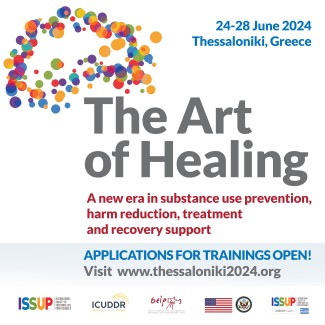
The 2024 ISSUP Global Event will be held in Thessaloniki, Greece between 24th & 28th June, 2024. Abstract submission is now open until December 31st, 2023, and we are inviting contributions from professionals across substance use prevention, harm reduction, treatment, and recovery support, as well as those working with vulnerable populations. Whether you're an academic or not, we welcome your submissions.
CICAD and ICUDDR invite you to learn about general tools and criteria for the publication of scientific articles on drug demand reduction for researchers in Latin America and the Caribbean. The event will offer language interpretation in...
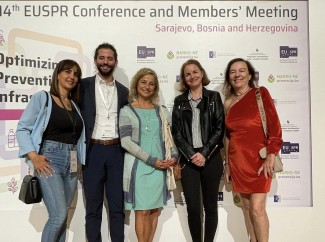
Our team recently took part in the 14th European Society for Prevention Research (EUSPR) Conference and Members' Meeting held in Sarajevo, Bosnia and Herzegovina from the 4th to the 6th of October 2023
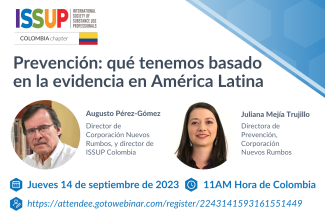
Por si te lo perdiste, aquí puedes encontrar la grabación del webinar de ISSUP Colombia: Prevención, qué tenemos basado en la evidencia en América Latina
Ponentes:
Augusto Pérez- Gómez
El profesor Augusto Pérez-Gómez es doctor en psicología por la Universidad de Lovaina (Bélgica). Ha trabajado en cuatro universidades: Lille (Francia); Los Andes (Colombia); Universidad de Londres como Profesor visitante; y también en la Escuela de Medicina y Odontología de la Universidad de New Jersey (USA). Desde 2002, es el Director de la Corporación Nuevos Rumbos, y fue nombrado director de ISSUP...
We are delighted to share the highlights from the recent Society for Prevention Research (SPR) Conference, held from 30th May to 2nd June in Washington, D.C.
Monteagudo-Piqueras, O., Puerta, C., Duch, M. A., González, A., De Silva, A., Rementería, O., Lloret, D., Alvira, P., Morán, J., & Sendino, R. (2023). Spanish project of best practice portal in drug demand reduction and behavioural addictions. Adiktologie, 23(1), 89–94. https://doi.org/10.35198/01-2023-002-0008
INTRODUCTION: In Spain, the offer of prevention programmes is very varied and structured, but today the challenge remains how to put evidence into practice. European Commission define a best practice as “a relevant policy or intervention implemented in a real-life setting which has been favourably assessed in terms of adequacy (ethics and evidence) and equity as well as effectiveness and efficiency related to process and outcomes”. The aim of the study was to describe the Spanish Project of Best Practice Portal in Drug Demand Reduction and Behavioural Addictions (the BBPPA portal).
Andreić, J.-L. (2023). The process of the implementation of quality standards in drug prevention in Croatia: A case study. Adiktologie, 23(1), 73–87. https://doi.org/10.35198/01-2023-002-0007
INTRODUCTION: Prevention science and quality standards of drug prevention in the EU and in the world have developed in recent decades. Progress has been made in quality development in Croatia, but the experience of the process of improving the field of drug prevention and the implementation of quality standards in Croatia has not been described in detail in the literature. This case study is an example of adaptation of the European QS and the emergence of other quality assurance components in the field of addiction prevention in the Republic of Croatia. The study describes the Croatian example...
Mutatayi, C. (2023). The ASPIRE standards: Taking a step towards quality assurance in drug prevention in France – A case study. Adiktologie, 23(1), 55–61. https://doi.org/10.35198/01-2023-002-0001
INTRODUCTION: In the favourable political climate of the mid-2010s, the standards for Assessment & Selection of Prevention programmes Issued from the Review of EDPQS (ASPIRE) were developed to support project planning in drug prevention.
METHODS: This case study is a narrative from the main coordinator responsible for drafting this quality assurance material.
RESULTS: The framework that led to the creation of the ASPIRE standards is described. The production process is then explained and, thereby, the 12 ASPIRE standards resulting from it are presented. These quality standards and their...
Kyprianou, E., Mina, Ch., Stylianou, K., Yiasemi, I., Gaist, B., Symeonidou E., Matheou, M., & Mavrou, J. (2023). National implementation of quality standards in prevention and treatment services for substance use/addictions – A case study of Cyprus. Adiktologie, 23(1), 41–46. https://doi.org/10.35198/01-2023-002-0004
INTRODUCTION: The Cyprus National Addictions Authority (NAAC) is the main coordinating body for all matters related to licit and illicit substances as well as pathological gambling in Cyprus and it is responsible, inter alia, for the licensing, evaluation, funding (where possible), coordination, and reinforcement of all programmes, actions, and activities related to substances and gambling. Licensing and funding are based on the fulfilment of certain criteria and a certain level of quality.
METHODS: The process that led to the establishment of a quality standards system for licensing and...
The world drug problem is a complex issue that affects millions of people worldwide. Many people who use drugs face stigma and discrimination, which can further harm their physical and mental health and prevent them from accessing the help they need. The United Nations Office on Drugs and Crime (UNODC) recognises the importance of taking a people-centred approach to drug policies, with a focus on human rights, compassion, and evidence-based practices.
The aim of this year’s World Drug Day campaign - People first: stop stigma and discrimination, strengthen prevention - is to raise awareness...