
Ara
 Treatment
The range of medical, psychological, and social services designed to help individuals reduce or stop substance use and manage substance use disorders. Treatment may include assessment, counselling and behavioural therapies, medication-assisted treatment, withdrawal management, and support for co-occurring mental or physical health conditions. Effective treatment is typically person-centred and evidence-informed, and may be provided in outpatient, community, or residential settings. Treatment aims to improve health and functioning, reduce substance-related harms, and support individuals in moving toward recovery and long-term wellbeing.


Effects of extended-release buprenorphine treatment for opioid dependence
In this webinar, findings were reported from the CoLAB qualitative study, which aimed to examine the multiple social, material and temporal effects of extended-release buprenorphine depot (BUP-XR) treatment in clients’ lives, among a group...
Workforce Wellbeing in Crisis Response - Learning from an NHS service following the Grenfell Tower Fire 2017
ISSUP UK are pleased to present their Webinar on Workforce Wellbeing in Crisis Response.
ISSUP The Gambia Launch
ISSUP The Gambia would are pleased to present their launch event followed by a webinar on Community Resilience in Substance Use.
Association Between Workplace Absenteeism and Alcohol Use Disorder From the National Survey on Drug Use and Health, 2015-2019
Abstract
Importance Alcohol use disorder (AUD) is common and associated with increased morbidity. The degree to which AUD currently factors into workplace absenteeism needs further characterization in the US.
Objective To examine the...
Mental Health Treatment Seeking and History of Suicidal Thoughts Among Suicide Decedents by Mechanism, 2003-2018
Abstract
Importance Understanding mental health and substance use treatment seeking and suicidality among suicide decedents is important to determine prevention efforts.
Objective To evaluate differences in treatment seeking and...
Training on UTC 02 by ITRAMIC Foundation Lahore
In order to endorse the evidence-based practices in the field of addiction treatment in Pakistan, ITRAMIC Foundation Lahore organized virtual training for treatment staff and professionals from 19th to 28th February 2022. The training was...

Enhancing treatment recovery services for women
This webinar addresses core issues that are unique to female SUD treatment. Gender-responsive approaches to augment and enhance existing treatment services are discussed.
COVID 19—impact on substance use treatment utilisation and provision in South Africa
Background
The coronavirus disease 2019 (COVID-19) pandemic has affected persons suffering from substance use disorders (SUDs) all around the world. The purpose of this study was to investigate changes in the number of SUD treatment...
Join us at the COMMISSION ON NARCOTIC DRUGS this week!
Dear friends and colleagues,
The Commission on Narcotic Drugs is starting very soon! In fact, tomorrow, Monday, 14 March 2022.
Once again, all sessions, as well as the side events, are to be held online due to the pandemic. The good...
In-depth View of ISSUP’s Online Learning Hub
In conjunction with the launch of ISSUP’s Online Learning Hub, ISSUP, The Colombo Plan and CICAD are pleased to present an In-depth View of the Hub.
Exploring ISSUP’s Online Learning Hub
In conjunction with the launch of ISSUP’s Online Learning Hub, ISSUP, The Colombo Plan and CICAD are pleased to invite you to attend an introductory webinar.
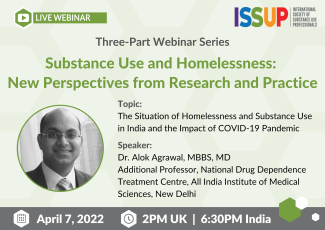
The Situation of Homelessness and Substance Use in India and the Impact of COVID-19 Pandemic
ISSUP are pleased to present the Final Event in the Webinar Series on Substance Use and Homelessness: New Perspectives from Research and Practice.
Ecolink Alumnis honor Global Trainers on Intl Women's Day
Ecolink Alumnis honor global trainers as outstanding Women of the Year on Women’s day.
Mangalore, India: Ecolink Alumni Association with over 200 students from 18 countries honored its Master trainers who trained over 250 addiction...

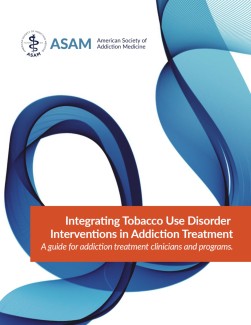
Integrating Tobacco Use Disorder Interventions in Addiction Treatment: A guide for addiction treatment clinicians and programs
Background
Between 65-87% of patients in addiction treatment smoke tobacco, compared to about 21% of the general population. These high rates of tobacco use contribute to significant patient suffering and early death. Over 53% of people...
Factors associated with retention on medications for opioid use disorder among a cohort of adults seeking treatment in the community
Abstract
Background
Medication treatment for opioid use disorder (OUD) (MOUD; buprenorphine and methadone) reduces opioid use and overdose. Discontinuation of MOUD can quickly lead to relapse, overdose and death. Few persons who initiate...
Sex Trafficking and Substance Use Identifying High-Priority Needs Within the Criminal Justice System
Substance use disorder (SUD) is common among victims of sex trafficking. Traffickers may exploit individuals' existing opioid use or other SUDs to coerce them into sex trafficking, or they may facilitate substance use to keep trafficking...
Effect of Combination Treatment With Varenicline and Nicotine Patch on Smoking Cessation Among Smokers Who Drink Heavily A Randomized Clinical Trial
Abstract
Importance The concurrent use of both tobacco and alcohol causes substantial disease and early mortality, and smokers who drink heavily tend to be less successful in smoking cessation than smokers who do not. Although varenicline...
Final Evaluation Report of Capacity Building for Effective Implementation of UPC Core Course in NDDCB Preventive Staff, Sri Lanka
Report of the Universal Prevention Curriculum Core training conducted at NDDCB Auditorium on 7th, 8th, 9th, 10th and 11th February 2022.
People with tobacco use disorder exhibit more prefrontal activity during preparatory control but reduced anterior cingulate activity during reactive control
Abstract
Reduced inhibitory control and a hypersensitivity to reward are key deficits in drug dependents; however, they tend to be studied in isolation. Here, we seek to understand the neural processes underlying control over reward and...
Effects of family history of substance use disorder on reward processing in adolescents with and without attention-deficit/hyperactivity disorder
Abstract
Patients with attention-deficit/hyperactivity disorder (ADHD) often develop early onset substance use disorder (SUD) and show poor treatment outcomes. Both disorders show similar reward-processing alterations, but it is unclear...