
Поиск
 Восстановление


Advancing the science of evaluating Collegiate Recovery Program processes and outcomes: A recovery capital perspective
Collegiate recovery programs (CRPs) offer resources and programming for postsecondary students in addiction recovery to ensure they can initiate or maintain their recovery and complete college. To achieve these goals, CRPs offer a variety...
Collegiate Recovery Communities Programs: What do we know and what do we need to know?
As the broad construct of recovery increasingly guides addiction services and policy, federal agencies have called for the expansion of peer-driven recovery support services. The high prevalence of substance use and abuse in colleges and...
Are Collegiate Recovery Programs worth the investment?
The first collegiate recovery program was founded at Brown University in 1977. Since then, these programs have seen explosive growth, with 136 currently in operation. Universities are often tasked with determining whether programs are worth...
Recovery High Schools: A Descriptive Study of School Programs and Students
High schools specifically designed for students recovering from a substance use disorder (substance abuse or dependence) have been emerging as a continuing care resource since 1987. This study of 17 schools provides the first systematic...
A systematic review of recovery high schools and collegiate recovery programs for building recovery capital among adolescents and emerging adults
Introduction:
Educational settings represent a prime opportunity for reaching adolescents and young adults (ages 12–27) experiencing substance use disorders (SUD). Recovery high schools (RHSs) were established to help adolescents in...
What is a Recovery High School?
This resource from the The Association of Recovery Schools explains the role of recovery high schools, which are secondary schools designed specifically to support students recovering from substance use disorders and co-occurring mental...
Recovery schools for improving behavioral and academic outcomes among students in recovery from substance use disorders: a systematic review
This Campbell systematic review examines the effects of recovery schools on student behavioral and academic outcomes, compared to the effects of non-recovery schools. The review summarizes evidence from one quasi-experimental study (with a...
A qualitative examination of social identity and stigma among adolescents recovering from alcohol or drug use
Introduction
Alcohol and other drug (AOD) use disorders are stigmatized conditions, but little is known about youth’s experience of this stigma, which may threaten their developing social identity and recovery process. This study...
Understanding recovery capital for addiction recovery in adolescence and young adulthood
In 2017, the Recovery Capital for Adolescents Model (RCAM) was proposed to highlight needs of adolescents in recovery (1), building on the seminal work of William Cloud and Robert Granfield (2). Research since the RCAM was proposed has...
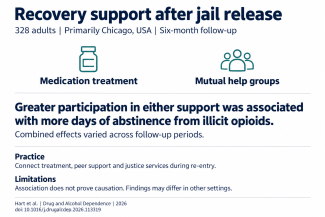
Adults with Problematic Opioid Use Released from Jail: Mutual Help Groups and Medication Support Contribute to a Greater Likelihood of Opioid Abstinence
A recent study found that medication treatment and mutual help group participation were each associated with more days of abstinence from illicit opioids after jail release. Their combined benefits were less clear and varied across follow-up periods. For ISSUP practitioners, the findings highlight the value of connecting treatment, recovery support and justice services during re-entry. The study does not establish causation, and findings from this US sample may not apply equally in other settings.
Para-Methoxymethamphetamine (PMMA) in tablets sold as ecstasy: Why this matters across our workforce
UNODC reports increasing PMMA detections in tablets sold as ecstasy in Europe, raising serious toxicity concerns. The alert encourages coordinated information sharing across prevention, treatment, recovery and law enforcement. It does not confirm local circulation, but prompts a review of local early warning responses.

Connecting Evidence, Prevention, Law Enforcement and Community Action: Key Insights from ISSUP 2026
How do we go about translating evidence into effective action, strengthen prevention, address drug-related crime, improve access to treatment and recovery support, and build safer, healthier communities?
This age-old question was explored...

Faith-Based Approaches: The Role of Faith and Religious Institutions in Addressing Substance Use
Faith, spirituality and faith-based organisations can play an important role in addressing substance use, supporting recovery and responding to related vulnerabilities as well as crime. Across different cultural and community settings, they...
Strengthening Faith-Based Responses to Drugs and Youth Criminal Recruitment: CICAD's Experience in the Americas
ABSTRACT
This presentation examines the experience of the Inter-American Drug Abuse Control Commission (CICAD) in strengthening the role of faith-based organizations in addressing substance use and the growing challenge of youth...
Latin American Pastoral Manual for Addiction Prevention and Support
ABSTRACT
Presentation of the Latin American Pastoral Manual for Addiction Prevention and Support, a resource that brings together science, faith and community experience. Developed through a synodal process involving representatives from...
Faith in young people? Understanding the potential and purpose of faith in the recovery and desistance journeys of adolescents and young adults.
ABSTRACT
Holistic transformation and wholesale change are the ultimate goals of those who work with substance users. But what does it mean to be truly holistic? And what does it look like to engage young people holistically including in...
Peer-based interventions for substance use among young people
ABSTRACT
Adolescents and young adults constitute a large proportion of the population in most low-to middle-income countries but face high levels of disability and mortality. This is influenced by unhealthy substance use, largely with...
Beyond Treatment: Building Systemic Capital for Recovery
ABSTRACT
Treatment is essential to addressing substance use disorders, but access to treatment alone does not determine whether recovery can be initiated and sustained. People enter treatment with very different levels of personal, social...
A Mosque-Based MOUD Programme: Bringing Treatment, Peer Support and Faith Together
The Ar-Rahman Mosque programme in Kuala Lumpur, Malaysia, was an innovative treatment initiative that combined faith-based and evidence-informed approaches for Muslim men experiencing Opioid Use Disorders. It was reported to be the first...

Faith Based Recovery
Faith-based recovery refers to programmes and communities that draw on spiritual and religious resources to support the process of change. It encompasses a wide range of approaches that foster recovery through meaning, hope, responsibility...