Tìm kiếm
 Law Enforcement
The activities of authorised agencies such as police, customs, border services, and investigative bodies to enforce drug control laws and address criminal activities related to the production, trafficking, and distribution of illicit substances. These activities may include investigations, intelligence gathering, interdiction, and collaboration with national and international partners to disrupt organised crime networks. Law enforcement plays an important role in protecting public safety and maintaining the rule of law, and is most effective when coordinated with broader public health, prevention, treatment, and recovery efforts as part of a balanced and comprehensive response to substance use.


Preventing Substance Use-Related Crime through Deflection
This article examines deflection as a crime prevention strategy aimed at addressing offending associated with substance use and co-occurring disorders through collaborative public health and public safety responses. Drawing on literature...
Understanding Youth Deflection & Pre-Arrest Diversion
This resource introduces youth deflection and pre-arrest diversion as early intervention strategies designed to support young people at risk of entering or progressing further into the criminal justice system. It explores challenges and...
Success in Deflection Programs: A Policy Brief
This policy brief examines the available evidence on the effectiveness of deflection programmes and provides recommendations for their implementation, evaluation and sustainability. Drawing on a review of 12 quantitative programme...
National Survey of First Responder Deflection Programs: Key Findings
This infographic presents key findings from a national survey of more than 300 first responder agencies in the United States, examining the development and implementation of deflection programmes in response to the opioid crisis. Findings...
Deflection Turns 10: Lessons from a Decade of Police, Drug Treatment, and Community Partnerships
This article reflects on the development of deflection over the past decade, examining its evolution from local police-led initiatives into an international approach to addressing substance use and drug-related offending. The authors...
Want to Reduce Drugs in Your Community? You Might Want to Deflect Instead of Arrest
In this foundational article, Jac Charlier introduces deflection as an alternative law enforcement response to individuals experiencing substance use disorders who repeatedly come into contact with the criminal justice system.
The article...
Leveraging Arrest Data for Youth Deflection
This resource from the Center for Health and Justice at TASC explores how youth arrest data can inform the development of deflection strategies that prevent unnecessary involvement in the criminal justice system.
Drawing on juvenile arrest...
Emerging Best Practices in Law Enforcement Deflection and Community Supervision Programs
The third volume of the Journal for Advancing Justice brings together researchers and practitioners to examine promising approaches for addressing substance use and mental health disorders among individuals who come into contact with law...
Checklist for Obtaining Officer Support for Deflection or Pre-Arrest Diversion Programs
Developed by the International Association of Chiefs of Police (IACP), this checklist presents evidence-based strategies for strengthening police officer engagement in deflection and pre-arrest diversion programmes.
The resource provides...
The Six Pathways: Frameworks for Implementing Deflection to Treatment, Services, and Recovery
This resource provides an overview of six pathways for implementing deflection and pre-arrest diversion initiatives that connect individuals with substance use-related needs to treatment, recovery support and community-based services.
Deve...
Using Police Data to Highlight Deflection Opportunities
Using Police Data to Highlight Deflection Opportunities, developed by the Center for Health and Justice at TASC, explores how police data can inform the development of deflection initiatives that connect individuals with community-based...
Law Enforcement Deflection Frameworks: A Decision Making Tool for Police Leaders
The Law Enforcement Deflection Frameworks: A Decision Making Tool for Police Leaders, developed by the Center for Health and Justice at TASC, provides practical guidance for law enforcement agencies seeking to develop alternatives to arrest...
Law Enforcement Pre-Arrest Diversion Resource Guide
The Law Enforcement Pre-Arrest Diversion Resource Guide, developed by SAFE Project in collaboration with the Police, Treatment, and Community Collaborative (PTACC), provides practical guidance on alternatives to arrest for individuals...
Critical Elements of Successful First Responder Diversion Programs
Critical Elements of Successful First Responder Diversion Programs provides practical guidance on developing and implementing first responder diversion initiatives that connect individuals experiencing substance use and mental health...
2025 National Drug Threat Assessment (NDTA)
The Drug Enforcement Administration (DEA) presents the 2025 National Drug Threat Assessment (NDTA), a comprehensive report that provides a national-level perspective on the threats posed by deadly illicit drugs and the violent transnational...
Drug & Precursor Trafficking: A Field Guide for Frontline Officers
Drug & Precursor Trafficking: A Field Guide for Frontline Officers is a practical resource designed to support law enforcement personnel in identifying, investigating and responding to drug trafficking and the illicit movement of precursor...
Colombia: Caribbean Routes Revive as Cocaine Flows Shift Towards European Markets
The report examines the resurgence of the Colombian Caribbean as a strategic corridor for cocaine trafficking towards European markets. It explores how criminal networks are adapting established trafficking routes in response to changing...
Faith, Identity and Belonging: Preventing Criminal Recruitment with Tim Rosier Pt. 1
What helps a person change, and what role can faith play in that journey? In this first episode, Tim Rosier joins Professor Goodman Sibeko to reflect on his career across probation, youth justice, prisons and academia, sharing experiences that challenged his understanding of crime, vulnerability and rehabilitation.

Pilot Training of Stakeholders on Alternatives to Incarceration for People Who Use Drugs in Contact with the Criminal Justice System in Nigeria: Lessons Learned and Future Directions
BACKGROUND: Studies have reported a high prevalence of substance misuse among people who use drugs (PWUD) in contact with the Criminal Justice System (CJS) in Nigeria. Further, there is limited access to treatment resulting in high rates of...
AddictologyIssue 2/2026
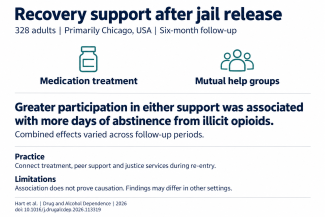
Adults with Problematic Opioid Use Released from Jail: Mutual Help Groups and Medication Support Contribute to a Greater Likelihood of Opioid Abstinence
A recent study found that medication treatment and mutual help group participation were each associated with more days of abstinence from illicit opioids after jail release. Their combined benefits were less clear and varied across follow-up periods. For ISSUP practitioners, the findings highlight the value of connecting treatment, recovery support and justice services during re-entry. The study does not establish causation, and findings from this US sample may not apply equally in other settings.