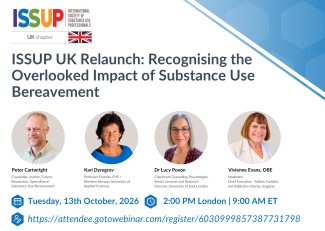
ISSUP UK presents its relaunch webinar, “Recognising the Overlooked Impact of Substance Use Bereavement.” The webinar will explore the experiences of those affected by substance use bereavement, including the impact of stigma, culture and complex grief, and consider compassionate approaches to support bereaved individuals and families.

Gillian Hunter, Tim McSweeney, Paul J. Turnbull, The introduction of drug Arrest Referral schemes in London: A partnership between drug services and the police, International Journal of Drug Policy, Volume 16, Issue 5, 2005, Pages 343-352, ISSN 0955-3959, https://doi.org/10.1016/j.drugpo.2005.06.008.
Arrest Referral (AR) schemes in London were established to connect people who use drugs with treatment services at the point of arrest through collaboration between police and drug service providers. Based on interviews with police officers and drug workers, the study explores the practical challenges of delivering treatment referrals within police custody settings, differences in professional perspectives, and the development of effective working relationships over time. The findings highlight the value of collaboration between health and criminal justice agencies in improving referral...
This report highlights a growing concern around stimulant use and related harms in Canada, particularly involving cocaine and methamphetamine. Data from multiple national sources show that stimulant-related deaths have significantly increased, with the rate of toxicity deaths doubling between 2018 and 2024.
At the same time, stimulants are increasingly involved in opioid-related deaths, indicating a rise in polysubstance use across most provinces and territories. The health impacts of stimulant use differ from opioids, with the main risks linked to cardiovascular complications, while opioids...
Al-Ajlouni, Y.A., Tanashat, M., Omari, D.A. et al. Public perceptions of heroin use: the influence of smoking, marital, and employment status on stigma toward people who use substances. Subst Abuse Treat Prev Policy (2025). https://doi.org/10.1186/s13011-025-00696-0
This study explored public stigma toward people who use heroin in Jordan, where cultural and religious beliefs often frame substance use as a moral failing. A nationwide online survey of over 900 adults found high levels of stigma, including fears of social rejection, job loss, and legal consequences for people who use heroin. Stigmatising attitudes were stronger among non-smokers, married individuals, and retired participants, while no differences were found by sex. The findings highlight how social norms shape stigma in Jordan and point to the need for culturally sensitive public health...
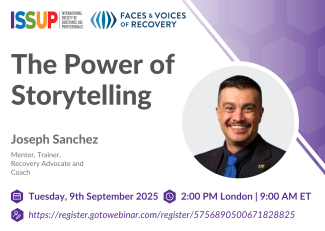
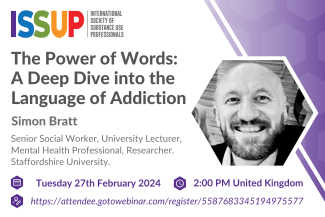
ISSUP Global, in collaboration with Faces & Voices of Recovery, invites you to the upcoming webinar titled 'Words Matter: Language and Stigma Reduction.'
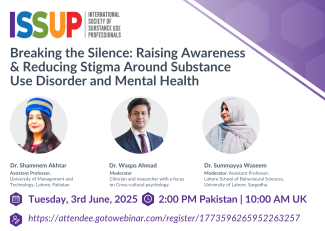
ISSUP in Pakistan invites you to its upcoming webinar: "Breaking the Silence: Raising Awareness and Reducing Stigma Around Substance Use Disorder and Mental Health"
Source: Caraveo-Anduaga, J. J., Martínez-Vélez, N. A., Arroyo-Belmonte, M., & Gaytán-Flores, F. I. (2025). Adaptation and Validation of an Instrument for Measuring Stigma towards Mental Health Problems in Children among Health Professionals. Salud Mental, 48(2), 99-109. Abstract: Introduction. One...
23-25 Ekim 2024 tarihleri arasında Lizbon, dünyanın dört bir yanından 2.231 katılımcıyı bir araya getiren Lizbon Bağımlılıkları 2024 Konferansı'na ev sahipliği yaptı. Etkinlik, bağımlılık bilimindeki en son araştırmaları paylaşmak ve bağımlılık politikası ve uygulamasında gelecekteki yönleri keşfetmek için dinamik bir platform sağladı. "Geleceğin İş Gücünü Güçlendirmek" adlı konferans teması, bağımlılığın önlenmesi, tedavisi ve iyileşmesinde işgücünü güçlendirmeye odaklandı ve alanın gelişen taleplerini karşılamak için iyi eğitimli profesyonellere olan kritik ihtiyacın altını çizdi.
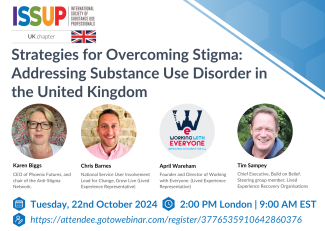
ISSUP UK, 22 Ekim'de "Damgalamanın Üstesinden Gelme Stratejileri: Birleşik Krallık'ta Madde Kullanım Bozukluğunu Ele Alma" konulu bir web semineri sunuyor.
McCall, J., Hobbs, H., Ranger, C. et al. Prescribed safer supply during dual public health emergencies: a qualitative study examining service providers perspectives on early implementation. Subst Abuse Treat Prev Policy 19, 19 (2024). https://doi.org/10.1186/s13011-024-00598-7
Background: Over the past decade, drug-related overdoses have seen a significant rise both in North America and globally. The COVID-19 pandemic has further emphasised the urgent need for safer supply programs to replace unregulated substances, reducing toxicity and overdose risks. Service providers play a crucial role in delivering safer supply initiatives, yet there's limited empirical evidence from their perspective on what constitutes effective safer supply programs. This study delves into the initial implementation and impacts of a safer supply program, capturing insights from an...
Fisher, H.L. (2024), The public mental health revolution must privilege lived experience voices and create alliances with affected communities. World Psychiatry, 23: 2-3.
In a new editorial in World Psychiatry, Prof. Helen L. Fisher discusses how public health must recognise the influence of social circumstances and experiences and calls for lived experience to be at the centre of this revolution.
Fisher argues that the design, delivery and evaluation of primary mental health prevention and promotion strategies and interventions should at the very least be informed by those most affected by the social and mental ill-health inequalities, and preferably involve those with lived experience in equal partnership.
Furthermore, she makes the case that engaging and...
Hulsey, J., Zawislak, K., Sawyer-Morris, G. et al. Stigmatizing imagery for substance use disorders: a qualitative exploration. Health Justice 11, 28 (2023).
This study used qualitative methods to identify stigmatizing and non-stigmatizing imagery for SUD and explore the reactions of people with lived experience with SUD to SUD-related imagery. We conducted focus groups and brief semi-structured qualitative interviews with 14 individuals in recovery from a range of SUD.
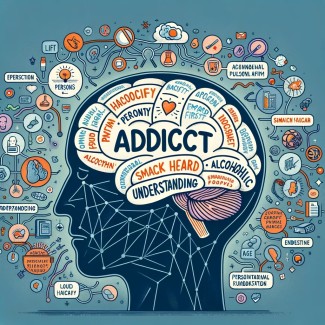
The Addiction Language Guide serves as a comprehensive resource designed to address and combat stigmatizing language associated with addiction. Stigmatizing language often involves attaching negative labels and stereotypes to specific groups of people, contributing to adverse consequences such as social isolation, diminished self-esteem, and reluctance to seek medical assistance. This guide aims to empower individuals and organizations to eliminate and replace stigmatizing language, thereby fostering positive change and enhancing the lives of those affected by substance use disorders both...
Language is a multifaceted tool that not only reflects human thoughts but actively molds them. It functions as both a window and a barrier in human communication, revealing the depths of cultural, historical, and personal beliefs while also defining and sometimes distorting our perceptions. The significance of language becomes particularly evident in the realm of mental health and addiction. The terms we employ in casual conversations or policy documents hold tremendous power – they can uplift or marginalise, clarify or misrepresent.
A journey through the labyrinth of language reveals how...