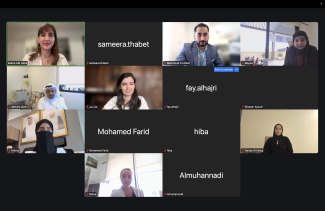
ISSUP, in collaboration with Naufar Qatar, delivered the Investing in Evidence-Based Prevention (IEP) workshop in Arabic on 2 and 9 September 2026, bringing together a multidisciplinary group of professionals and decision-makers from across key sectors in Qatar.
The workshop was delivered by Rasha Abi Hana, Scientific Support Coordinator at ISSUP, and organised with the support of the ISSUP training team, Hala Najm and Luciana Bruno, in close collaboration with the Naufar team.
In this reading list, we provide resources exploring recovery from substance use disorders among adolescents and young adults, with a particular focus on recovery capital, supportive educational environments, and community-based recovery support. Recovery during adolescence and young adulthood presents unique challenges, as young people navigate important developmental transitions, including identity formation, peer relationships, education, and increasing independence. Access to supportive relationships, positive social environments, and appropriate recovery resources can play an important...
Daryl Mahon. (2026) Building recovery capital through an integrated educational and fitness substance use programme: a patient and public involvement (PPI) approach. Journal of Integrated Care 34:4, pages 217-233.
Published in the Indian Journal of Psychological Medicine, this systematic review examines the effectiveness of family-based interventions for addressing substance use among adolescents and young adults.
The researchers reviewed 41 studies published between 2000 and 2023, including randomised controlled trials and quasi-experimental studies involving young people aged 10–25 years. The interventions included family therapy, counselling, psychoeducation and other approaches involving family members in treatment.
The findings suggest that family-based interventions can contribute to reductions...
Kosgolla J, Smith D, Lee A, Reinhart C and Jurinsky J (2025) Community support and youth recovery: the mediating role of peer and parental disapproval. Front. Adolesc. Med. 3:1602279. doi: 10.3389/fradm.2025.1602279
This study, published in Frontiers in Adolescent Medicine, examines the relationship between community recovery support, parental and peer attitudes towards substance use, and recovery among young people.
Using data from the 2022 Illinois Youth Survey and the Recovery Ecosystem Index, researchers explored whether parental and peer disapproval of substance use helped explain the association between community recovery resources and self-reported recovery status.
The findings suggest that stronger community recovery environments are associated with greater parental and peer disapproval of...
Miovský, M., Jandáč, T., Nováková, E., Habiňáková, R., Šejvl, J., & Gabrhelík, R. (2026). IPREV: A national interactive platform for promoting mental health and preventing risk behaviour – A case study of a comprehensive school- and community-based prevention system. Adiktologie, 26(2), 93–108.
BACKGORUND: Infrastructural support has become a critical factor in the implementation of prevention at the regional and national level. The complexity of risk behaviour prevention requires a diverse and systematic approach.
AIM: This case study aims to describe an example of a structured national digital infrastructural support system for school- and community-based prevention.
METHODS: The case study is based on a qualitative analysis of published documents, studies, and grey literature, together with a descriptive analysis of the iPREV Alpha version, tested and operated in 2021–2025...
Melgar, M. I. E., Agbayani, B. E., Rabajante, D. J. L. L., Usman, A. U. A., Nufable, H. R. B., & Rabajante, R. A., Jr. (2026). Educating educators on substance use: Insights from the blended approach. Adiktologie, 26(2), 75–82.
The school-based drugprevention training program under study is about the combined use of an online learning format and a traditional face-to-face session. This study aims to identify the factors that facilitated or impeded the successful implementation of a hybrid learning approach. Twelve faculty and staff members at a university completed the e-course, which was designed to last 10 weeks and was delivered via the HeK platform. The in-person class, on the other hand, was designed and implemented by the master trainers. Results show a significant, moderate increase in participants’ scores...
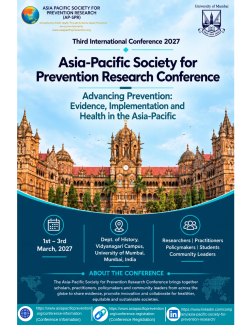
The Asia-Pacific Society for Prevention Research (APSPR) is inviting abstract submissions and registrations for the 3rd International Asia-Pacific Society for Prevention Research Conference, taking place on 1–3 March 2027 in Mumbai, India.
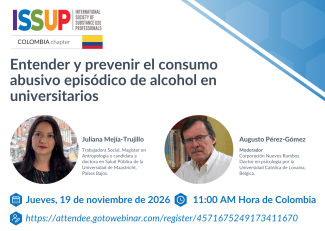
ISSUP Colombia le invita cordialmente a participar en su seminario web sobre Entender y prevenir el consumo abusivo episódico de alcohol en universitarios.
How do we go about translating evidence into effective action, strengthen prevention, address drug-related crime, improve access to treatment and recovery support, and build safer, healthier communities?
This age-old question was explored during ISSUP's 2026 Virtual Conference, held on 22–23 September 2026 under the theme Connecting Sectors, Creating Impact: A United Response on Drugs.
Bringing together researchers, practitioners, policymakers, law enforcement professionals and community representatives from different regions, the conference provided an opportunity to exchange evidence...
Protecting young people from substance use and crime: building safer communities and pathways to support
Young people's involvement in substance use and crime cannot be understood without considering the environments in which they grow up. Family circumstances, social connections, exposure to violence and access to opportunities can influence vulnerability, while supportive relationships, education and community engagement can help protect young people and create pathways towards healthier futures.
These issues were explored during Addressing Youth Substance Use and Crime: Risk Factors and...
Evidence-based interventions can improve prevention, treatment and recovery outcomes, but knowing what works does not guarantee that people will benefit. Effective responses depend on trained professionals, supportive systems, coordinated services and the ability to translate research into everyday practice. Even when appropriate interventions exist, gaps in implementation, access and continuity of care can limit their impact.
The use of psychoactive substances by young people is a rising environmental health concern in many Nigerian communities. Prevention efforts have shown fragmentation across institutions, thus curtailing their impact. It has therefore, become necessary to fortify collaboration, teamwork, partnership, alliances, etc between and among societal sectors in order to build sustainable and impactful prevention systems.
This Poster presents a local drugabuse prevention initiative implemented in EWU-EKITI by Lydia's Lifeline Initiative for Well-being, a community-based organisation...
Background
With the largest population of adolescents globally (253 million), India is witnessing an increasing burden of substance use and mental health concerns. The age of substance use initiation is declining, with early risk taking and substance use behaviors being linked to substance use disorders and poor psychosocial outcomes later in adulthood. Despite this, there is a dearth of accessible and engaging prevention strategies that can effectively tackle adolescent substance use, highlighting need for contextually relevant and innovative interventions.
ISSUP Global, in collaboration with the Vienna NGO Committee on Drugs (VNGOC), present a webinar on onnecting Civil Society with the United Nations: Opportunities for Engagement in Drug Policy, Crime Prevention and Criminal Justice.
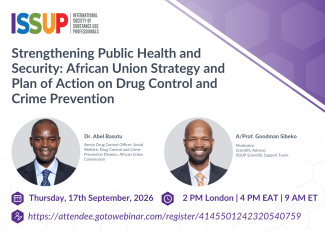
ISSUP Global, in collaboration with the African Union, presents a webinar on Strengthening Public Health and Security: African Union Strategy and Plan of Action on Drug Control and Crime Prevention.
ISSUP Uganda presents its webinar, " Building Safer Communities: The Role of Community Policing in Substance Use, violence and Crime Prevention in Uganda"
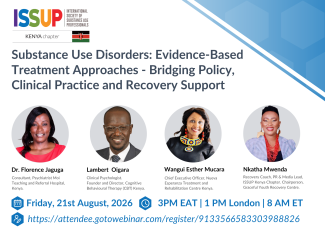
ISSUP Kenya would like to invite you to its webinar onSubstance Use Disorders: Evidence-Based Treatment Approaches; Bridging Policy, Clinical Practice and Recovery Support.