
Ara
 Treatment
The range of medical, psychological, and social services designed to help individuals reduce or stop substance use and manage substance use disorders. Treatment may include assessment, counselling and behavioural therapies, medication-assisted treatment, withdrawal management, and support for co-occurring mental or physical health conditions. Effective treatment is typically person-centred and evidence-informed, and may be provided in outpatient, community, or residential settings. Treatment aims to improve health and functioning, reduce substance-related harms, and support individuals in moving toward recovery and long-term wellbeing.


The Role of Faith Communities in Addressing Substance Use and Crime – Reading List (Part 2)
In this second reading list, we continue exploring the growing evidence on the role and contribution of faith communities and faith-based organisations in addressing substance use and crime, with a particular focus on treatment engagement...

During, After, or Both? Isolating the Effect of Religious Support on Recidivism During Reentry
This study examines how religious support during and after incarceration influences substance use and recidivism among people returning to the community. Using data from the Serious and Violent Offender Reentry Initiative, the authors...
Introducing the ISSUP Singapore National Chapter
ISSUP Singapore presents its maiden webinar. This webinar will introduce the ISSUP community to Singapore’s Substance Use workforce and outlining the priorities of the newly formed chapter.
Behavioural Addiction among Youths: Patterns and Innovative strategies for Prevention
ISSUP Nigeria presents the 34th session of its bi-monthly webinar in the Knowledge Update Series. This webinar will focus on the topic 'Behavioural Addiction among Youths: Patterns and Innovative strategies for Prevention'.
Tobacco Associated Disease Claims and ICD-10 F17 Tobacco Dependence Coding Among Psychiatric Patients in Indonesia National Health Insurance Dataset: A Retrospective Claims-Based Observational Study, 2015 - 2023
To compare hospital claims and costs for major tobacco associated diseases with ICD 10 F17 tobacco dependence coding in Indonesian national health insurance claims and to assess whether the insurer records tobacco addiction or mainly pays for its complications.
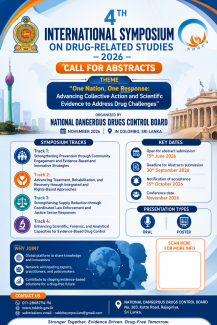
4th International Symposium on Drug-Related Studies - 2026, Sri Lanka
Call for Abstracts – 4th International Symposium on Drug-Related Studies 2026
The National Dangerous Drugs Control Board (NDDCB), Sri Lanka, warmly invites researchers, academics, policymakers, practitioners, healthcare professionals, law...
International Journal of Substance Abuse Research and Policy
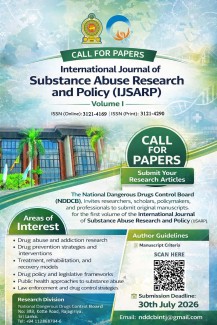
Call for Papers
International Journal of Substance Abuse Research and Policy (IJSARP)
The National Dangerous Drugs Control Board (NDDCB), Sri Lanka, is pleased to invite researchers, academics, policymakers, practitioners, and...
Democratising Evidence with David Patton Pt. 4: The Future of Evidence
In this final episode, Professor Goodman Sibeko and Dr David Patton look ahead to the future of addiction science and explore what it would take for lived experience to become a recognised and embedded part of the global evidence base.
Dav...
Democratising Evidence with David Patton Pt. 3: Participatory Research in Practice
In episode three , Professor Goodman Sibeko and Dr David Patton move from theory to practice, exploring how lived experience can be meaningfully embedded throughout the research process. Drawing on examples from participatory projects...
Small-Scale International Day Against Drug Abuse and Illicit Trafficking (IDADAIT) 2026 in Rural Sabah: A Stepping Stone Towards Evidence-Based Substance Use Prevention
The International Day Against Drug Abuse and Illicit Trafficking 2026 was successfully organised on 25 June 2026 at the Rural Medical Education Centre (RMEC), Faculty of Medicine and Health Sciences, Universiti Malaysia Sabah (UMS), Kudat...
MEN’S WELLNESS FOR ADDICTION PREVENTION
As Men’s Mental Health Month comes to a close, it’s important to remember that good mental health is not just about feeling well. Healthy minds are powerful shields against addiction. Drugs affect the brain and thus they become a burden to...

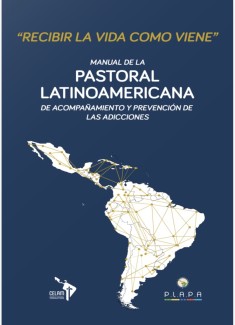
Manual de la Pastoral Latinoamericana de Acompañamiento y Prevención de las Adicciones
Nos complace compartir el lanzamiento del Manual de Pastoral de Adicciones, una iniciativa desarrollada por la Pastoral Latinoamericana de las Adicciones (PLAPA) y el CELAM.
Este manual ofrece una guía pastoral para la prevención, el...
Suboxone, Kratom, and 7-Hydroxymitragynine (7-OH): A Guide to Withdrawal Risks, Buprenorphine Treatment, and Clinical Considerations
Kratom, 7-OH, and Suboxone: Withdrawal, Blocking Effects, and Treatment Options
Quick answer: Yes, Suboxone can block the effects of kratom because buprenorphine binds strongly to the brain’s opioid receptors. However, taking Suboxone too...
Advancing Drug Policy, Mental Health, and Tobacco Control
From Stigma to Treatment: A Forum on Medical Cannabis Legalization in the Philippines
The University of the Philippines Law Center Institute of Human Rights (UP IHR) hosted the public forum "From Stigma to Treatment: A Forum on Medical...
What Is Xylazine
What Is Xylazine ("Tranq")? Effects, Wounds, Withdrawal, and Getting Help
Written by Benjamin Zohar, NCACIP
Published: 21 June 2026 | Last Updated: 21 June 2026 | 6 min read
Reviewed by Brandon McNally, RN
Xylazine—known on the...
Faith-Based Interventions for Reducing Gang Violence in the Caribbean: Reflections from a Professor and a Priest
This book chapter explores the role of faith-based interventions in preventing and reducing gang violence in Trinidad and Tobago. Drawing on the experiences of a criminologist and a religious leader, it argues that gang violence should be...
The Association Between Religiosity and Substance Use Patterns Among Women Involved in the Criminal Justice System
This study explores the relationship between religiosity and substance use patterns among women involved in the criminal justice system. Using data from women participating in a drug court programme in the United States, the researchers...
Religiosity and crime: Evidence from a city-wide shock
This study examines the relationship between religiosity and crime using data from the 2015 visit of Pope Francis to Philadelphia. By analysing daily crime reports before, during, and after the visit, the researchers found a significant...
The Role of Faith Communities in Addressing Substance Use and Crime – Reading List (Part 1)
In this reading list, we provide resources exploring the role of faith communities and faith-based organisations in addressing substance use, crime, violence and related social harms. Faith-based strategies draw on spiritual values...
