Source: Petersén, E., Augustsson Öfverström, H., Johansson, M. et al. Digital interventions as part of routine addiction care in Sweden: healthcare staff perceptions of what works. Addict Sci Clin Pract 20, 41 (2025). https://doi.org/10.1186/s13722-025-00570-1 Abstract Background Every year about...
This brief examines the average alcohol consumption of people in Canada and where it falls within the risk zones outlined in Canada’s Guidance on Alcohol and Health (CGAH). The publication presents updated data on weekly drinking patterns by province, age, and sex, and assesses the extent to which people in Canada adhere to the CGAH guidelines. This report is intended to inform public health professionals, policy makers and researchers working to reduce alcohol-related harm.
Three Key Points You Will Find in the Document:
People who drink alcohol in Canada consume an average of more than13...
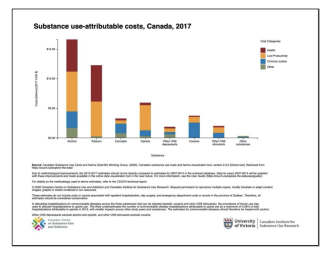
CSUCH’s data visualisation tool can be used to estimate substance use trends across the country. The data helps inform programs, practices, and research to protect communities, save lives, and improve the well-being of people in Canada.
Spotlight: Top 3 causes of death due to substance use in Canada
More than 200 people died each day due to substance use (SU) in 2020 (the latest year for which data are available). That works out to 73,994 deaths that year. The average age of death due to SU was 45 years. Tobacco use caused 63% (46,366) of SU-related deaths, followed by alcohol at 23%...
Cofresí, R.U., Piasecki, T.M. & Bartholow, B.D. Alcohol insensitivity and the incentive salience of alcohol: Two decades of work relevant to future directions of the addictions neuroclinical assessment. Transl Psychiatry 15, 50 (2025). https://doi.org/10.1038/s41398-025-03273-y
In a recent article, Gunawan and colleagues explore how the Incentive Salience (IS) domain in the Addictions Neuroclinical Assessment (ANA) framework relates to alcohol motivation and alcohol insensitivity. Their findings support previous research suggesting a connection between alcohol insensitivity and the motivation-driven response to alcohol-related cues. This review highlights the importance of understanding how individuals with low alcohol sensitivity (LS) experience stronger reactions to alcohol cues compared to those with high alcohol sensitivity (HS). It also emphasizes the need for...
Zyoud, S.H. Global scientific research landscape on binge drinking: a comprehensive bibliometric and visualization analysis of trends, collaborations, and future directions. Subst Abuse Treat Prev Policy 20, 13 (2025). https://doi.org/10.1186/s13011-025-00641-1
Background
Binge drinking, defined as consuming five or more alcoholic drinks in a single session, is a major public health issue. It leads to cognitive and motor impairments and is linked to numerous health problems. This study aims to analyze globally published peer-reviewed literature on binge drinking.
Methods
A thorough search was conducted in the Scopus database using keywords related to binge drinking. Specific criteria were applied to filter the results, resulting in 2,763 relevant research papers. VOSviewer software was used to analyze and visualize connections between these studies...
Høiland, K., Raudeberg, R. & Egeland, J. The repeatable battery for the assessment of neuropsychological status (RBANS) and substance use disorders: a systematic review. Subst Abuse Treat Prev Policy 20, 12 (2025). https://doi.org/10.1186/s13011-025-00640-2
Background
Cognitive deficits are common in patients with substance use disorder (SUD) and can impact treatment outcomes. The Repeatable Battery for the Assessment of Neuropsychological Status (RBANS) is a widely used tool that could help identify cognitive impairments in SUD patients. This systematic review examines the RBANS’ effectiveness in detecting cognitive impairment in SUD patients and discusses knowledge gaps and the need for further research.
Methods
A systematic search was conducted in PsycINFO, Medline, and Cochrane databases to find relevant studies on the use of RBANS in SUD...
Addiction and obesity share similar neurological pathways, both linked to compulsive behaviors and the brain's reward system. Research has highlighted the potential of GLP-1 receptor agonists, originally developed for diabetes, to help manage both appetite and addictive cravings. These medications, such as semaglutide, may regulate addictive behaviors by influencing reward circuits in the brain. However, they come with potential side effects, and their long-term effects are still under investigation.
In addition, a new compound, 5-Methoxy-2-aminoindane (MEAI), is being researched for its...
This week, we say goodbye to our dear friend and mentor, Jeff Lee, the founding Executive Director of ISSUP. Jeff was a steadfast advocate for the professionalization of prevention, insisting that those working in this field should be appropriately specialized. He often reminded us that while generalists and treatment specialists are well-meaning and deeply embedded within their communities, they are not always best placed to develop and implement evidence-based prevention systems. Jeff emphasized that prevention must be treated as a distinct science—one that is grounded in rigorous research...
Europol (2025), European Union Serious and Organised Crime Threat Assessment - The changing DNA of serious and organised crime, Publications Office of the European Union, Luxembourg
The EU-SOCTA offers one of the most thorough analyses conducted on the threats posed by serious organised crime to the EU’s internal security. Based on intelligence from EU Member States and international law enforcement partners, this report not only analyses the state of organised crime today – it anticipates threats of tomorrow, providing a roadmap for Europe’s law enforcement...
Bayigga, J., Kakai, I., Odongpiny, E.A.L. et al. Alcohol use disorder among people diagnosed with tuberculosis in a large urban case-finding project in central Uganda: prevalence, associated factors and challenges to treatment adherence. Subst Abuse Treat Prev Policy 20, 10 (2025). https://doi.org/10.1186/s13011-024-00629-3
Background
Heavy alcohol consumption increases the risk of developing tuberculosis (TB), delays diagnosis, and affects treatment adherence. This study aimed to examine the prevalence of alcohol use disorder (AUD) among individuals with TB and to explore the challenges they face in accessing and adhering to TB treatment.
Methods
An explanatory sequential study was conducted in two urban districts in Uganda. Quantitative data on the prevalence of AUD were collected using the CAGE tool. Factors associated with AUD were analyzed using Poisson regression. Focus group discussions (FGDs) were held...
Schøler, P.N., Andersen, M.B., Andersen, K. et al. Validation of the alcohol use disorders identification test in a Danish hospital setting. Subst Abuse Treat Prev Policy 20, 7 (2025). https://doi.org/10.1186/s13011-025-00638-w
Background
Early identification of alcohol problems is important for timely intervention. The Alcohol Use Disorders Identification Test (AUDIT) and its shorter version, AUDIT-C, are widely used screening tools. This study tested the effectiveness of recommended AUDIT and AUDIT-C cut-off scores in a hospital setting in Denmark.
Methods
From February to April 2023, data were collected from 300 patients at Odense University Hospital. The study tested AUDIT cut-offs (≥8, ≥16, ≥20) and AUDIT-C cut-offs (≥4, ≥5) against Danish low-risk drinking guidelines and self-reported alcohol dependence...
Substance use surveillance has emerged as a crucial public health strategy across Africa, particularly in light of the alarming rise in substance use among adolescents (1). This trend poses significant health risks that require a comprehensive understanding of the underlying dynamics. Substance use surveillance plays a pivotal role in developing a thorough understanding of the underlying dynamics of substance use across various populations, particularly in Africa. By systematically collecting and analyzing data on substance use trends, prevalence, and associated health risks, surveillance...
Fitzgerald N, Angus K, Howell R, Labhart H, Morris J, Fenton L, et al. Changing public perceptions of alcohol, alcohol harms and alcohol policies: A multi-methods study to develop novel framing approaches. Addiction. 2024. https://doi.org/10.1111/add.16743
Background and Aims
Public views on alcohol, its harms, and related policies can influence behaviour and support for policies. This research aimed to (i) summarise evidence on public understanding of alcohol, (ii) compare public views with expert opinions, and (iii) develop new ways to improve public understanding and support for alcohol policies in the UK.
Methods
The study used a mix of methods:
A literature review to explore previous evidence on framing and alcohol policy.
Focus groups (20 participants) to compare public views on alcohol harms with those of public health experts.
George F. Koob, Annual Review of Pharmacology and Toxicology, Volume 64, 2024, pp. 255-275
This review outlines challenges that face the alcohol field in closing this treatment gap and offers solutions, including broadening end points for the approval of medications for the treatment of AUD
The National Survey of Substance Use and Mental Health Services (N-SUMHSS) is a voluntary, annual survey that collects data from all active substance use and mental health treatment facilities across the United States, its territories, and Washington D.C. The annual report provides valuable insights into key operational characteristics of these treatment facilities, including the use of pharmacotherapies, availability of language assistance services, and the provision of suicide prevention assistance. This comprehensive survey helps to inform policymakers, researchers, and service providers on...
Individuals with chronic pain are more likely to engage in hazardous alcohol use compared to the general population. Despite this increased risk, they are an underserved group regarding targeted interventions. There is a pressing need to explore and develop alternative strategies to effectively reduce hazardous drinking in this vulnerable population. One promising approach is to focus on managing pain-related anxiety, which is a potential mechanism linked to hazardous drinking.
Researchers adopted a phased model (1A/1B) to address this need to create and test a new personalized feedback...
A significant number of individuals with alcohol use disorder (AUD) do not seek treatment, and the factors influencing treatment-seeking behavior are not well understood. While it is known that alcohol consumption levels can fluctuate with the seasons, the impact of these seasonal changes on seeking treatment for AUD remains unclear. This study aimed to explore whether there are seasonal patterns in the pursuit of treatment for AUD.
To investigate this, researchers conducted a time-series analysis involving adults in Denmark aged 18 and older who sought treatment for AUD. They focused on two...
Previous studies have shown that when students perceive their parents set strict limits on underage drinking, they tend to consume less alcohol. However, the best ways to communicate these limits effectively remain unclear. To explore this, a recent study examined the potential impact of hypothetical text messages focused on drinking limits on students' estimated alcohol consumption.
The study involved 253 undergraduate students who participated in an online survey. They were asked to imagine a scenario where they planned to attend a night event that involved drinking. Each participant was...
A study was conducted to examine how patterns of alcohol and cannabis use are associated with bystander intervention in situations involving the risk of sexual and relationship violence among college students. Researchers aimed to explore whether students' substance use influenced their awareness of risky situations (referred to as bystander opportunities) and their likelihood of taking action (bystander behaviors). Two key hypotheses guided this investigation: the first being that the frequency of bystander opportunities would vary depending on the students’ patterns of alcohol and cannabis...