Behind the Infamous ”Sabu”: The Social and Psychiatric Burden of Methamphetamine Use in Indonesia
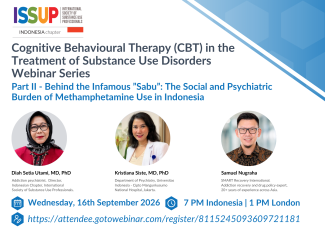
ISSUP Indonesia , ISSUP Sri Lanka and ISSUP Kazakhstan, welcome you to a three-part part webinar series on Cognitive Behavioural Therapy (CBT) in the Treatment of Substance Use Disorders.
Date: Wednesday, 16th September 2026
Time: 7 PM Indonesia | 1 PM London
Cognitive Behavioural Therapy (CBT) in the Treatment of Substance Use Disorders Webinar Series
This is a three-part webinar that will explore the application of Cognitive Behavioural Therapy (CBT) in the treatment of substance use disorders across diverse populations and settings in Asia. Drawing on experiences from Sri Lanka, Indonesia and Kazakhstan, the series will examine core CBT principles and their adaptation to different cultural, clinical, community, institutional and humanitarian contexts. Particular attention will be given to co-occurring mental health conditions, methamphetamine and new psychoactive substance use, incarcerated populations, migrants and displaced populations, and the practical implementation of evidence-informed approaches in different service settings.
Part II - Behind the Infamous ”Sabu”: The Social and Psychiatric Burden of Methamphetamine Use in Indonesia
This webinar will present an overview of methamphetamine use disorder, focusing on its significance as the most commonly misused illicit drug among the Indonesian population. A total of 36,050 cases of methamphetamine misuse were reported in 2025, representing 83.7% of the total cases. This substance imposes a heavy burden, including increased risk of polysubstance use disorder, increased risk of HIV transmission, and economic loss.
Based on the problem, this webinar presents the development, implementation, and preliminary outcomes of the Indo-SURFT (Indonesia Substance Use Reduction for Female Therapy), a culturally adapted, gender-sensitive group Cognitive Behavioural Therapy (CBT) programme designed for incarcerated women with methamphetamine use disorder (MUD). The programme consists of 12 structured sessions delivered over 6 weeks, adapted from the Seeking Safety CBT framework and tailored to Indonesian sociocultural contexts, including gender roles, trauma exposure, and family responsibilities.
The study presented high acceptability and retention (100% session completion), improvement in functional outcomes, particularly employment-related functioning, and reduction in craving during treatment.
This webinar will highlight key findings, methodologies, and translation to clinical approaches that are feasible and readily adaptable to manage substance use disorder.
Intended audience:
- Addiction psychiatrists and psychologists
- CBT practitioners
- Mental health professionals working in SUD treatment (psychiatrists, general practitioners, nurses)
- Public health professionals
- Social workers and rehabilitation counsellors
Learning Outcomes:
At the end of the webinar, participants will be able to:
-
Explain the rationale for culture-sensitive CBT in SUD
-
Describe the core components and structure of CBT program in SUD
-
Apply effective CBT techniques for managing craving, identifying trigger, developing self-efficacy, and cognitive restructuring
-
Adapt feasible CBT in low-resource or institutional settings (e.g. prisons)
-
Recognize limitation of CBT interventions
-
Explore CBT-informed and trauma-sensitive psychosocial support approaches used in humanitarian and migration settings
-
Application of CBT for common co-occurring conditions such as PTSD, anxiety, depression.
Presenters:
Diah Setia Utami, MD, PhD
ISSUP Indonesia, Jakarta
Dr. Diah Setia Utami, MD, PhD, is an addiction psychiatrist and the Director of the Indonesian chapter of International Society of Substance Use Professionals. Since completing her psychiatric training at Universitas Indonesia in 1996, she has dedicated her career to the clinical management of patients with addiction disorders. Dr. Diah previously served as Deputy of Rehabilitation and is currently a trusted member of the expert team at the Indonesian National Narcotics Board. Her contributions also include developing national guidelines for the treatment and rehabilitation of substance use disorders for the Indonesian Ministry of Health. In recognition of her expertise, Dr. Diah has been invited to speak at numerous prestigious national and international events, including the Asia Conference of Harm Reduction 2024. She is currently actively involved in mentoring students, lecturing on addiction disorders, and collaborating with local communities across Indonesia to address the ongoing challenges of substance use disorders.
Kristiana Siste, MD, PhD
Department of Psychiatry, Universitas Indonesia - Cipto Mangunkusumo National Hospital, Jakarta
Kristiana Siste, MD, PhD is an addiction psychiatrist and Chair of the Department of Psychiatry at the Cipto Mangunkusumo General Hospital (RSCM). After completing her psychiatric training at Universitas Indonesia, she obtained her addiction psychiatry specialization in 2013. Kristiana has led many research studies on addiction disorders, both substance and behavior, including developing Indo-DARPP modules for substance use disorder (SUD) Indo-SURFT for methamphetamine use disorder (MUD) in incarcerated women, and theta burst stimulation in treating craving and severity in MUD. She is also vocal in destigmatizing addiction disorder and has talked in multiple forums, both national and international, to disseminate her studies to care providers and bridge patients’ needs with stakeholders, especially to prevent internet and gambling disorder in Indonesia.
Moderator:
Samuel Nugraha
SMART Recovery International
Samuel Nugraha, is an addiction recovery and drug policy expert with 20+ years of experience across Asia.
He works with UN agencies and the Colombo Plan, contributes to Indonesia’s national standards, and serves as Global SMART Trainer and Southeast Asia representative for SMART Recovery Indonesia. He specializes in the Universal Treatment Curriculum (UTC) and Universal Recovery Curriculum (URC), focusing on building capacity of addiction counselor and professionals.
This webinar is hosted by ISSUP Indonesia and is part of a Series on Cognitive Behavioural Therapy (CBT) in the Treatment of Substance Use Disorders.
Find below the links to the other two Webinars taking place:
- Friday, 11th September 2026 - Part I
ISSUP Sri Lanka: Cognitive Behavioural Therapy for Substance Use Disorders: Principles, and Practice Examples from a Sri Lankan Context. Learn More >>>
-
Tuesday, 29th September, 2026 - Part III
ISSUP Kazakhstan: CBT in Addiction and Humanitarian Settings: Supporting Migrants and People Who Use New Psychoactive Substances Learn More >>>
References:
-
Randomized Controlled Pilot Study of Cognitive-Behavioral Therapy in a Sample of Incarcerated Women With Substance Use Disorder and PTSD. C. Zlotnick, Jennifer E. Johnson, L. Najavits
-
A cognitive-behavioral treatment for incarcerated women with substance abuse disorder and posttraumatic stress disorder: findings from a pilot study. C. Zlotnick, L. Najavits, D. Rohsenow, Dawn M. Johnson
-
Acceptance and commitment therapy versus cognitive behavioral therapy in the treatment of substance use disorder with incarcerated women. Patricia Villagrá Lanza, Paula Fernández García, Filomena Rodríguez Lamelas, Ana González-Ménendez
-
Efficacy of the Marlatt cognitive-behavioral model on decreasing relapse and craving in women with methamphetamine dependence: A clinical trial. N. Abdoli, V. Farnia, S. Salemi, F. Tatari, Touraj Ahmadi Juibari, et al.
-
Associations between psychosocial risk factors, and changes in substance dependence and psychosocial functioning, during engagement with digital cognitive behavioral therapy for methamphetamine use: use of 'Breaking Free from Substance Abuse' by incarcerated people during the COVID-19 pandemic. Sarah Elison-Davies, Jamie Newsome, A. Jones, G. Davies, Jonathan Ward
-
Effectiveness of cognitive-behavioral trauma treatment for incarcerated women with mental illnesses and substance abuse disorders. N. Wolff, B. Frueh, Jing Shi, Brooke E. Schumann
-
Psychosocial Treatment for Methamphetamine Use Disorders: A Preliminary Randomized Controlled Trial of Cognitive Behavior Therapy and Acceptance and Commitment Therapy. M. Smout, M. Longo, S. Harrison, R. Minniti, W. Wickes, et al.
-
A Randomized Controlled Trial of Brief Cognitive Behavioral Therapy for Regular Methamphetamine Use in Methadone Treatment. Zahra Alammehrjerdi, Nancy Briggs, A. Biglarian, A. Mokri, K. Dolan
Webinars and online events delivered and hosted by the International Society of Substance Use Professionals (ISSUP) are provided for informational purposes only. They are educational in nature and do not constitute medical advice, diagnosis or treatment.