Humanitarian settings and Use of Substances: CBT as a model of care
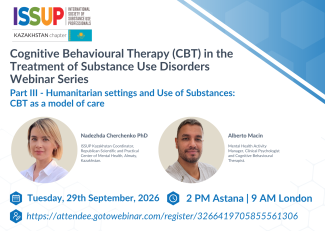
ISSUP Kazakhstan, ISSUP Indonesia and ISSUP Sri Lanka, welcome you to a three-part part webinar series on Cognitive Behavioural Therapy (CBT) in the Treatment of Substance Use Disorders.
Date: Tuesday, 29th September, 2026
Time: 2 PM Astana | 9 AM London
Cognitive Behavioural Therapy (CBT) in the Treatment of Substance Use Disorders Webinar Series
This is a three-part webinar that will explore the application of Cognitive Behavioural Therapy (CBT) in the treatment of substance use disorders across diverse populations and settings in Asia. Drawing on experiences from Sri Lanka, Indonesia and Kazakhstan, the series will examine core CBT principles and their adaptation to different cultural, clinical, community, institutional and humanitarian contexts. Particular attention will be given to co-occurring mental health conditions, methamphetamine and new psychoactive substance use, incarcerated populations, migrants and displaced populations, and the practical implementation of evidence-informed approaches in different service settings.
Part III - Humanitarian settings and Use of Substances: CBT as a model of care.
The session will bring together perspectives from addiction medicine, mental health care, and humanitarian psychosocial support to explore how evidence-based psychological interventions can be implemented in real-world settings for people who use new psychoactive substances (NPS), and other vulnerable groups.
ISSUP Kazakhstan and RSPCMH will present the experience of implementing a pilot CBT program for people who use NPS in Kazakhstan, including preliminary findings, mental health outcomes, and implications for HIV prevention and addiction treatment services. MSF will present the experience of Mexico’s rehabilitation Programme in MHPSS for survivors of torture, ill-treatment and Internal-displacement-related trauma in humanitarian settings within key population. “Holistic Model of Care in Mexico for Functional Rehabilitation. The factors: Complex trauma, Use of substances, personality Disorders and MH emergencies”.
Intended audience:
- Addiction psychiatrists and psychologists
- CBT practitioners
- Mental health professionals working in SUD treatment (psychiatrists, general practitioners, nurses)
- Public health professionals
- Social workers and rehabilitation counsellors
Learning Outcomes:
At the end of the webinar, participants will be able to:
-
Explain the rationale for culture-sensitive CBT in SUD
-
Describe the core components and structure of CBT program in SUD
-
Apply effective CBT techniques for managing craving, identifying trigger, developing self-efficacy, and cognitive restructuring
-
Adapt feasible CBT in low-resource or institutional settings (e.g. prisons)
-
Recognize limitation of CBT interventions
-
Explore CBT-informed and trauma-sensitive psychosocial support approaches used in humanitarian and migration settings
-
Application of CBT for common co-occurring conditions such as PTSD, anxiety, depression.
Presenters:
Nadezhda Cherchenko – Psychiatrist, PhD (c.),
ISSUP Kazakhstan Coordinator, Republican Scientific and Practical Center of Mental Health, Almaty, Kazakhstan. Nadezhda Cherchenko is a psychiatrist specializing in addiction medicine, mental health, and evidence-based interventions for vulnerable populations. She works at the Republican Scientific and Practical Center of Mental Health in Kazakhstan and serves as the ISSUP Kazakhstan Coordinator. Her professional activities focus on substance use disorders, new psychoactive substances (NPS), opioid agonist therapy (OAT), overdose prevention, and the integration of mental health and HIV-related services.
Alberto Macin
MSF mental health activity manager, Alberto Macin, has been working with Médecins Sans Frontières/Doctors Without Borders for the last nine years. During this period, he has worked in various locations including Mexico, El Salvador, South Sudan, Ukraine, migratory routes between Libya and the Mediterranean, Mozambique, Kenya, Somalia and Kazakhstan. He is a Clinical Psychologist and Master's Studies in Health Psychology. His role involves developing mental health strategy and integrating mental health services in MSF's activities, implementing mental health and psycho-social support, and training and supervising project teams.
This webinar is hosted by ISSUP Kazakhstan and is part of a Series on Cognitive Behavioural Therapy (CBT) in the Treatment of Substance Use Disorders.
Find below the links to the other two Webinars taking place:
-
Friday, 11th September 2026 - Part I
ISSUP Sri Lanka: Cognitive Behavioural Therapy for Substance Use Disorders: Principles, and Practice Examples from a Sri Lankan Context. Learn More >>>
- Wednesday, 16th September 2026 - Part II
ISSUP Indonesia: Behind the Infamous ”Sabu”: The Social and Psychiatric Burden of Methamphetamine Use in Indonesia. Learn More >>>
References:
-
Nikolay Lunchenkov, Nadezhda Cherchenko, Kuanysh Altynbekov, Assel Terlikbayeva, Sholpan Primbetova, Denis Gryazev, Elena German, Uluk Batyrgaliev, Janina Isabel Steinert. "A way to liberate myself": A qualitative study of perceived benefits and risks of chemsex among gay, bisexual, and other men who have sex with men in Almaty, Kazakhstan. Drug and Alcohol Dependence, Volume 264, 2024, 112464, ISSN 0376-8716, https://doi.org/10.1016/j.drugalcdep.2024.112464.
-
N. Lunchenkov, N. Cherchenko, E. German, S. Rinne-Wolf. “Emptiness Filled with Love”: A Reflexive Thematic Analysis of Chemsex Trajectories Among Gay, Bisexual, and Other Men Who Have Sex with Men in Almaty, Kazakhstan Using a Life Course Framework. Emerging Trends in Drugs, Addictions, and Health, Volume 5, 2025, 100240, ISSN 2667-1182, https://doi.org/10.1016/j.etdah.2025.100240.
-
https://www.msf.org.co/actualidad/mexico-las-secuelas-de-la-tortura-persisten-durante-anos-sin-atencion-oportuna/ Predictors of mental health outcomes among survivors of torture and ill-treatment in a Médecins Sans Frontières retrospective cohort study in Mexico | Journal Article / Pre-Print | MSF Science Portal
Webinars and online events delivered and hosted by the International Society of Substance Use Professionals (ISSUP) are provided for informational purposes only. They are educational in nature and do not constitute medical advice, diagnosis or treatment.