


Іздестіру
Policy Advocacy
Informing local, national, and international policy to manage and reduce substance use e.g., drug policy reform, legislation and regulations, education.

Connecting Evidence, Prevention, Law Enforcement and Community Action: Key Insights from ISSUP 2026
How do we go about translating evidence into effective action, strengthen prevention, address drug-related crime, improve access to treatment and recovery support, and build safer, healthier communities?
This age-old question was explored...

World Drug Report 2026: Key Trends and Policy Challenges for Africa
ISSUP Global, in collaboration with the African Union, presents World Drug Report 2026: Key Trends and Policy Challenges for Africa.
Substance Use Disorders: Evidence-Based Treatment Approaches - Bridging Policy, Clinical Practice and Recovery Support
ISSUP Kenya presents its webinar on Substance Use Disorders: Evidence-Based Treatment Approaches; Bridging Policy, Clinical Practice and Recovery Support.
Addressing the recruitment of young people into criminal drugs networks
This report examines how and why young people are recruited into criminal drug networks across Europe. It highlights the range of factors that can increase vulnerability to recruitment, including social and economic disadvantage, peer...
Faith-Based Interventions for Reducing Gang Violence in the Caribbean: Reflections from a Professor and a Priest
This book chapter explores the role of faith-based interventions in preventing and reducing gang violence in Trinidad and Tobago. Drawing on the experiences of a criminologist and a religious leader, it argues that gang violence should be...
The Role of Law Enforcement in the Reduction of Substance Use and Other Behavioral Health Risks: Substance Use as a Focus: United States as an Example
This paper explores how law enforcement can contribute to the prevention of substance use and other behavioural health risks beyond their traditional enforcement role. Using the United States as an example, it argues that police and other...

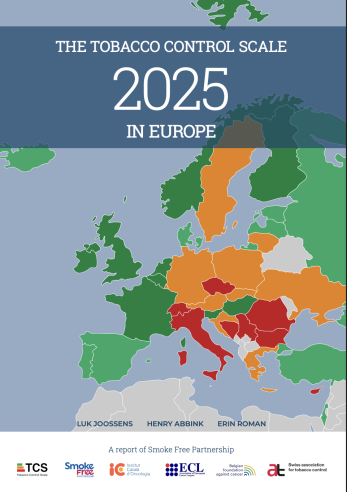
The Tobacco Control Scale 2025 in Europe
The Tobacco Control Scale 2025 shows that progress in tobacco control across Europe has slowed, with more countries recording lower scores than in previous years. Key reasons include the failure to regulate heated tobacco products in the same way as cigarettes and the lack of adjustments to tobacco taxes and prices to keep pace with inflation.
The Opioid Crisis Practical Toolkit: Supporting Faith and Community Responses
This practical toolkit highlights the role of faith-based and community leaders in responding to the opioid crisis in the United States. Developed by the U.S. Department of Health and Human Services, it recognizes that community and faith...
2026 National Drug Control Strategy - The White House
The 2026 National Drug Control Strategy outlines a comprehensive roadmap to reduce illicit drug use and protect communities across the United States. It prioritizes stopping the flow of drugs and precursor chemicals at all borders through...
Playing legislative catch-up: Drug law reform in the Pacific
Drug trafficking in the Pacific is rapidly expanding, shifting countries from transit points to consumer and production markets. However, many national laws remain outdated, as they were designed for earlier challenges like cannabis and are...

Policy Brief: Scam Centres – Combating a Global Phenomenon
Short Summary
Scam centres are a fast-growing global organized crime threat, generating over $1 trillion in losses in 2024. They use technology and psychological manipulation to target victims worldwide, supported by global criminal...
Preventina (PreventAdvisor)
On 9 March 2026, we officially launched Preventina (PreventAdvisor)—an AI chatbot designed to support prevention science, policy, and practice.
This is not a generic chatbot. Preventina is built on a curated knowledge base of verified...
The Promotion of Alcohol, Cannabis, Gambling, Tobacco and Vaping Products: A Comparative Analysis of the Potential of Legal Frameworks to Limit Exposure Among Minors
Promotions deemed attractive to minors concerning alcohol, cannabis, gambling, tobacco and vaping are circulating in media outlets and places where minors are very active. This report examines the different legal frameworks in Canada that...
Perceptions of Law Enforcement Personnel and Public Health Professionals on Synthetic Drug Use in Nigeria
BACKGROUND: Nigeria is one of the countries in the world severely impacted by synthetic drug production and use, yet lacks fundamental understanding of the synthetic drug market, how many people use, and how much they use. AIMS: The aims of...
Day 2, 08:00 - 09:00, Plenary 6: Reducing Drug-Related Crime in Asia
Panel Presented at Indonesia 2025 on the 18th of September 2025
Moderator: Michele Worobiec
Presentations:
Tery Zakier Muslim: Reducing Drug-Related Crime
Grace Sopacua: The Situation of Drugs Law Enforcement in Indonesia
Augus...
Dispatch from the Front: Lessons Learned at the Collision of Public Health, Peer Support, and a Rising Tide of Hope
ISSUP Global, in collaboration with Faces & Voices of Recovery, presents its webinar titled 'Dispatch from the Front: Lessons Learned at the Collision of Public Health, Peer Support, and a Rising Tide of Hope'
Attitudes and views regarding law enforcement activity at large outdoor raves in Israel: a cross-sectional survey
ABSTRACT
Harm reduction services, such as drug testing kiosks and ‘safe zones’ are often advocated for reducing the harms of drug use among rave and festival attendees. However, interaction with law enforcement can undermine efforts at...
Seattle’s law enforcement assisted diversion (LEAD): Program effects on criminal justice and legal system utilization and costs.
Abstract
Objectives We evaluated a prebooking law enforcement assisted diversion (LEAD) program (i.e., initial diversion from the criminal justice system paired with harm-reduction case management and legal assistance to individuals with...
Law enforcement-led, pre-arrest diversion-to-treatment may reduce crime recidivism, incarceration, and overdose deaths: Program evaluation outcomes.
Abstract
Introduction: Substance use disorder (SUD), overdose, and drug use-related crime continue to increase in the U.S. Pre-arrest diversion-to-treatment programs may decrease crime recidivism and overdose deaths. We assessed the impact...
A multi-site evaluation of law enforcement deflection in the United States.
Many law enforcement and other first responder agencies have adopted deflection as a front-line response to the increasing number of drug overdoses and deaths in the United States over the past two decades. Deflection programs aim to...