
لټون
 Responding to Drug-Related Offending
Coordinated efforts between law enforcement, courts, treatment providers, and social services to reduce reoffending, promote recovery, and address the underlying causes of drug-related crime.



2026 National Drug Control Strategy - The White House
The 2026 National Drug Control Strategy outlines a comprehensive roadmap to reduce illicit drug use and protect communities across the United States. It prioritizes stopping the flow of drugs and precursor chemicals at all borders through...
Global Organized Crime Index 2025 - Europe Overview
The 2025 Global Organized Crime Index shows that overall crime levels in Europe remain stable, and the region continues to rank among the least affected globally. However, this stability hides a more complex reality, with criminal markets...
Policy Brief: Scam Centres – Combating a Global Phenomenon
Short Summary
Scam centres are a fast-growing global organized crime threat, generating over $1 trillion in losses in 2024. They use technology and psychological manipulation to target victims worldwide, supported by global criminal...
Advancing Advocacy: ISSUP Philippine Chapter's March 2026 Activities
March 2026 has been a productive month for the ISSUP Philippine Chapter, with representatives participating in various events. Each activity reflects the Chapter's continued commitment to working together with government agencies and non...
A Reading List on Responding to Drug-Related Offending through Science-Based Policy and Practice
As justice systems increasingly shift their focus from punishment to rehabilitation, it becomes essential to understand the complex relationship between substance use, criminal behaviour, and treatment, particularly among individuals whose involvement with the system stems from substance use.

ISSUP Bangladesh Chapter Launch Ceremony
ISSUP Bangladesh presents the launch of the ISSUP Bangladesh Chapter. Organised in collaboration with Dhaka Ahsania Mission, the ceremony will bring together national and international experts, policymakers, youth leaders, and development partners working in substance use prevention, treatment, and recovery support.
Safety Starts Early: Drug Use Prevention and Violence Prevention as Public Security Investments
ISSUP Global presents a webinar on Safety Starts Early: Drug Use Prevention and Violence Prevention as Public Security Investments.
Reducing Drug‑Use–Related Offenses Through Health‑Centered Approaches
ISSUP Global, in collaboration with Proyecto Hombre, presents a webinar on Reducing Drug-Use–Related Offenses Through Health-Centered Approaches.
Navigating opioid use disorder treatment for pregnant and parenting people: composite narratives for policy action
Opioid use during pregnancy and the postpartum period is increasing in the United States, yet many pregnant and parenting people face serious barriers to accessing effective treatment and supportive services. These barriers arise from...

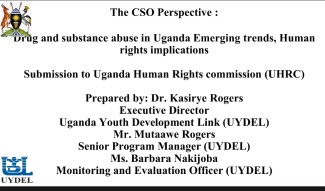
A CSO PERSPECTIVE: Drug and substance abuse in Uganda Emerging trends,Human rights implications
Due to the rising incidence of narcotics-related cases and associated crime, there is an urgent need to expand and strengthen alternatives to criminal activity. This concern was emphasized by Dr. Rogers Kasirye during the 28th UHRC Annual...
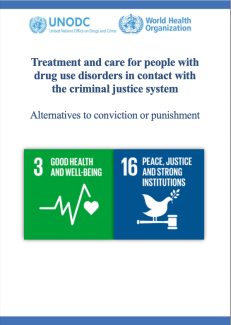
Treatment and Care for People with Drug Use Disorders in Contact with the Criminal Justice System
The UNODC and WHO report Treatment and care for people with drug use disorders in contact with the criminal justice system: Alternatives to conviction or punishment examines how health-centred, evidence-based responses can be integrated...
Perceptions of Law Enforcement Personnel and Public Health Professionals on Synthetic Drug Use in Nigeria
BACKGROUND: Nigeria is one of the countries in the world severely impacted by synthetic drug production and use, yet lacks fundamental understanding of the synthetic drug market, how many people use, and how much they use. AIMS: The aims of...
Ilicit Trafficking Nexus: Ilicit Drugs, Human Trafficking, and Arms Trade in Asia
Panel Presented at Indonesia 2025 on the 18th of September 2025
Author: Augus Irianto
Abstract:
The escalating drug problem in Asia has evolved into a multidimensional threat that extends far beyond public health. Illicit drug...
Day 2, 08:00 - 09:00, Plenary 6: Reducing Drug-Related Crime in Asia
Panel Presented at Indonesia 2025 on the 18th of September 2025
Moderator: Michele Worobiec
Presentations:
Tery Zakier Muslim: Reducing Drug-Related Crime
Grace Sopacua: The Situation of Drugs Law Enforcement in Indonesia
Augus...
Day 1, 16:00 - 17:30, Plenary 4: Reducing Drug Related Crimes in the Community
Panel Presented at Indonesia 2025 on the 17th of September 2025
Moderator: Imelda Indriyani
Presentations:
Mirza Hapsari Massarapa: Reducing Drug-Related Crime: A Comprehensive Approach from the Indonesian Directorate General of...
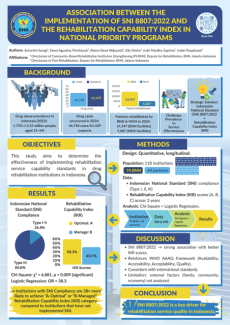
ASSOCIATION BETWEEN THE IMPLEMENTATION OF SNI 8807:2022 AND THE REHABILITATION CAPABILITY INDEX IN NATIONAL PRIORITY PROGRAMS
Background:
In 2023, the prevalence of drug abuse in Indonesia among the population aged 15–64 years reached 1.73%, equivalent to 3.33 million people. This problem has prompted The National Narcotics Board (BNN) as a government agency which...
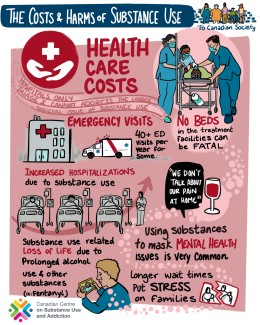
Personal Impacts of Substance Use
The Canadian Centre on Substance Use and Addiction (CCSA) transforms complex data into insights that reflect real human experiences. Every aspect of the Canadian Substance Use Cost and Harms (CSUCH) project represents individuals with lived...
Becoming a Member of the Prevention Club: Development of Interdisciplinary Prevention Terminology
Introduction
Prevention science is interdisciplinary, drawing upon multiple fields of research and practice to develop integrated knowledge. A challenge facing the field is the proliferation of different terms with the same meaning, and of...
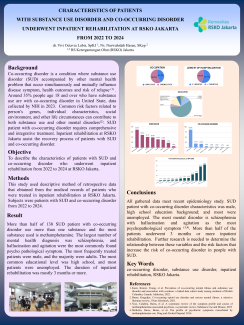
Characteristics of Patients with Substance Use Disorder and Co-occuring Disorder Underwent Inpatient Rehabilitation at RSKO Jakarta from 2022 to 2024
Co-occurring disorder is a condition where substance use disorder accompanied by other mental health problem that occur simultaneously and mutually influence disease symptom, health outcomes and risk of relapse. Around 35% people age 18 and...
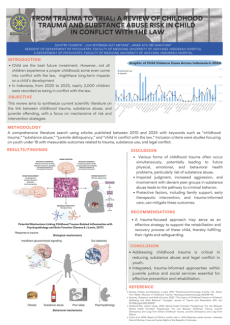
From Trauma to Trial: A Review of Childhood Trauma and Substance Abuse Risk in Child in Conflict with the Law
| Introduction. Child in conflict with the law often present with complex psychosocial backgrounds, prominently featuring histories of childhood trauma. Emerging evidence suggests a strong correlation between early traumatic... |