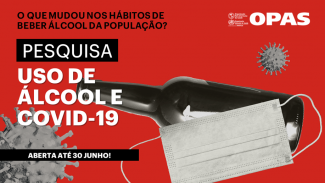
The COVID-19 pandemic has modified the availability and use of alcoholic beverages. To find out how alcohol consumption has changed, the Pan American Health Organization (PAHO) invites you to answer an anonymous survey for people 18 years of age and older. The obtained data will allow responding...
La disponibilidad de bebidas alcohólicas durante la pandemia por COVID-19 ha cambiado. Para conocer cómo ha cambiado el consumo de alcohol, la Organización Panamericana de la Salud (OPS) invita a contestar una encuesta anónima, para mayores de 18 años. La información que se obtenga permitirá...
20 de mayo del 2020 Palabras de bienvenida: Dra. Farah Urrutia, Secretaria de Seguridad Multidimensional, de la Organización de los Estados Americanos (OEA) Emb. Adam E. Namm, Secretario Ejecutivo de la Comisión Interamericana para el Control del Abuso de Drogas (CICAD) Jimena Kalawski, Jefa de la...
Palabras de bienvenida: Dra. Farah Urrutia, Secretaria de Seguridad Multidimensional, de la Organización de los Estados Americanos (OEA) Emb. Adam E. Namm, Secretario Ejecutivo de la Comisión Interamericana para el Control del Abuso de Drogas (CICAD) Jimena Kalawski, Jefa de la Unidad de Reducción...
The New Horizons grants programme is now open with the first round of grants focused on developing a greater understanding of 'Groups, Communities and Alcohol Harm', particularly those that focus on:
Groups, sub-groups and communities that are subject to stigma, discrimination or structural disadvantage by society at large or by the dominant group of identity.
Newly emerging or atypical communities (such as gamers, neo-libertarians, ‘sober...
Seminario por internet realizado el 13 de mayo del 2020 En este seminario, el Sr. Morlachetti discute el papel de las normas y estandares de derechos humanos en la regulación y restricción de la comercialización de las bebidas alcohólicas. Además, aborda las medidas que pueden tomar los Estados...
Rehm, J., Kilian, C., Ferreira‐Borges, C., Jernigan, D., Monteiro, M., Parry, C.D.H., Sanchez, Z.M. and Manthey, J. (2020), Alcohol use in times of the COVID 19: Implications for monitoring and policy. Drug Alcohol Rev.. doi:10.1111/dar.13074
During this global lockdown, most people have had to make major lifestyle changes in order to adhere to guidelines outlined by their respective governments.
The situation has forced people's behaviour and choices to change, and it is important to monitor these adjustments from a public health perspective.
In the past, researchers have monitored how major events have influenced peoples drinking behaviour, both during and post-crisis. Although behaviour scientists around the world are carrying out similar analysis, there are several factors that make this situation unique. These include the...
In a time where many other research interactions have been halted, the Sheffield Alcohol Research Group is pleased to host a new annual symposium: the “Early Career Alcohol Research Symposium”.
The Policy and Communications team at Adfam have asked us to relay this call-out to ISSUP members and the international DDR community...
Adfam is a UK-based charity that improves life for families affected by someone else’s substance use.
We’ve heard through our frontline projects, findings from an online survey, activity on our online family forum and statements from partner organisations that Covid-19 is resulting in a number of additional challenges for families in the UK that are affected in this way. These challenges are complex and multifaceted and include:
Dialog Interaktif adalah serangkaian pertemuan virtual yang diselenggarakan oleh USAPA untuk mendorong penyebaran ide dan hubungan yang lebih besar di antara mereka yang bekerja di bidang kebijakan alkohol...
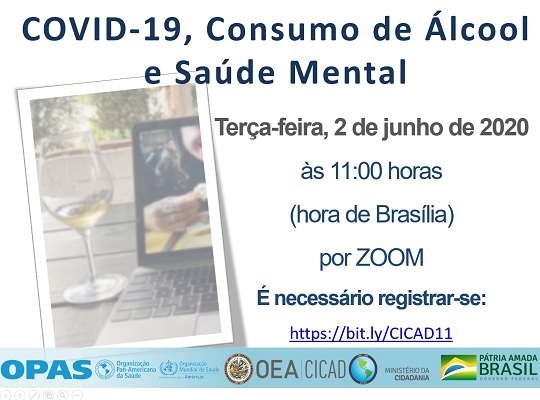
Presenter: David Jernigan Moderator: Dr. Maristela Monteiro This event is part of the webinar series on Alcohol and Health, organized by the Pan American Health Organization (PAHO)
COVID-19 is a global health crisis that is increasing the workload of healthcare professionals around the world.
In order to support practitioners during these critical circumstances, it is essential that everyone is informed about other health risks and hazards so that they can stay safe and healthy.
The following factsheet provides important information that you should know about alcohol consumption and COVID-19.
It addresses, among other things, the misinformation that is being spread through social media and other communication channels about alcohol and COVID-19.
The first cell in row two of the Alcohol Treatment Matrix initiates our investigation of treatment as opposed to brief interventions, discussing seminal and key research relevant across different treatment modalities. It focuses on the ‘common factors’ often sidelined as components of the placebo effect, but which are actually active ingredients at least as important as the particular therapy. Starts with a “frankly inspiring series of studies from the 1950s”, highlights the multi-million dollar US Project MATCH trial, and develops evidence...
Psychology of Addictive Behaviors, the official journal of APA Division 50 (Society of Addiction Psychology), invites manuscript proposals for an upcoming special issue on brief alcohol interventions for young adults.
Details:
Structured abstract (up to 1000 words) due: June 15, 2020
Invitations to submit a full manuscript (with authors notified of this decision): July 15, 2020
Full manuscripts of invited submissions due: November 15, 2020
Source: Cheetham, A., Sandral, E. & Lubman, D.I. Outcomes of reducing stigma towards alcohol misuse during adolescence: results of a randomized controlled trial of the MAKINGtheLINK intervention. Child Adolesc Psychiatry Ment Health 14, 11 (2020). https://doi.org/10.1186/s13034-020-00317-7 Abstract...
Panduan ini membantu penyedia dalam menawarkan perawatan kepada wanita yang hidup dengan gangguan penggunaan zat. Ini meninjau penelitian khusus gender dan praktik terbaik, seperti pola umum penggunaan awal dan masalah dan strategi perawatan khusus.
Latest instalment of fortnightly course on the evidence for alcohol treatment and brief interventions. Context is that Britain’s National Institute for Health and Care Excellence (NICE) insists commissioners and managers “must” generate a system which provides the training, resources and time needed for routine brief intervention. Find out what happened when that was tried in Scotland, and develop evidence-informed understanding of four key issues:
- Advice is to commission for quality as well as quantity – but what is quality?