
Іздестіру

Medetomidine in the U.S. Illegal Fentanyl Supply Increasing Risk for Overdose and Severe Withdrawal Syndrome
The Centers for Disease Control and Prevention (CDC), in conjunction with the White House Office of National Drug Control Policy (ONDCP), is issuing this Health Advisory to notify public health professionals, clinicians, laboratorians, and...
CCENDU Issue 7 (Part 2): Stimulant Use and Related Harms in Canada — Drivers and Adaptive Responses
This issue is the second of a special two-part series. Part 2 examines key factors driving stimulant use, what these trends mean for different groups of people and the responses being implemented to reduce harms.
Three key points of...
CCENDU Issue 7 (Part 1): Stimulant Use and Related Harms in Canada - Recent Trends
This issue is a special two-part series. The first part features a regional breakdown of reports from seven Canadian Community Epidemiology Network on Drug Use (CCENDU) nodes and five drug checking services from across the country. It...
Evaluating the DALY impact of disease associated with second-hand smoke exposure in different socio-demographic index regions
Secondhand smoke (SHS) continues to be a major global health risk, contributing to cardiovascular diseases, metabolic disorders, and respiratory illnesses. Using data from the Global Burden of Disease 2021 study across 204 countries, this...

Perspectives on addiction-related problems in Vietnam
The article provides an overview of key substance use and addictive behaviors in Vietnam, alongside the development of addiction science, drawing from a synthesis of literature and the authors' perspectives. Over the last two decades, the...

Effectiveness of an mHealth Intervention to Help Parents Prevent Early-Onset Alcohol Involvement: Findings from a Pilot of a Randomized Waitlist Control Trial
A quarter of 11-year-old children in the USA have tried alcohol, typically provided by parents. Parents are the primary source of alcohol socialization for preteens, yet many are unaware of their influence and lack tools to discourage early...
The Promotion of Alcohol, Cannabis, Gambling, Tobacco and Vaping Products: A Comparative Analysis of the Potential of Legal Frameworks to Limit Exposure Among Minors
Promotions deemed attractive to minors concerning alcohol, cannabis, gambling, tobacco and vaping are circulating in media outlets and places where minors are very active. This report examines the different legal frameworks in Canada that...
Stimulant Use and Related Harms in Canada: Recent Trends
This issue is a special two-part series. The first part features a regional breakdown of reports from seven Canadian Community Epidemiology Network on Drug Use (CCENDU) nodes and five drug checking services from across the country. It...
Addressing Cannabis Hyperemesis Syndrome in Canada
Cannabis is one of the most commonly used substances in Canada. In 2024, about one in four people (26%) people living in Canada said they had used cannabis within the past year, and 6% said they used it daily or almost daily (Health Canada...
How Do Stimulant Users Perceive Available Drug Demand Reduction Interventions in Croatia?
BACKGROUND:
This study represents the first qualitative research on stimulant use in the Republic of Croatia, offering valuable insights into the perspectives of hard-to-reach stimulant users. The aim is to better understand the needs of...
AddictologyIssue 2/2025
Clinical implementation of AI-based screening for risk for opioid use disorder in hospitalized adults
The article reports on an NIH-supported clinical trial showing that an artificial intelligence (AI)–based screening tool for opioid use disorder (OUD) can improve hospital outcomes without reducing quality of care. Embedded in the...
Ilicit Trafficking Nexus: Ilicit Drugs, Human Trafficking, and Arms Trade in Asia
Panel Presented at Indonesia 2025 on the 18th of September 2025
Author: Augus Irianto
Abstract:
The escalating drug problem in Asia has evolved into a multidimensional threat that extends far beyond public health. Illicit drug...
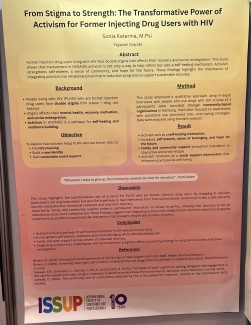
From Stigma to Strength: The Transformative Power of Activism for Former Injecting Drug Users with HIV
Injection drug users (IDUs) living with HIV/AIDS (PLWHA) often face multiple stigmas stemming from their HIV status and history of drug use. This stigma can impact their mental health, motivation to recover, and social integration. This...
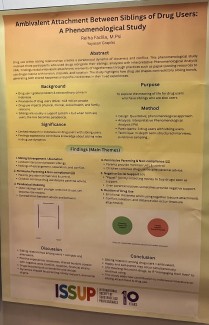
AMBIVALENT ATTACHMENT BETWEEN SIBLINGS OF DRUG USERS: A PHENOMENOLOGICAL STUDY
Using drugs is behavior that is not expected because of the bad impact on physical and mental health, especially to addiction. Especially when in a sibling relationship, there is more than one person who is using or addicted. This situation...
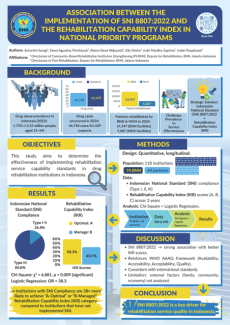
ASSOCIATION BETWEEN THE IMPLEMENTATION OF SNI 8807:2022 AND THE REHABILITATION CAPABILITY INDEX IN NATIONAL PRIORITY PROGRAMS
Background:
In 2023, the prevalence of drug abuse in Indonesia among the population aged 15–64 years reached 1.73%, equivalent to 3.33 million people. This problem has prompted The National Narcotics Board (BNN) as a government agency which...
New Psychoactive Substances: Finding and Legal Challenges in Indonesia
This presentation was featured at Indonesia 2025, on the 18.09.2025.
Authors:
Supiyanto 1 and Tanti 2
1 Chief of The Center of Narcotics Laboratory, National Narcotics Board of The Republic of Indonesia
2 Research Team Leader, Center of...
Navigating stigma: a qualitative study of barriers to opioid treatment engagement in Tanzania
Background
Stigma related to drug use is a well-documented barrier to engaging and remaining on medication for opioid use disorder (MOUD), yet little is known about how stigma operates across multiple social and institutional settings in...
Initial stakeholder perceptions around opioid settlement funds in Pennsylvania
Background
The opioid epidemic continues to pose significant challenges in the United States, with over 75% of nearly 107,000 drug overdose deaths in 2022 involving opioids. Recently, efforts to curb the epidemic have made strides...
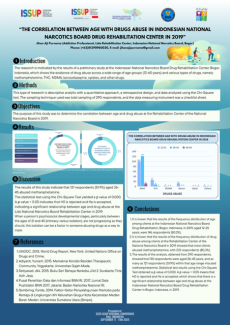
The Correlation Between Age With Drugs Abuse In Rehabilitation Center Of National Narcotics Board Lido 2019
The research is motivated by the results of a preliminary study at the Rehabilitation Center of National Narcotics Board Lido which shows the existence of drug abuse with a wide range of age groups at the age of 12-60 years and various...
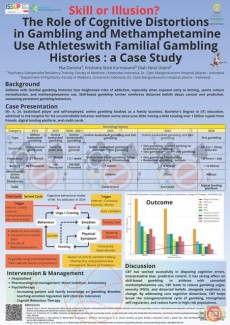
Skill or Illusion? The Role of Cognitive Distortions in Gambling Disorder and Methamphetamine Use Among Athletes with Familial Gambling Backgrounds
Introduction
Athletes with extensive sports knowledge may falsely believe that gambling outcomes can be predicted with skill. This cognitive distortion, combined with methamphetamine use and familial gambling exposure, increases the risk...