
تلاش
 Populations
Distinct groups of people within a society who share certain characteristics such as age, gender, geographic location, socioeconomic status, cultural background, or exposure to particular risk factors that may influence patterns of substance use, vulnerability to substance use disorders, and access to services. In the context of substance use systems, identifying and understanding different populations helps guide the design of prevention, treatment, recovery, and policy responses that are appropriate, equitable, and responsive to specific needs. Examples may include youth, women, people experiencing homelessness, individuals in the criminal justice system, or communities affected by specific social or economic conditions.

Contextual Factors Associated with Marijuana Use in School Population
ABSTRACT
Introduction: Marijuana use among the student population has increased in Mexico and Latin America. There are social, interpersonal and individual factors associated with the onset and continuation of marijuana use. These include...
Sexual Orientation and Estimates of Adult Substance Use and Mental Health
Abstract
Background: Research suggests that sexual minorities (e.g. people who identify as lesbian, gay, or bisexual) are at greater risk for substance use and mental health issues compared with the sexual majority population that...
Moderate Alcohol Consumption as Risk Factor for Adverse Brain Outcomes and Cognitive Decline
Abstract
Objectives: To investigate whether moderate alcohol consumption has a favourable or adverse association or no association with brain structure and function.
Design: Observational cohort study with weekly alcohol intake and...
"Does Red Bull Give Vodka Wings?"
 Credit: Nattu https://creativecommons.org/licenses/by/2.0/legalcode " data-entity-type="file" data-entity-uuid="c2856301-a3ca-4aa4-8756-7a0c62bfc6b6" src="/files/inline-images/3081506471_5120b39fa8_z.jpg">
New research that will be published in the new edition of the Journal of Consumer Psychology sets out to answer the question: ‘Does Red Bull Give Wings to Vodka?’
"Red Bull has long used the slogan 'Red Bull gives you wings,' but our...
Gender-Specific Predictors of At-Risk Adolescents’ Hazardous Alcohol Use
Abstract
Background
Previous research has found strong associations between adolescents’ hazardous alcohol use and their perception of peer behavior, as well as own spending money and a range of antisocial behaviors. However, there is...
Does the Effect of Alcohol on the Brain Differ between Men and Women?
New research published in the journal Psychiatry Research Neuroimaging has found that the effects of alcohol on the reward system in the brain may differ between men and women.
The reward system is a grouped structure in the brain that...
ISSUP Mexico 2017
At the beginning of April ISSUP’s Deputy Executive Director, Joanna Travis-Roberts, headed to Cancún, Mexico to plan for this year’s Annual ISSUP Workshop.

Estimation of National, Regional and Global Prevalence of Alcohol Use during Pregnancy and Fetal Alcohol Syndrome
Background
Alcohol use during pregnancy is the direct cause of fetal alcohol syndrome (FAS). We aimed to estimate the prevalence of alcohol use during pregnancy and FAS in the general population and, by linking these two indicators...
The Comparative Effectiveness of Outpatient Treatment for Adolescent Substance Abuse: A Meta-Analysis
Multi-prong therapies centred on the family emerge as probably the most effective in this comprehensive and careful synthesis of the results of trials of non-residential programmes for substance using teenagers - but do the outcomes warrant...
ISSUP Staff in the Spotlight: Jeff Lee
Over many years Jeff has undertaken and managed projects in more than 80 different countries around the world as well as taken the lead role in one national and two international organisations.

نوزائیدہ بچوں کے پرہیز سنڈروم کی روک تھام کے لئے صحت عامہ کی حکمت عملی: سی ڈی سی گرینڈ راؤنڈ
نوزائیدہ بچوں کے پرہیز سنڈروم کا عوامی صحت کا بوجھ
نوزائیدہ پرہیز سنڈروم (این اے ایس) ایک منشیات سے دستبرداری کا سنڈروم ہے جو عام طور پر نوزائیدہ بچوں میں اوپیوئڈز کی زد میں آنے کے بعد ہوتا ہے ، حالانکہ دیگر مادے بھی سنڈروم سے وابستہ ہیں (...
Can Drug Prevention Programmes Reduce Substance Use by Participants’ Friends?
Besides reducing substance use between its participants one prevention programme also reduced drug use among the friends of those who took part.
Effectiveness of the Gold Standard Programme Compared with Other Smoking Cessation Interventions in Denmark
Strengths and Limitations of this Study
-
This study was based on a large cohort of smokers from all regions and settings in Denmark. 46 287 smokers were included in the study, and the follow-up rate was high (74%).
-
The study was...
XR-Naltrexone: A Step-by-Step Guide
The Providers' Clinical Support System for Medication Assisted Treatment (PCSS-MAT) experts have recently created a virtual step-by-step XR-Naltrexone User Guide to assist you in your practice in treating opioid use disorder (OUD). XR...
The Drug Problem in the Americas: Drugs and Public Health
Summary and Findings
Most people do not use illicit drugs and among those who try them, only a fraction will develop patterns of dependence. Still, drug use constitutes a serious health problem for many people in the Americas. Early age of...
The Punjabi Problem: Drug Use in One of India’s Wealthiest Regions
According to the BBC, a recent government-conducted investigation suggests that more than 860,000 young men (15 – 35) in the Punjab region of India take drugs. This is three times the national average. Heroin is used by 53% of all...
خطرے کو کم کرنا: کمپیوٹر پر مبنی مداخلت وں کی تاثیر کا اندازہ لگانا
ایک نئی تحقیق سے پتہ چلتا ہے کہ کمپیوٹر پر مبنی مداخلت کے پروگرام شہری ماحول میں رہنے والے ابتدائی نوعمروں میں مادہ کے استعمال کے خطرے کو کم کرسکتے ہیں۔
Guidelines for the Identification and Management of Substance Use and Substance Use Disorders in Pregnancy
These guidelines contain recommendations on the identification and management of substance use and substance use disorders for health care services which assist women who are pregnant, or have recently had a child, and who use alcohol or...
Whole Family Recovery
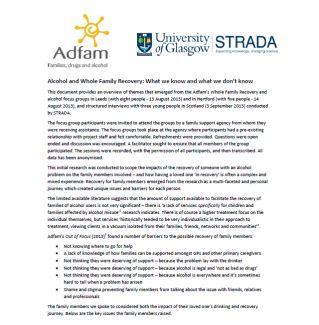
This document provides an overview of themes that emerged from the Adfam’s Whole Family Recovery and Alcohol Focus Groups and interviews. This research was conducted to scope the impacts of the recovery of someone with an alcohol problem on...
Adfam’s Manifesto for Families: 5 Key Challenges for Supporting Families Affected by Drug and Alcohol Use
“You don’t have to use drugs to be affected by them.”
In 2010 Adfam identified five key challenges for families that the Government should address, identified by stakeholders across England. They were:
- Supporting families in their own...