Galanter, M., White, W. L., Khalsa, J., & Hansen, H. (2024). A scoping review of spirituality in relation to substance use disorders: Psychological, biological, and cultural issues. Journal of Addictive Diseases, 42(3), 210–218. https://doi.org/10.1080/10550887.2023.2174785
This scoping review explores the role of spirituality in substance use disorders (SUD) across psychological, biological and cultural dimensions. It reviews research on topics including spiritual awakening, drugcraving, psychedelic-assisted psychotherapy, biological and neurological aspects of spiritual experiences, and the ways spirituality is understood across different cultural settings.
The review also considers the distinction between spirituality and religion and the role of spirituality in building recovery capital. While existing research points to several potentially important...
Hahn, J.L. (2025), Religion and Spirituality in AddictionRecovery. Religion Compass, 19: e70017. https://doi.org/10.1111/rec3.70017
This scoping review examines the role of spirituality in substance use disorders across three interconnected areas: psychology, biology, and culture. It explores topics including spiritual awakening, the relationship between spirituality and drugcraving, spirituality in psychedelic-assisted psychotherapy, and the psychological ways in which people understand substance use and recovery.
The review also considers biological research on spiritual experiences and brain processes, as well as cultural differences in how spirituality and religion relate to substance use and recovery. It highlights...
Yri, M., Brattgjerd, M. & Koefoed, A. From Darkness to Light: Spiritual Turning Points in Recovery among Former Substance Users in Norway. J Relig Health (2026). https://doi.org/10.1007/s10943-026-02695-2
This qualitative study explores how spiritual experiences contribute to recovery from substance use disorders among 24 people who completed Christian faith-based rehabilitation programmes in Norway. Participants described experiencing loss of identity, hopelessness, and emotional distress before entering rehabilitation.
Within faith-based communities, experiences of forgiveness, belonging, and unconditional acceptance were described as important spiritual turning points. Participants associated these experiences with renewed meaning, dignity, and a changed sense of identity. The study...
Rusdi Abd Rashid, Khosrow Kamali, Mohammad Hussain Habil, Mohamed Hatta Shaharom, Tahereh Seghatoleslam, Majid Yoosefi Looyeh, A mosque-based methadone maintenance treatment strategy: Implementation and pilot results, International Journal of Drug Policy, Volume 25, Issue 6, 2014, Pages 1071-1075, ISSN 0955-3959, https://doi.org/10.1016/j.drugpo.2014.07.003.
This study describes an Islamic-inspired methadone maintenance treatment programme delivered in a mosque setting for 36 Muslim men who used heroin. The programme combined methadone treatment with peer support and religious counselling, exploring whether mosques could provide an accessible community setting for substance use treatment and longer-term recovery support.
After 12 months, the programme had an 80% retention rate, and all but one participant tested negative for opioids and other substances. Participants also reported reductions in substance use and improvements in general health and...
In this second reading list, we continue exploring the growing evidence on the role and contribution of faith communities and faith-based organisations in addressing substance use and crime, with a particular focus on treatment engagement, recovery, rehabilitation, and criminal justice. While Part 1 highlighted the contribution of faith communities to prevention, community resilience, and violence reduction, this collection examines how spirituality and religiosity may influence help-seeking, substance use outcomes, abstinence, recidivism, and successful reintegration into society.
Koh HK, Frederick DE, Balboni TA, O'Reilly SM, Kelly JF, Humphreys K, Botticelli M, Mathur MB, Psimopoulos CS, Long KNG, VanderWeele TJ. Spirituality and Harmful or Hazardous Alcohol and Other Drug Use: A Meta-Analysis of Longitudinal Studies. JAMA Psychiatry. 2026 Apr 1;83(4):363-378. doi: 10.1001/jamapsychiatry.2025.4816. PMID: 41706493; PMCID: PMC12917744.
This meta-analysis synthesises evidence from 55 longitudinal studies involving more than 540,000 participants to examine the relationship between spirituality and harmful or hazardous alcohol and other drug (AOD) use. The findings demonstrate a consistent protective association, with spirituality linked to a 13% reduction in the risk of alcohol and other drug use across prevention and recovery outcomes. Among individuals who regularly participated in spiritual or religious communities, the protective effect increased to an 18% reduction in risk.
Mowen TJ, Stansfield R, Boman JH 4th. During, After, or Both? Isolating the Effect of Religious Support on Recidivism During Reentry. J Quant Criminol. 2018 Dec;34(4):1079-1101. doi: 10.1007/s10940-017-9366-5. Epub 2017 Sep 20. PMID: 32382211; PMCID: PMC7205271.
This study examines how religious support during and after incarceration influences substance use and recidivism among people returning to the community. Using data from the Serious and Violent Offender Reentry Initiative, the authors distinguish between individuals' initial levels of religious support while incarcerated and changes in religious support after release.
The findings show that increases in religious support during reentry are associated with lower levels of substance use after release. While baseline religious support alone did not reduce substance use or offending, individuals...
This article explores how faith-based recovery programs combine spiritual support with evidence-based addictiontreatment to help people achieve and maintain recovery. These programs integrate religious beliefs and practices with services such as detoxification, counselling, behavioural therapies, rehabilitation, and aftercare.
Faith-based approaches may provide additional benefits through shared values, community support, accountability, and opportunities to address feelings of shame and stigma often associated with substance use disorders. The article also highlights a range of faith...
This European guide by EUDA highlights the importance of addressing dual disorders, where mental health conditions and substance use disorders occur at the same time. These co-occurring conditions are common and often lead to poorer health outcomes, increased social marginalisation, and more complex recovery pathways.
The guide emphasizes that effective responses require integrated and coordinated care, bringing together mental health services, addictiontreatment, medication management, and social support. It also highlights the value of early identification, personalised treatment plans...
Yeung JWK. Faith-based intervention, change of religiosity, and abstinence of substance addicts. Braz J Psychiatry. 2022 Jan-Feb;44(1):46-56. doi: 10.1590/1516-4446-2020-1576. PMID: 34190824; PMCID: PMC8827378.
This study examines how changes in religiosity influence recovery outcomes among people in addictiontreatment. It finds that individuals in faith-based programs show higher and increasing levels of religiosity over time, which is linked to better abstinence outcomes after treatment.
While both faith-based and secular programs provide similar clinical support (e.g. counseling, social support), faith-based approaches add a strong spiritual dimension, which appears to strengthen long-term recovery. The findings highlight that religiosity is not static—its development over time plays an...
Sroková, V. & Kurilla, A. (2025). Ecological Momentary Assessment and Ecological Momentary Interventions in Substance Use DisordersRecovery. Adiktologie, 25(4), 205–212
INTRODUCTION: Ecological Momentary Assessment (EMA) can capture fluctuations in an individual’s recovery while minimizing recall bias by collecting real-time data in daily life. Ecological Momentary Interventions (EMIs) build on EMA to provide patients with timely, real-world support. This study aimed to familiarize practitioners with the m-Path app – a tool for delivering both EMA and EMIs – and to illustrate its acceptability through interviews with five patients who used it.
METHODS: In this study, five participants in recovery from substance use disorder tested the m-Path app for 31...
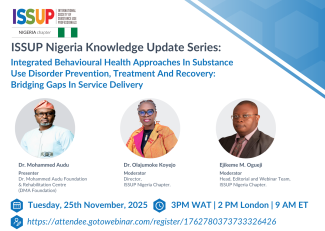
ISSUP Nigeria presents the 30th session of its bi-monthly webinar in the Knowledge Update Series. This webinar will focus on the topic 'Integrated Behavioural Health Approaches In Substance Use Disorder (SUD) Prevention, Treatment And Recovery: Bridging Gaps In Service Delivery'.
ISSUP Nigeria would like to invite you to the 30th session of its bi-monthly webinar in the Knowledge Update Series. This webinar will focus on the topic 'Integrated Behavioural Health Approaches In Substance Use Disorder (SUD) Prevention, Treatment And Recovery: Bridging Gaps In Service Delivery'.
This article presents key studies from the National Institute of Justice’s (NIJ) Courts Research Portfolio that examine pretrial, prosecution, and sentencing policies promoting alternatives to incarceration, such as Veterans Treatment Courts (VTCs) and other problem-solving courts. Collectively, these initiatives reflect NIJ’s long-standing collaboration with federal partners, court professionals, stakeholders, and research experts. The article also summarizes findings from NIJ’s Multisite Evaluation of VTCs and outlines recommendations for policy and future research. Together, these efforts...
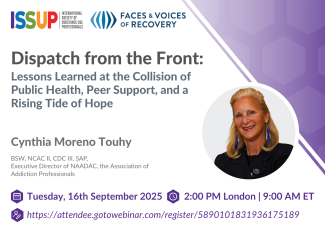
ISSUP Global, en colaboración con Faces & Voices of Recovery, presenta su seminario web, "Crónica desde la primera línea: Lecciones aprendidas en la intersección de la salud pública, el apoyo entre pares y una creciente ola de esperanza".
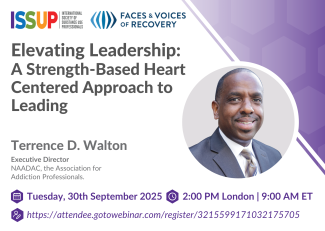
ISSUP Global, en colaboración con Faces & Voices of Recovery, le invita a la cuarta parte de su serie de seminarios web titulada 'Elevando el Liderazgo: Un Enfoque Basado en Fortalezas y Centrado en el Corazón para Liderar'.
ISSUP Global, en colaboración con Faces & Voices of Recovery, le invita a la cuarta parte de su serie de seminarios web titulada 'Crónica desde la primera línea: Lecciones aprendidas en la intersección de la salud pública, el apoyo entre pares y una creciente ola de esperanza'.