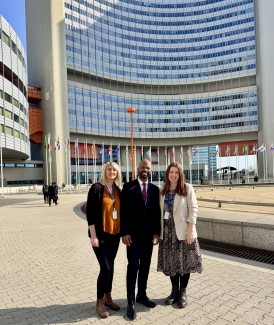
The Commission on Crime Prevention and Criminal Justice (CCPCJ) is shaping global responses to drug-related crime through stronger international cooperation and more integrated justice systems. There is increasing emphasis on multi-sector approaches that link justice, prevention,
treatment
, and
recovery
. In this context, ISSUP has expanded its engagement with law enforcement, courts, and policymakers as key partners. At the 2026 CCPCJ, ISSUP will contribute through a side event focused on strengthening justice systems and workforce capacity. This highlights ISSUP’s role in advancing coordinated, workforce-driven responses to drug-related crime.
A new chapter in training has begun at ISSUP. A new Training Team has been formed with the goal of improving the accessibility and relevance of ISSUP’s training, while ensuring it reflects the learning needs of members worldwide.
In the early months of its work, the team carried out a training needs assessment to better understand members’ online learning needs. At the same time, the team engaged with several Learning Management System (LMS) providers to explore options for a new platform that supports accessible, high-quality learning. The proposals received are now being reviewed.
The Canadian Centre on Substance Use and
Addiction
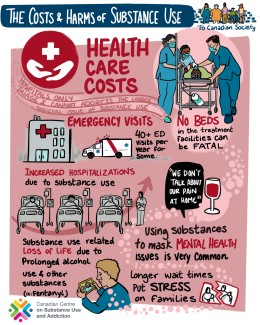
(CCSA) transforms complex data into insights that reflect real human experiences. Every aspect of the Canadian Substance Use Cost and Harms (CSUCH) project represents individuals with lived or living experience of substance use, along with their families, workplaces, and communities.
A new resource highlights these journeys and the human cost of substance use through illustrated stories from people with
lived experience
and their families. The illustrations cover three key areas of the CSUCH project: healthcare, lost productivity, and...
In this reading list, we provide resources to help engage our members with the latest knowledge, tools, and case studies on quality standards in substance use disorder
treatment
. These materials highlight international frameworks, research-backed practices, and country-level initiatives designed to improve access, strengthen systems, and ensure safe, ethical, and effective care.
Together, they offer a practical foundation for policy-makers, service providers, researchers, and healthcare professionals to reflect on what “quality” means in treatment and how to achieve it across diverse...
The 2025 Annual Report to the Parliament on Drug Addictions in Italy offers a comprehensive overview of the current drug
addiction
landscape. Despite a slight decline in youth drug use for the first time since 2018, the report highlights ongoing challenges, particularly with substances like cocaine, synthetic opioids, and high-potency cannabis derivatives. Law enforcement and judicial efforts remain strong, and Italy continues to be a key collaborator in global anti-drug initiatives, particularly with countries in South America and the Indo-Pacific region.
Recovery
is not a one-size-fits-all process—it is dynamic, multifaceted, and deeply individual. To truly support individuals on their recovery journey, practitioners must access tools, systems, and knowledge that reflect the realities of those they serve.
ISSUP, in collaboration with Faces & Voices of Recovery, has launched a new Global Recovery Network webinar series to spotlight diverse perspectives on recovery. The first webinar featured Dr. Haner Hernández, a respected expert in the field and a person in long-term recovery. Dr. Hernández currently serves as a Senior Consultant to the Massachusetts Department of Public Health and plays a key role in advancing health equity, workforce development, and recovery support. His presentation provided an insightful and inclusive overview of multiple pathways to recovery, grounded in both...
As we celebrate International Nurses Week, we honour the dedication, expertise, and compassion of nurses around the globe—especially those working on the frontlines of substance use prevention,
treatment
, and
recovery
support.
Addiction
nurses play a crucial role not only in clinical care but also in education,
advocacy
, and research.
Tomic D, Shaw JE, Magliano DJ. The burden and risks of emerging complications of diabetes mellitus. Nat Rev Endocrinol. 2022 Sep;18(9):525-539. doi: 10.1038/s41574-022-00690-7. Epub 2022 Jun 6. PMID: 35668219; PMCID: PMC9169030.
Abstract:
While the traditional complications of diabetes mellitus—such as cardiovascular disease—are well recognized, advances in
treatment
and increased life expectancy have revealed a new set of lesser-known complications that are becoming more prominent.
As mortality from vascular disease declines, conditions like cancer and dementia have emerged as leading causes of death among people with diabetes in several countries. In addition, growing evidence shows strong associations between diabetes and a range of comorbidities, including:
Richard S. Chaudhary, Melanie B. Turner, Laxmi S. Mehta, Nora M. Al-Roub, Sidney C. Smith, Dhruv S. Kazi; Low Awareness of Diabetes as a Major Risk Factor for Cardiovascular Disease in Middle- and High-Income Countries. Diabetes Care 23 February 2024; 47 (3): 379–383. https://doi.org/10.2337/dc23-1731
Objective:
Understanding that diabetes is a major risk factor for cardiovascular disease (CVD) may help increase diabetes screening and improve prevention efforts for CVD.
Overview:
The American Heart Association conducted an online survey across 50 countries to assess public awareness of the link between diabetes and CVD. The study looked at differences in awareness by sex, age, region, and country income level.
Key Findings:
Out of 48,988 respondents, only 32.1% recognized diabetes as a major risk factor for CVD.
Awareness was similar between men and women, but higher among older...
Lee, EH., Yu, HJ. Effectiveness of nurse-initiated smoking cessation intervention: a systematic review and meta-analysis. Subst Abuse Treat Prev Policy 20, 18 (2025). https://doi.org/10.1186/s13011-025-00648-8
Background
Smoking is one of the top causes of preventable death and is linked to many serious health problems, including cancer and chronic diseases. Nurses can play a big role in helping people quit smoking by offering support through counselling, education, and mental health care. These nurse-led programs have been shown to increase quit rates. Training nurses to deliver these programs is important, and reviewing past studies helps us understand what works best.
Methods
Researchers searched eight major health databases between March 27 and August 1, 2024, to find studies on nurse-led...
The UNODC #ScaleUp Initiative is a vital response to the growing global challenge of stimulant use disorders, which affect millions of individuals worldwide. In 2021, approximately 78 million people used substances like amphetamines, cocaine, or ecstasy non-medically, with stimulant use ranking as the second most common drug use worldwide. However, effective
treatment
options remain limited, with significant gaps in both access and equity, particularly for women. In response, UNODC launched the #ScaleUp initiative during the 2024 Commission on Narcotic Drugs (CND) session to scale up combined...
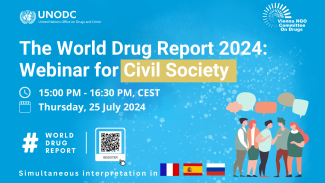
Learn about global drug trends from the authors of the World Drug Report 2024!
UNODC experts will present the World Drug Report 2024, giving an overview of the latest developments and diving into the most up-to-date global data. In the...
Temos o prazer de convidá-lo para um webinar discutindo o Relatório Global da Sociedade Civil. O relatório foi publicado em conjunto com o Comitê de Drogas da ONG de Nova York em preparação para a revisão intermediária de 2024 da Comissão de Entorpecentes e mostra os insights de mais de 200 ONGs.
Vienna and New York NGO Committees on Drugs (VNGOC & NYNGOC) 2024
The Vienna & New York NGO Committees on Drugs are pleased to present the global civil society report for the 2024 mid-term review of the Commission on Narcotic Drugs (CND). The report is the result of constructive inputs by more than 200 NGOs from all regions of the world, representing a wide range of expertise and perspectives on drug-related issues. It showcases the importance of meaningful civil society engagement in the formulation and implementation of drug policies on all levels, as well as the challenges and opportunities that civil society faces in this regard.
The Commission on Narcotic Drugs (CND) will hold on 14-15 March 2024 a High Level Segment to conduct the 2024 Mid-Term Review. The Review will focus on taking stock of the implementation of all existing international drug policy commitments and the work to accelerate the implementation of the commitments from 2024 to 2029.
The High Level Segment will consist of a General Debate and two multi-stakeholder roundtables on the topics of "Taking Stock: work undertaken since 2019" and "The way forward: the road to 2029".
For each roundtable up to 4 NGOs (1 panelist & 3 speakers 'from the floor')...