The 2026 UNODC World Drug Report highlights an increasingly complex global drug landscape, characterised by expanding synthetic drug markets, poly-drug use, and evolving public health and public safety challenges. In this ISSUP webinar, Giovanna Campello (UNODC) explored the report’s key findings and discussed what they mean for professionals working across prevention,
treatment
,
recovery
, policy, law enforcement, and criminal justice. This post summarises the key discussion points and practical implications for the global workforce. It also highlights the new interactive World Drug Report data platform as a valuable resource for evidence-informed policy and practice, with links to both the webinar recording and the full report.
Medina, Juanjo & Aldridge, Judith & Shute, Jon & Ross, Andy. (2013). Measuring gang membership in England and Wales: A latent class analysis with Eurogang survey questions. European Journal of Criminology. 10. 591-605. 10.1177/1477370813475393.
This study examines how gang membership is measured among young people using the Eurogang Network’s survey approach. Drawing on nationally representative data from England and Wales, the researchers used statistical analysis to identify different types of peer groups and assess whether commonly used survey questions accurately distinguish gang-involved youth.
The findings suggest that the Eurogang measures successfully identified a group of young people involved in more frequent and serious offending. However, the same measures also classified another group whose primary behaviour was...
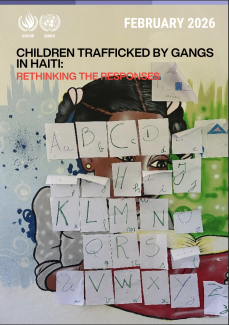
European Union Drugs Agency (2026), Addressing the recruitment of young people into criminal drugs networks, Publications Office of the European Union, Luxembourg.
This report examines how and why young people are recruited into criminal drug networks across Europe. It highlights the range of factors that can increase vulnerability to recruitment, including social and economic disadvantage, peer influence, family circumstances, and community environments.
Drawing on international evidence, the report identifies several promising approaches to prevention, including family-based support, school-based interventions, community engagement, digital prevention initiatives, and targeted efforts to disrupt criminal networks. It also emphasizes the importance of...
Maguire, Edward & Gordon, C.. (2015). Faith-Based Interventions for Reducing Gang Violence in the Caribbean: Reflections from a Professor and a Priest
This book chapter explores the role of faith-based interventions in preventing and reducing gang violence in Trinidad and Tobago. Drawing on the experiences of a criminologist and a religious leader, it argues that gang violence should be viewed not only as a criminal justice issue but also as a community challenge that requires coordinated responses from multiple sectors.
The chapter describes faith-based initiatives implemented in a community affected by gang violence and highlights how religious organizations can contribute through community engagement, social support, mentorship, and...
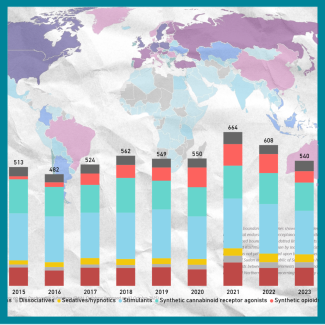
The UNODC Early Warning Advisory highlights a continued global expansion of new psychoactive substances (NPS), with nearly 1,400 substances reported worldwide. In 2024 alone, a record number of substances were identified, including over 100 newly detected compounds.
Synthetic opioids—particularly fentanyl analogues and nitazenes—are a growing concern, now reported across all regions. At the same time, benzodiazepine-type substances remain widely present in drug samples. A key emerging risk is polysubstance use, with a significant share of deaths involving multiple substances.
The second edition of F.O.C.U.S. – Future-Oriented Careers in Understanding Substance Use, is now live!
This special edition newsletter is created for early-career professionals and students stepping into the field of substance use.
In this edition, we’re spotlighting something you’ll feel quickly as you step into this work: the substance use field is truly multi-sectoral. It’s shaped by parents and teachers, schools and healthcare teams,
recovery
communities and people with
lived experience
, researchers and community organisations, law enforcement and policymakers, courts and governments...
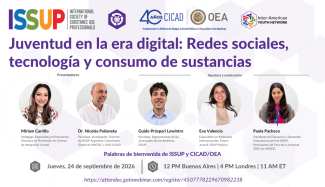
La ISSUP y la OEA/CICAD siguen fortaleciendo sus esfuerzos conjuntos para establecer y coordinar una Red Latinoamericana de Jóvenes Líderes. Esta iniciativa reúne a representantes juveniles de 10 países de la región, cada uno en representación de su respectivo Capítulo Nacional de la ISSUP.
La red busca garantizar que las voces de los jóvenes sean escuchadas activamente y se integren de manera significativa en las respuestas globales al consumo de sustancias y los desafíos relacionados con las drogas. Un enfoque clave es abordar la vulnerabilidad de la juventud al consumo de drogas y la...
ISSUP Mexico continues to advance its strategic agenda with a strong focus on empowering youth leaders in high-risk communities. This commitment was recently reinforced through the successful completion of the “Engaging Youth” training course, delivered in collaboration with OAS/CICAD.
A cohort of 30 young leaders from Mexico has now successfully completed the programme, marking a significant milestone in strengthening youth-led efforts. Through this initiative, participants have been equipped with the knowledge and tools to act as agents of change, working to reduce violence, substance use...
Al Khouri, I., Kaščáková, I. & Iannaccone, B. (2025). The Impact of the COVID-19 Pandemic on Gambling in Europe Adiktologie, 25(4), 213–224
INTRODUCTION: The COVID-19 pandemic disrupted Europe‘s gambling market, reshaping consumer behaviour, market structure, and regulatory priorities. Restrictions on land-based venues and the cancellation of major sporting events accelerated a shift to digital platforms, raising public health concerns.
METHODS: We conducted a secondary analysis of market-level quantitative data from the European Gaming and Betting Association (EGBA) and H2 Gambling Capital to assess changes in the EU-27 and the United Kingdom between 2019 and 2029.
RESULTS: Land-based revenues fell sharply in 2020, while...
Sitařová, P. & Obereignerů, R. (2025). Towards Comprehensive Sexuality Education in the Czech Republic: A Qualitative Study of Practitioners‘ Perspectives on Key Themes and Methods. Adiktologie, 25(4), 191–204
INTRODUCTION: This study explores the perspectives of Czech practitioners on sexuality education (SE) for upper primary school students (ISCED level 2). It focuses on the topics they consider relevant, including those currently underrepresented in school curricula as well as the approaches and methods they apply in practice. The framework of Comprehensive Sexuality Education (CSE) is used as a lens for interpreting their experiences and practices.
METHODS: Fourteen practitioners participated in two semi-structured focus groups (n = 4 per group, 8 in total) and six individual interviews...
The Canadian Centre on Substance Use and
Addiction
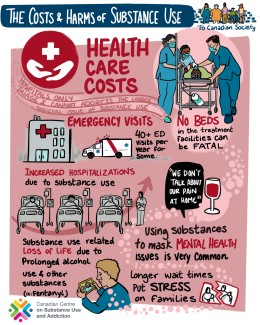
(CCSA) transforms complex data into insights that reflect real human experiences. Every aspect of the Canadian Substance Use Cost and Harms (CSUCH) project represents individuals with lived or living experience of substance use, along with their families, workplaces, and communities.
A new resource highlights these journeys and the human cost of substance use through illustrated stories from people with
lived experience
and their families. The illustrations cover three key areas of the CSUCH project: healthcare, lost productivity, and...
Ceresnik, M., Dolejs, M., Povazanova, B., Knazek, G., & Ceresnikova, M. (2024). Big Five Personality Traits of Adolescents aged 11–19 Years from the Czech and Slovak Republics: Age, Sex and Nationality Specifications. Adiktologie 24(4), pp-pp
The article explores basic personality characteristics in accordance with the Big Five inventory; it concerns the age category of adolescence, i.e. the ages 11–19. Particular attention is paid to the variables of age, sex, and nationality as factors contributing to the establishment of these personality characteristics. The research involved 2,830 adolescents aged 11–19. The average age was 14.89 (SD = 2.23). Participants attended lower or higher secondary education (ISCED 2 and 3) in the Czech Republic or the Slovak Republic. The research employed the Big Five Inventory BFI-10. While...
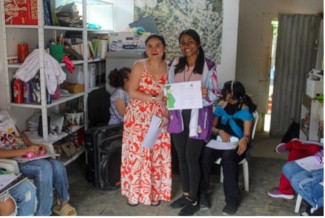
El proyecto Generación Sin Fronteras fue seleccionado como uno de los tres proyectos ganadores en el Foro de Jóvenes celebrado en Grecia en junio de 2024, destacando por su enfoque innovador y su compromiso con el bienestar de adolescentes en contextos vulnerables.
La iniciativa fue desarrollada por Daniela Junco Rocha, líder juvenil de ISSUP Colombia, con el acompañamiento del equipo de la Corporación Nuevos Rumbos, organización anfitriona de ISSUP en el país, y con el apoyo de la Fundación Princesas Guerreras en Cúcuta, primera ciudad receptora de población migrante venezolana en Colombia...
Lee, EH., Yu, HJ. Effectiveness of nurse-initiated smoking cessation intervention: a systematic review and meta-analysis. Subst Abuse Treat Prev Policy 20, 18 (2025). https://doi.org/10.1186/s13011-025-00648-8
Background
Smoking is one of the top causes of preventable death and is linked to many serious health problems, including cancer and chronic diseases. Nurses can play a big role in helping people quit smoking by offering support through counselling, education, and mental health care. These nurse-led programs have been shown to increase quit rates. Training nurses to deliver these programs is important, and reviewing past studies helps us understand what works best.
Methods
Researchers searched eight major health databases between March 27 and August 1, 2024, to find studies on nurse-led...
This week, we say goodbye to our dear friend and mentor, Jeff Lee, the founding Executive Director of ISSUP. Jeff was a steadfast advocate for the professionalization of prevention, insisting that those working in this field should be appropriately specialized. He often reminded us that while generalists and
treatment
specialists are well-meaning and deeply embedded within their communities, they are not always best placed to develop and implement evidence-based prevention systems. Jeff emphasized that prevention must be treated as a distinct science—one that is grounded in rigorous research...
El martes 15 de octubre se dio inicio al Foro juvenil líderes en prevención del uso de sustancias en Guatemala en modalidad virtual. La actividad dirigida a jóvenes entre 18 y 26 años busca que los participantes se apropien de las estrategias para desarrollar proyectos de prevención del consumo de sustancias, las cuales sean basados en evidencia e impacten en su entorno próximo. Con ello los jóvenes asumen un rol protagónico en la prevención del uso de sustancias, para ser agentes clave para el desarrollo de iniciativas, adquiriendo conocimientos y habilidades que podrán transferir a otras...
ISSUP Uganda, ISSUP Kazajistán e ISSUP Colombia les invitan a un webinar conjunto sobre Voces juveniles en la gestión del uso de sustancias: retos y oportunidades
Banárová, K., Čerešník, M., & Pipová, H. (2022). Avoidance, anxiety towards parents, and self-acceptance of adolescents in the system of higher secondary education. Adiktologie, 22(2), 82–93. https://doi.org/10.35198/01-2022-002-0001
BACKGROUND:
A close relationship between a parent and a child and parental acceptance can mediate the appropriate self-acceptance of an adolescent, which is an important variable related to personality and a pillar of emotional health. In the paper we present the conclusions of a research study about the quality of the attachment towards parents and self-acceptance of adolescents at Czech secondary schools.
AIMS:
The aim of the study was the exploration of the relation between the attachment style and self-acceptance.
SAMPLE:
The research sample consists of 3,239 adolescents aged 15–19 in...