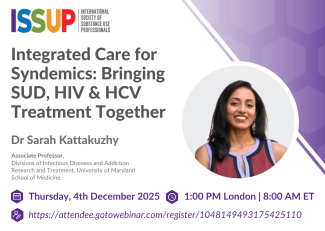
ISSUP hosted a webinar on 4 December 2025 with Dr Sarah Kattakuzhy, exploring integrated care for the syndemic of SUD, HIV, and HCV. She highlighted that these conditions often occur together and intensify one another, making siloed approaches ineffective. The session showcased strong evidence that integrated care models; whether co-located, mobile, telemedicine-supported, or provider-integrated; improve treatment uptake, viral suppression, and HCV cure rates. Case studies illustrated how person-centred, joined-up care strengthens trust, stability, and quality of life. The discussion emphasized the significant opportunity to scale integrated, flexible, and humane care models across diverse health systems.
As we celebrate International Nurses Week, we honour the dedication, expertise, and compassion of nurses around the globe—especially those working on the frontlines of substance use prevention, treatment, and recovery support. Addiction nurses play a crucial role not only in clinical care but also in education, advocacy, and research.
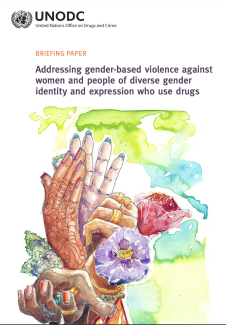
This briefing paper aims to raise awareness about the widespread and severe impact of GBV on women and people of diverse gender identity and expression who use drugs, as well as the strong connection between GBV and the HIV epidemic within these populations. It outlines practical responses that harm reduction providers and allied services can adopt to address violence and support the rights and health of these groups. The paper also demonstrates how a gender-responsive approach to drug use can improve outcomes for women and gender-diverse individuals by reducing harm, increasing access to...
Gleason-Comstock, J., Calhoun, C.B., Locke, B.J. et al. People who use drugs engagement in substance use disorder services and harm reduction: evaluation, challenges and future direction of a community-based intervention. Subst Abuse Treat Prev Policy 19, 24 (2024). https://doi.org/10.1186/s13011-024-00601-1
Background:
Since 1996, an urban community-based organization has been providing screening, testing, overdose prevention, referrals, and access to treatment for substance use disorders (SUD) and communicable diseases such as HIV through its Life Points harm reduction program.
Methods:
In 2021, the organization recruited a convenience sample of people who use drugs for a survey focused on substance use, healthcare, and barriers to SUD services. Community health workers conducted outreach and collected data using an encrypted identifier. Paper surveys were entered into Qualtrics for analysis...
Gleason-Comstock, J., Calhoun, C.B., Locke, B.J. et al. People who use drugs engagement in substance use disorder services and harm reduction: evaluation, challenges and future direction of a community-based intervention. Subst Abuse Treat Prev Policy 19, 24 (2024). https://doi.org/10.1186/s13011-024-00601-1
Background
Since 1996, an urban community-based organisation whose primary mission is to serve diverse94 and emerging community health needs has provided screening, testing, overdose prevention and training, referrals, and access to treatment for substance use disorders (SUD) and communicable diseases such as HIV through its Life Points harm reduction program.
Methods
As a partner in a State survey in 2021, the community organisation recruited a convenience sample of people who use drugs to participate in a survey focused on their substance use, healthcare, and barriers to SUD services...
ISSUP Indonesia, ISSUP Malaysia and ISSUP Philippines, in collaboration with ITTC, present its joint webinar series on the use of Amphetamine-type stimulants (ATS) in the Asian region. This is Part I of a three-part webinar series on Stimulant Use
International Network on Health and Hepatitis in Substance Users
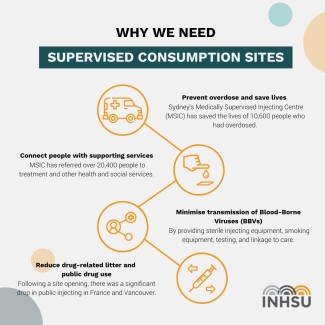
At the 10th International Conference on Health and Hepatitis in Substance Users, held in Glasgow, Scotland, international policymakers gathered to discuss the global overdose crisis and the role that supervised consumption sites can play in helping end these needless and preventable deaths.
The policy brief
A new policy brief is now available that summarises the day’s discussions and provides a starting point for those wanting to know more about supervised consumption rooms and their impact.
El 17 de octubre de 2022 en Harare, República de Zimbabue, se confirió a Zimbabue el derecho a acoger la 22ª edición de la Conferencia Internacional sobre el Sida y las ITS en África bajo el liderazgo efectivo de Su Excelencia, el Dr. E. D...
Harm Reduction International (HRI) y la Iniciativa Clinton de Acceso a la Salud (CHAI), en colaboración con la Secretaría de la Organización Mundial de la Salud (OMS), se complacen en invitarle a participar en un seminario web sobre la...
Este seminario web se lleva a cabo bajo la iniciativa conjunta de ISSUP Ucrania, el Centro de Salud Pública del Ministerio de Salud de Ucrania y la ICF "Alianza para la Salud Pública".
El PTTC del Sureste, en asociación con Carolinas CARE Partnership, presenta "VIH A a Z: Una capacitación interactiva para proveedores de prevención y tratamiento" el 6 de junio de 9 a.m. a 4 p.m.
INHSU 2023 facilitará los aprendizajes de la comunidad científica, los proveedores de atención médica, los profesionales de la salud pública y la comunidad de personas que usan drogas.
Conéctese con una comunidad global dedicada a la salud...
The Covid pandemic, the war in Ukraine and other ongoing conflicts in the world, have globally disrupted health services and affected treatment and psychosocial care of people living with HIV.
La 12ª Conferencia IAS sobre Ciencia del VIH tendrá lugar en Brisbane, Australia, y virtualmente del 23 al 26 de julio de 2023. IAS 2023, que se celebrará en el Centro de Convenciones y Exposiciones de Brisbane, destacará los avances...
World AIDS Day takes place in December each year. This reading list contains a list of research, publications and resources for practitioners relating to HIV/Aids. We also have a network dedicated to HIV and HCV where you can find a collection of further reading.
UNODC has developed a series of publications relating to Drug use and HIV. Here, you can find out more about the work that UNODC has done relating to drug use and HIV; prisons and HIV; HIV and the sustainable development goals; and critical enablers.
The purpose of this publication, which was also developed by UNODC, is to provide...
People with mental illness and/or SUD are disproportionally affected by HIV. They may participate in behaviours that increase risk for contracting and transmitting HIV, such as sharing injection drug equipment or engaging in sexual behaviours that increase HIV risk. This guide addresses the co-occurrence of HIV and mental illness and/or SUD. It reviews effective programs and practices to prevent HIV and, for those with HIV, to increase linkage and retention in care in order to improve health outcomes.
Haldane, V., Jung, A. S., De Foo, C., Shrestha, P., Urdaneta, E., Turk, E., … & Legido-Quigley, H. (2022). Integrating HIV and substance misuse services: a person-centred approach grounded in human rights. The Lancet Psychiatry. https://doi.org/10.1016/S2215-0366(22)00159-6
Integrating HIV-related care with treatment for substance use disorder provides an opportunity to better meet the needs of people living with these conditions. People with substance use disorder are rendered especially vulnerable by prevailing policies, structural inequalities, and stigmatisation.
In this Series paper, the authors analyse existing literature and empirical evidence from scoping reviews on integration designs for the treatment of HIV and substance use disorder, to understand barriers to and facilitators of care integration and to map ways forward.
This side event for the 65th Commission on Narcotic Drugs was originally presented on 14 March, 2022. Organised by INPUD, it was co-sponsored by Médecins du Monde, UNAIDS, UNODC HIV/AIDS Section, the Netherlands and Australia.
In 2021, thanks to significant advocacy work by people who use drugs and other key population networks, both the Global AIDS Strategy 2022-2026 and the 2021 Political Declaration on HIV and AIDS committed Member States to fulfill bold new targets on ‘social enablers’ which have significant implications concerning drug policy.