The 2026 UNODC World Drug Report highlights an increasingly complex global drug landscape, characterised by expanding synthetic drug markets, poly-drug use, and evolving public health and public safety challenges. In this ISSUP webinar, Giovanna Campello (UNODC) explored the report’s key findings and discussed what they mean for professionals working across prevention,
treatment
,
recovery
, policy, law enforcement, and criminal justice. This post summarises the key discussion points and practical implications for the global workforce. It also highlights the new interactive World Drug Report data platform as a valuable resource for evidence-informed policy and practice, with links to both the webinar recording and the full report.
Jones AA, Webb FJ, Lasopa SO, Striley CW, Cottler LB. The Association Between Religiosity and Substance Use Patterns Among Women Involved in the Criminal Justice System. J Drug Issues. 2018 Jul 1;48(3):327-336. doi: 10.1177/0022042618757208. Epub 2018 Feb 19. PMID: 33814600; PMCID: PMC8015967.
This study explores the relationship between religiosity and substance use patterns among women involved in the criminal justice system. Using data from women participating in a drug court programme in the United States, the researchers found that higher levels of religiosity were associated with a lower likelihood of cocaine use, either alone or in combination with cannabis.
The findings suggest that religiosity may serve as a protective factor for some forms of substance use, although the same association was not observed for cannabis use alone. Other factors linked to substance use...
This article explores how faith-based
recovery
programs combine spiritual support with evidence-based
addictiontreatment to help people achieve and maintain recovery. These programs integrate religious beliefs and practices with services such as detoxification, counselling, behavioural therapies,
rehabilitation
, and aftercare.
Faith-based approaches may provide additional benefits through shared values, community support, accountability, and opportunities to address feelings of shame and
stigma often associated with substance use disorders. The article also highlights a range of faith...
Koh HK, Frederick DE, Balboni TA, O'Reilly SM, Kelly JF, Humphreys K, Botticelli M, Mathur MB, Psimopoulos CS, Long KNG, VanderWeele TJ. Spirituality and Harmful or Hazardous Alcohol and Other Drug Use: A Meta-Analysis of Longitudinal Studies. JAMA Psychiatry. 2026 Apr 1;83(4):363-378. doi: 10.1001/jamapsychiatry.2025.4816. PMID: 41706493; PMCID: PMC12917744.
This meta-analysis reviewed 55 longitudinal studies involving more than 540,000 participants to examine the relationship between spirituality and harmful or hazardous alcohol and other drug use. The findings show that spiritual and religious involvement is associated with a 13% reduction in the risk of substance use and related harms, with even stronger protective effects among individuals who regularly participate in religious communities.
The protective association was observed across alcohol, tobacco, cannabis, and other illicit drugs, and was linked to both prevention of substance use and...
The Partnership center for faith and oportunity initiatives - U.S. Department of Health and Human Services
This practical toolkit highlights the role of faith-based and community leaders in responding to the opioid crisis in the United States. Developed by the U.S. Department of Health and Human Services, it recognizes that community and faith organizations are often among the first to support individuals and families affected by
addiction
.
The toolkit encourages local action through prevention,
recovery
support, and community engagement, while emphasizing compassion, hope, and partnership. It also reflects growing recognition that addressing opioid use disorder requires collaboration between...
Grim, B.J., Grim, M.E. Belief, Behavior, and Belonging: How Faith is Indispensable in Preventing and Recovering from
Substance Abuse
. J Relig Health 58, 1713–1750 (2019). https://doi.org/10.1007/s10943-019-00876-w
This study reviews evidence on the role of faith and spirituality in preventing substance use and supporting
recovery
. It highlights that many
addictiontreatment
programs in the United States include a spiritual component, particularly through 12-step models that emphasize support from a Higher Power.
The research finds that faith-based recovery programs and congregation-led support groups provide significant social and economic value, contributing substantial savings through volunteer-led recovery support services. Most studies reviewed also suggest that faith is generally associated with...
Yeung JWK. Faith-based intervention, change of religiosity, and
abstinence
of substance addicts. Braz J Psychiatry. 2022 Jan-Feb;44(1):46-56. doi: 10.1590/1516-4446-2020-1576. PMID: 34190824; PMCID: PMC8827378.
This study examines how changes in religiosity influence
recovery
outcomes among people in
addictiontreatment
. It finds that individuals in faith-based programs show higher and increasing levels of religiosity over time, which is linked to better abstinence outcomes after treatment.
While both faith-based and secular programs provide similar clinical support (e.g. counseling, social support), faith-based approaches add a strong spiritual dimension, which appears to strengthen long-term recovery. The findings highlight that religiosity is not static—its development over time plays an...
ISSUP was pleased to host a global webinar titled “Faith Communities and Religion in Addressing Substance Use” bringing together a diverse audience of professionals working in substance use and drug-related crime issues, alongside community and religious leaders, policymakers, and researchers.
The strong participation highlighted the importance of coordinated, inter-sectoral approaches to addressing substance use in a comprehensive and sustainable way.
At ISSUP, we remain committed to strengthening the global workforce and promoting evidence-informed practices across the full continuum of...
Sroková, V. & Kurilla, A. (2025). Ecological Momentary Assessment and Ecological Momentary Interventions in Substance Use Disorders
Recovery
. Adiktologie, 25(4), 205–212
INTRODUCTION: Ecological Momentary Assessment (EMA) can capture fluctuations in an individual’s recovery while minimizing recall bias by collecting real-time data in daily life. Ecological Momentary Interventions (EMIs) build on EMA to provide patients with timely, real-world support. This study aimed to familiarize practitioners with the m-Path app – a tool for delivering both EMA and EMIs – and to illustrate its acceptability through interviews with five patients who used it.
METHODS: In this study, five participants in recovery from substance use disorder tested the m-Path app for 31...
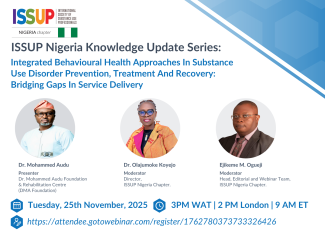
ISSUP Nigeria would like to invite you to the 30th session of its bi-monthly webinar in the Knowledge Update Series. This webinar will focus on the topic 'Integrated Behavioural Health Approaches In Substance Use Disorder (SUD) Prevention,
Treatment
And
Recovery
: Bridging Gaps In Service Delivery'.
ISSUP Global, en colaboración con Faces & Voices of Recovery, presenta su seminario web, "Elevando el Liderazgo: Un Enfoque Basado en Fortalezas y Centrado en el Corazón para Liderar".
ISSUP Global, en colaboración con Faces & Voices of Recovery, le invita a la cuarta parte de su serie de seminarios web titulada 'Crónica desde la primera línea: Lecciones aprendidas en la intersección de la salud pública, el apoyo entre pares y una creciente ola de esperanza'.
Welcome to a special edition on
recovery
support! Recovery extends beyond individual transformation. It reflects a collective responsibility to establish robust systems of care, foster supportive communities, and create effective pathways to sustained wellbeing.
ISSUP Global, en colaboración con Faces & Voices of Recovery, presenta su seminario web, "Importancia de la experiencia vivida en un sistema de atención orientado a la recuperación".
ISSUP Global, en colaboración con Faces & Voices of Recovery, le invita a la cuarta parte de su serie de seminarios web titulada 'Las palabras importan: lenguaje y reducción del estigma'.
Recovery
is not a one-size-fits-all process—it is dynamic, multifaceted, and deeply individual. To truly support individuals on their recovery journey, practitioners must access tools, systems, and knowledge that reflect the realities of those they serve.
This report from the Centre of Excellence for Women’s Health reviews what we know about women’s substance use
treatment
and
recovery
in Canada. It highlights the need for
trauma
-informed, culturally sensitive, and family-focused care. Since women-centred treatment has been under-researched and underfunded, the report brings together researchers, service providers, and organisations to discuss current evidence and identify key research priorities. The discussion focuses on four main areas essential to women’s recovery, emphasising Indigenous principles of purpose, belonging, hope, and...