
بحث
Treatment Settings
Various treatment formats, either in a live-in facility or through regular visits to a clinic, are designed for ongoing support, to help maintain recovery, and to prevent relapse.

From Evidence to Action: Building Partnerships to Strengthen the Drug Demand Reduction Strategy
Grounded in UNODC research—particularly the World Drug Report on synthetic trends, polydrug use, and treatment gaps—this presentation translates evidence into a partnership blueprint for stronger drug demand reduction (DDR).
Getting to Know Joanna Travis-Roberts Pt.1
Building the Future Together: Joanna Travis-Roberts on 10 Years of ISSUP
A special three-part series celebrating 10 years of the International Society of Substance Use Professionals (ISSUP).
In this first episode, host Associate...

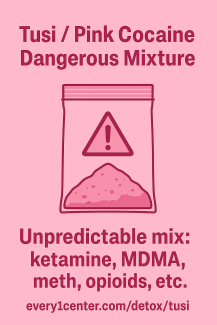
⚠️ Tusi (“Cocaína Rosa”): Qué es, Riesgos y Dónde Obtener Ayuda
⚠️ Tusi (“Cocaína Rosa”): Qué es, Riesgos y Dónde Obtener Ayuda
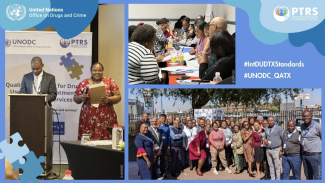
Health And Hope: Reflecting On Progress In Developing The Quality Assurance Mechanism For The Treatment Of Drug Use Disorders In South Africa
UNODC is collaborating with South Africa to enhance the quality and effectiveness of drug use disorder treatment, ensuring services align with the International Standards for the Treatment of Drug Use Disorders. Through training, workshops...
Codeine Crisis To Care: How UNODC’s Quality Assurance Mechanisms Redefined Drug Treatment Services In Dawanau, Kano
What started with a BBC documentary exposing the harsh realities of Nigeria’s codeine crisis has since become a powerful story of change. In Kano State, UNODC, with support from the European Union, introduced Quality Assurance mechanisms...

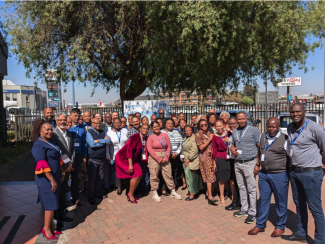
Enhancing Quality Assurance Mechanisms For The Treatment Of Drug Use Disorders – Workshop On Adaptation Of Key Quality Standards For Service Appraisal For The Treatment Of Drug Use Disorders In South Africa
In August 2024, UNODC convened policymakers and treatment managers in Johannesburg for a workshop on adapting Key Quality Standards for drug use disorder treatment. The meeting, held in partnership with South Africa’s Department of Social...
25 Professionals Trained On The UNODC Drug Use Disorder Treatment Systems Quality Assurance Toolkit To Improve Quality Of Care And Ultimately The Life Of People With Drug Use Disorders In Serbia
In June 2023, UNODC Serbia, with support from the Ministry of Health and international partners, hosted a training in Belgrade on quality assurance for drug use disorder treatment systems. Based on the UNODC-WHO International Standards and...

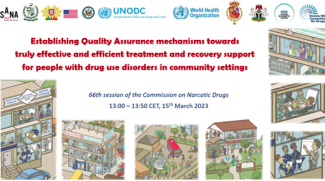
The Meaning of Quality in Drug Treatment, Care, and Rehabilitation
At the 66th Commission on Narcotic Drugs in March 2023, UNODC, together with international partners, hosted a side event on strengthening quality assurance in the treatment and recovery support of people with drug use disorders. Experts...
Global Launch – Universal Nurses Addiction Curriculum (UNAC)
On June 26, 2025, the International Consortium of Universities for Drug Demand Reduction (ICUDDR) marked an important milestone with the global launch of the Universal Nurses Addiction Curriculum (UNAC). This initiative, supported by the U...
ISSUP Nigeria Knowledge Update Series (29th Session): Beyond Tokenistic Roles: Harnessing The Power of Young People in Drug Use Prevention
ISSUP Nigeria presents the 29th session of its bi-monthly webinar in the Knowledge Update Series. This webinar will focus on the topic 'Beyond Tokenistic Roles: Harnessing The Power of Young People in Drug Use Prevention'.
A Review of the Quality of Drug Treatment, Sustained Recovery and Related Support Services based on data submitted in the Annual Report Questionnaire collections in 2020 and 2021
In 2021, the Commission on Narcotic Drugs (CND) called on UNODC, alongside Member States and partners, to assess the quality of drug prevention, treatment, sustained recovery, and related support services worldwide. This report uses data...
The Relationship Between Person-Centred Care for Substance Use Disorders and Service Outcomes: a Systematic Scoping Review
This Discussion Paper, prepared by UNODC, aligns with key international policy frameworks, including CND resolutions 59/4 and 64/3. These resolutions highlight the importance of developing and disseminating international standards for the...
The Relationship Between Quality of Specialist Treatment for Substance Use Disorders and Patient Outcomes: A Scoping Review of the Literature
This Discussion Paper, prepared by UNODC, aligns with key international policy frameworks, including Commission on Narcotic Drugs (CND) resolutions 59/4 and 64/3. These resolutions emphasise the development and dissemination of...
Quality Assurance In Treatment For Drug Use Disorders: Key Quality Standards For Service Appraisal
Improving the quality and coverage of treatment for drug use disorders is a global health priority, highlighted in the United Nations Sustainable Development Goals. To support this, the Key Quality Standards for Drug Use Disorder Treatment...
Quality Assurance for Drug Use Disorder Treatment
Over 38 million people worldwide are living with drug use disorders, yet only a fraction have access to appropriate treatment. These disorders place a heavy burden on individuals, families and communities, and their wider social costs –...
International Standards for the Treatment of Drug Use Disorders
The International Standards for the Treatment of Drug Use Disorders, developed by UNODC and WHO, provide guidance for countries to strengthen evidence-based, ethical and effective treatment systems. They are designed for policymakers...
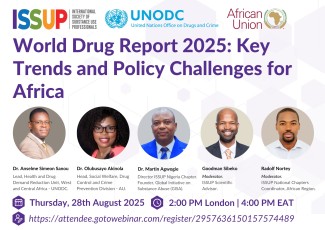
World Drug Report 2025: Webinar on Key Trends and Policy Challenges for Africa
As a follow-up to our previous webinar outlining the Key Findings of the World Drug Report 2025, ISSUP on 28 August 2025 presented a review of the World Drug Report 2025 through an African lens. The webinar was moderated by Radolf Nortey...
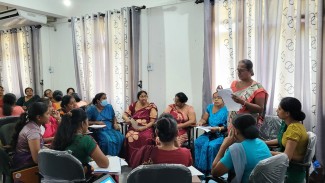
Three-day Teacher TOT, Second Phase in Kurunagala District
Preventive Education and Training Division of National Dangerous Drugs Control Board collaboratively with Ministry of Health, Sri Lanka has conducted a Three-day TOT program for counseling teachers in kurunagala District (Second Phase).
S...

Three-day Teacher TOT Program, First Phase in Kurunagala District
Preventive Education and Training Division of National Dangerous Drugs Control Board collaboratively with Ministry of Health, Sri Lanka has conducted a Three-day TOT program for counseling teachers in kurunagala District.
Substance abuse...
Council of the European Union (1999), Point of Departure and Work Programme of the Horizontal Working Party on Drugs (HDG) for the First Half of 1999 under the German Presidency
In 1999, the EU highlighted the growing threat of drug abuse and trafficking, noting a sharp rise in cocaine, amphetamines, and synthetic drugs like ecstasy. Reports at the time showed that no Member State was spared from these challenges.
...