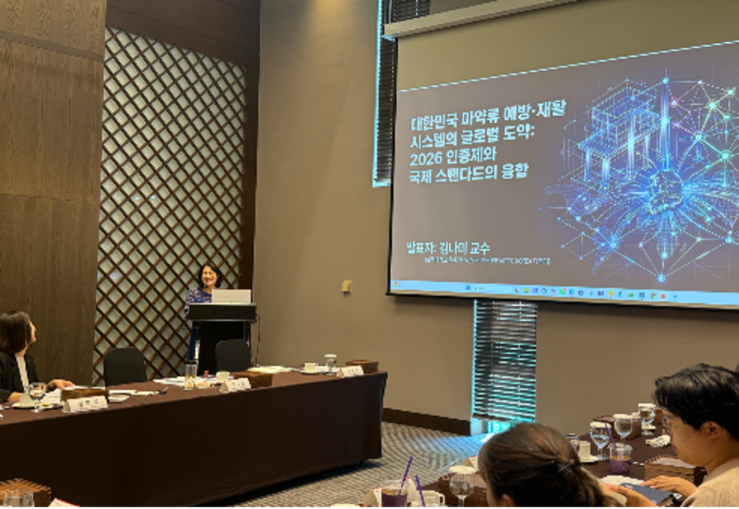
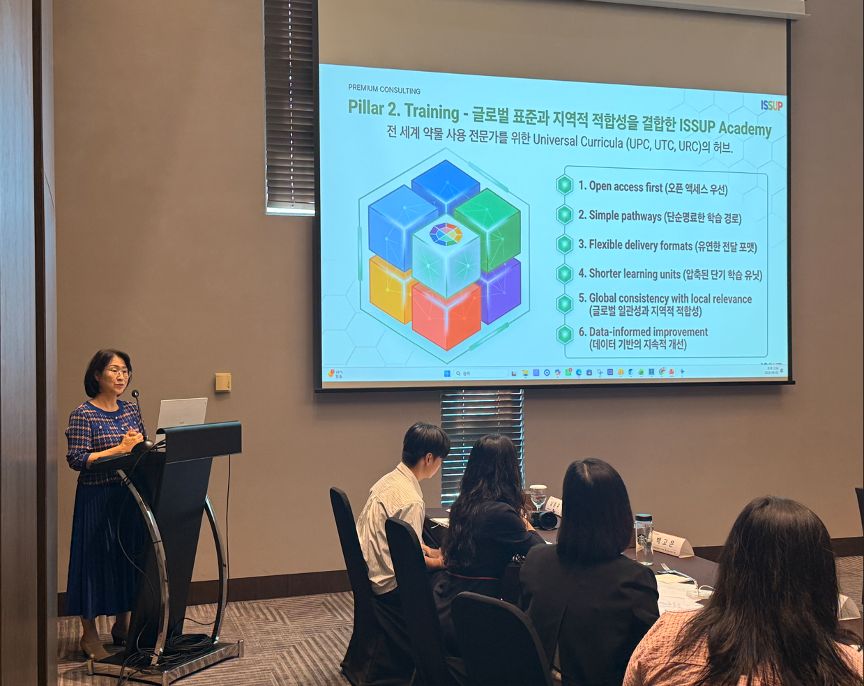
SEOUL, SOUTH KOREA — Marking the third anniversary of South Korea’s national Addiction Prevention and Rehabilitation Certification System, ISSUP Korea and ITTC Korea hosted a strategic training session to introduce global evidence-based standards. Delivered by Prof. Nami Kim (Director of ISSUP/ITTC Korea), the two-hour session invited senior policymakers and executives from the Ministry of Food and Drug Safety (MFDS), the Korea Association Against Drug Abuse (KAADA), and the Korea Institute of Drug Safety & Risk Management (KIDS) to explore potential future avenues for workforce development.
As South Korea conducts its three-year mid-term evaluation of the national certification system, the session offered a comparative overview against global benchmarks supported by ISSUP, ICUDDR, and the Center for Credentialing & Accreditation (CCA).
Key Areas of Policy Interest (Exploratory Discussions):
- Positive Reception of Universal Curricula (UC): Participants noted the scientific rigor of the UPC, UTC, and URC, showing strong interest in clinical modules such as Motivational Interviewing (MI), CBT, and WHO-validated screening tools (ASSIST/DAST).
- Exploratory Interest in an In-Country ICAP Center: Attendees demonstrated keen interest in the concept of a domestic ICAP Examination Center, discussing its potential long-term value for international recognition of Korean specialists.
- Potential Alignment in Continuing Education (CE): Stakeholders expressed interest in further exploring how international UC modules might serve as a helpful reference for South Korea’s ongoing professional development programs.
"The session provided a valuable foundation to introduce international frameworks to key national stakeholders. We look forward to continued dialogue on how these global models might inform South Korea's evolving workforce vision," stated Prof. Nami Kim.