

खोज
 Public Health
The organised efforts of governments, health systems, and communities to prevent substance-related harms, promote wellbeing, and improve population health outcomes. A public health approach focuses on prevention, early intervention, treatment, recovery support, and harm reduction, while also addressing the social, economic, and environmental factors that influence substance use. It relies on surveillance data, evidence-based interventions, policies, and cross-sector collaboration to reduce the overall burden of substance use disorders and promote healthier communities.


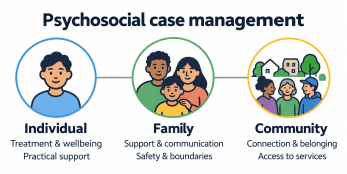
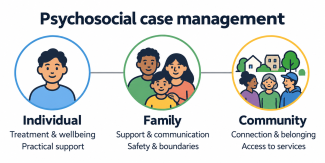
Psychosocial case management: connecting treatment, relationships and community recovery
Psychosocial case management connects evidence-based treatment with the practical and relational support needed for sustained recovery.
Its clearest benefits are helping people access services and remain engaged in care.
Individual care should consider housing, mental health, meaningful activity and continuity of support after discharge.
Families and affected communities also need support, with involvement guided by consent, safety and individual circumstances.
For treatment and prevention, interventions should address identified needs, draw on relevant evidence and be reviewed as circumstances change.
Para-Methoxymethamphetamine (PMMA) in tablets sold as ecstasy: Why this matters across our workforce
UNODC reports increasing PMMA detections in tablets sold as ecstasy in Europe, raising serious toxicity concerns. The alert encourages coordinated information sharing across prevention, treatment, recovery and law enforcement. It does not confirm local circulation, but prompts a review of local early warning responses.

Connecting Evidence, Prevention, Law Enforcement and Community Action: Key Insights from ISSUP 2026
How do we go about translating evidence into effective action, strengthen prevention, address drug-related crime, improve access to treatment and recovery support, and build safer, healthier communities?
This age-old question was explored...

Faith-Based Approaches: The Role of Faith and Religious Institutions in Addressing Substance Use
Faith, spirituality and faith-based organisations can play an important role in addressing substance use, supporting recovery and responding to related vulnerabilities as well as crime. Across different cultural and community settings, they...
Addressing Youth Substance Use and Crime: Risk Factors and Strategies
Protecting young people from substance use and crime: building safer communities and pathways to support
Young people's involvement in substance use and crime cannot be understood without considering the environments in which they grow up...
From Evidence to Practice: Advances in Substance Use Disorder Care
Evidence-based interventions can improve prevention, treatment and recovery outcomes, but knowing what works does not guarantee that people will benefit. Effective responses depend on trained professionals, supportive systems, coordinated...
WHO Expert Committee on Drug Dependence: forty-eighth report
The forty-eighth meeting of the WHO Expert Committee on Drug Dependence (ECDD) was convened from 20 to 22 October 2025 and was coordinated from WHO headquarters in Geneva. The forty-eighth WHO ECDD critically reviewed four substances...
Hidden risks in mental health services: Workplace drivers of substance use among psychiatric staff in Accra
Abstract
Substance use among psychiatric health professionals poses a critical but under-recognised threat to patient safety, quality of care, and workforce well-being. Impaired judgment, diminished performance, and increased risk of...
Public Health Alert: Cychlorphine, a Highly Potent Emerging Synthetic Opioid
This public health alert from Addiction Policy Forum highlights cychlorphine, a highly potent emerging synthetic opioid detected in the unregulated drug supply in the United States, including alongside fentanyl and other substances. The...

Factors Associated with Receipt of Medications for Alcohol Use Disorder in Primary Care Prior to Acute Care Encounters in Southern California
Background: Medications for alcohol use disorder (MAUD) are U.S. Food and Drug Administration (FDA)-approved, evidence-based treatments that increase percent days abstinent, reduce heavy drinking, and decrease alcohol cravings. However, a...
We know what works, why don’t we use it? Some reflections from our work with Member States
For more than 15 years, UNODC has been promoting evidence-based practice on drug use, as well as treatment, harm reduction and recovery services for people who use drugs and people with drug use disorders, both in the community and when in...
Religion and Spirituality in Addiction Recovery
This scoping review examines the role of spirituality in substance use disorders across three interconnected areas: psychology, biology, and culture. It explores topics including spiritual awakening, the relationship between spirituality...
Integrated In-Patient Rehabilitation and Community Outreach for Substance Use Disorders in a Resource-Limited Post-Conflict Setting: Experience from Liberia
|
Substance use disorders (SUDs) represent an increasing public health challenge in Liberia, particularly among vulnerable youth and individuals affected by trauma, poverty, and social instability. The National Rehabilitation... |

New Synthetic Drugs Increase Overdose Risks in Scotland
Scotland’s illicit drug market is becoming increasingly complex with the emergence of highly potent synthetic substances, including synthetic cannabinoids and opioids such as nitazenes. Some of these substances can be considerably more...

Recent U.S. drug alerts: Turning emerging evidence into workforce preparedness
Recent United States alerts on fentanyl analogues, medetomidine, cychlorphine, drug mixtures and concentrated 7-OH products highlight evolving challenges across the substance use workforce. They invite us to review local preparedness, understand testing limitations and strengthen links between frontline services, laboratories and public-health partners. A useful response brings together clinical, prevention, recovery and peer perspectives, with clear responsibilities for turning relevant findings into action. For the global ISSUP community, these alerts offer lessons in preparedness while requiring careful consideration of local evidence, resources and service arrangements. Staying informed through trusted sources and sharing practical responses through ISSUP can help translate emerging knowledge into safer care and more responsive support for individuals, families and communities.

ISSUP UK Relaunch: Recognising the Overlooked Impact of Substance Use Bereavement
ISSUP UK presents its relaunch webinar, “Recognising the Overlooked Impact of Substance Use Bereavement.” The webinar will explore the experiences of those affected by substance use bereavement, including the impact of stigma, culture and complex grief, and consider compassionate approaches to support bereaved individuals and families.
World Drug Report 2026: Key Trends and Policy Challenges for Africa
ISSUP Global, in collaboration with the African Union, presents World Drug Report 2026: Key Trends and Policy Challenges for Africa.
The prevalence, risk and protective factors and service needs in relation to the comorbidity of substance use and neurodiversity
This report was commissioned by Citywide because Community Drugs Projects had recognised a need for support to develop better service delivery for people who were neurodivergent. Citywide Drugs Crisis Campaign is a national network of...
Strengthening Public Health and Security in the new African Union Strategy and Plan of Action on Drug Control and Crime Prevention
ISSUP Global, in collaboration with the African Union, presents a webinar on Strengthening Public Health and Security: African Union Strategy and Plan of Action on Drug Control and Crime Prevention.
International Youth Day 2026: Launch of the Global Youth Survey
ISSUP Global Youth Network, in collaboration with Drug Free America Foundation, World Federation Against Drugs and Fourth Wave Foundation, presented a webinar to celebrate International Youth Day on 12 August.