


Search
 Public Health
The organised efforts of governments, health systems, and communities to prevent substance-related harms, promote wellbeing, and improve population health outcomes. A public health approach focuses on prevention, early intervention, treatment, recovery support, and harm reduction, while also addressing the social, economic, and environmental factors that influence substance use. It relies on surveillance data, evidence-based interventions, policies, and cross-sector collaboration to reduce the overall burden of substance use disorders and promote healthier communities.


Integrated In-Patient Rehabilitation and Community Outreach for Substance Use Disorders in a Resource-Limited Post-Conflict Setting: Experience from Liberia
|
Substance use disorders (SUDs) represent an increasing public health challenge in Liberia, particularly among vulnerable youth and individuals affected by trauma, poverty, and social instability. The National Rehabilitation... |

New Synthetic Drugs Increase Overdose Risks in Scotland
Scotland’s illicit drug market is becoming increasingly complex with the emergence of highly potent synthetic substances, including synthetic cannabinoids and opioids such as nitazenes. Some of these substances can be considerably more...

Recent U.S. drug alerts: Turning emerging evidence into workforce preparedness
Recent United States alerts on fentanyl analogues, medetomidine, cychlorphine, drug mixtures and concentrated 7-OH products highlight evolving challenges across the substance use workforce. They invite us to review local preparedness, understand testing limitations and strengthen links between frontline services, laboratories and public-health partners. A useful response brings together clinical, prevention, recovery and peer perspectives, with clear responsibilities for turning relevant findings into action. For the global ISSUP community, these alerts offer lessons in preparedness while requiring careful consideration of local evidence, resources and service arrangements. Staying informed through trusted sources and sharing practical responses through ISSUP can help translate emerging knowledge into safer care and more responsive support for individuals, families and communities.

The prevalence, risk and protective factors and service needs in relation to the comorbidity of substance use and neurodiversity
This report was commissioned by Citywide because Community Drugs Projects had recognised a need for support to develop better service delivery for people who were neurodivergent. Citywide Drugs Crisis Campaign is a national network of...
Strengthening Public Health and Security in the new African Union Strategy and Plan of Action on Drug Control and Crime Prevention
ISSUP Global, in collaboration with the African Union, presents a webinar on Strengthening Public Health and Security: African Union Strategy and Plan of Action on Drug Control and Crime Prevention.
International Youth Day 2026: Launch of the Global Youth Survey
ISSUP Global Youth Network, in collaboration with Drug Free America Foundation, World Federation Against Drugs and Fourth Wave Foundation, presented a webinar to celebrate International Youth Day on 12 August.
Substance Use Disorders: Evidence-Based Treatment Approaches - Bridging Policy, Clinical Practice and Recovery Support
ISSUP Kenya presents its webinar on Substance Use Disorders: Evidence-Based Treatment Approaches; Bridging Policy, Clinical Practice and Recovery Support.
Assessment of the threat posed by highly potent synthetic opioids in Europe
This threat assessment examines the potential risks posed by highly potent synthetic opioids (HPSOs) in Europe over the next two years. Drawing on early warning data, forensic and clinical evidence, and expert input, the report explores how...
The Role of Faith Communities in Addressing Substance Use and Crime – Reading List (Part 2)
In this second reading list, we continue exploring the growing evidence on the role and contribution of faith communities and faith-based organisations in addressing substance use and crime, with a particular focus on treatment engagement...

Spirituality and Harmful or Hazardous Alcohol and Other Drug Use
This meta-analysis synthesises evidence from 55 longitudinal studies involving more than 540,000 participants to examine the relationship between spirituality and harmful or hazardous alcohol and other drug (AOD) use. The findings...

Association Between Religiosity and Spirituality and Cocaine Use: A Systematic Review
This systematic review examines the association between religiosity, spirituality, and cocaine use by analysing findings from 20 observational studies involving adults and adolescents. Most studies found that higher levels of religiosity...
Religion, Crime, and Criminal Justice
This chapter reviews the evidence on the relationship between religion, crime, and the criminal justice system. It highlights a growing body of research showing a consistent inverse association between religiosity and criminal behaviour...

Youth Narratives Concerning Drug Trafficking in Sinaloa: Joining, Risks, and Plans
This qualitative study explores the experiences of young people involved in drug trafficking in Culiacán, Sinaloa, Mexico. Based on interviews with 16 young adults, the research examines why they joined drug trafficking, how they perceived...

Democratising Evidence with David Patton Pt. 3: Participatory Research in Practice
In episode three , Professor Goodman Sibeko and Dr David Patton move from theory to practice, exploring how lived experience can be meaningfully embedded throughout the research process. Drawing on examples from participatory projects...

Internet-Based Brief Intervention to Reduce Alcohol Consumption in College Students: An Exploratory Randomized Clinical Trial
Abstract
Introduction. Hazardous alcohol consumption among university students is a public health issue, which theoretically supported internet-based interventions have proven effective in addressing.
Objective. To evaluate the...
Explore the UNODC World Drug Report 2026: Drug Market Patterns and Trends
The UNODC World Drug Report 2026 introduces a new interactive platform that allows users to explore the latest global, regional, and subregional trends in drug demand and supply through dynamic data visualisations, maps, graphs, and...
Measuring gang membership in England and Wales: A latent class analysis with Eurogang survey questions
This study examines how gang membership is measured among young people using the Eurogang Network’s survey approach. Drawing on nationally representative data from England and Wales, the researchers used statistical analysis to identify...
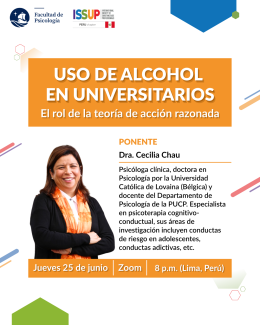
Webinar: Alcohol Use in College Students: The Role of Reasoned Action Theory
On this occasion, we will be accompanied by Dr. Cecilia Chau. She is a Clinical Psychologist, PhD in Psychology from the Catholic University of Louvain (Belgium) and a professor in the Department of Psychology at PUCP. Specialist in...
Addressing the recruitment of young people into criminal drugs networks
This report examines how and why young people are recruited into criminal drug networks across Europe. It highlights the range of factors that can increase vulnerability to recruitment, including social and economic disadvantage, peer...
Faith-Based Interventions for Reducing Gang Violence in the Caribbean: Reflections from a Professor and a Priest
This book chapter explores the role of faith-based interventions in preventing and reducing gang violence in Trinidad and Tobago. Drawing on the experiences of a criminologist and a religious leader, it argues that gang violence should be...