Search
Methadone maintenance treatment
Document of the Ministry of Health and Social Protection of Colombia that presents baseline of the maintenance programs with methadone in the country and the profile of the population served and the general characteristics of the treatment...
Public expenditure on supply reduction policies
Supply reduction is often the main approach used for addressing the illicit drug problem.
Evaluating drug policy is an integral part of a cost-efficient approach to tackle illicit drugs. This report takes a first step towards a systematic...
Costs and Unintended consequences of drug policy
Evaluation is an integral part of a good governance approach to public policy. This principle applies equally to the component of drug policy designed to counter the availability of and access to illicit drugs. Estimation or full costing of...
Alcohol energy (calorie) labelling: Evidence, public support, alternatives, and wider labelling considerations
This briefing synthesises existing evidence on alcohol energy (calorie) labelling, spanning the past five years (2016-2021).
This briefing covers reviews in the academic literature about the impact of alcohol energy labelling, studies and...
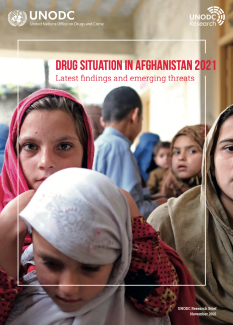
Drug situation in Afghanistan
This report, published by UNODC, highlights the latest findings and emerging trends relating to the drug situation in Afghanistan.
Guide to Indispensable Criteria for Starting-up and Operating Treatment Centers for People with Psychoactive Substance Use Disorders
The WHO Expert Committee on Drug Dependence defines treatment as the process that begins when psychoactive substance users contact a health provider or other community service and may continue through a succession of specific interventions...
Synthetic drugs and new psychoactive substances in Latin America and the Caribbean- 2021
The report provides a regional analysis of the key trends and emerging developments of the synthetic drugs and NPS market as well as options for response in Latin America and the Caribbean.
Over the past years, the synthetics drug market...
Impact of Cannabis Legalization on Youth Contact with the Criminal Justice System
The Canadian Centre on Substance Use and Addiction (CCSA) provided funding to Dr. Akwasi Owusu-Bempah and Dr. Scot Wortley from the University of Toronto to research youth interactions with the criminal justice system, including the nature...
A Kit for Employers: Making your workplace drug free
The Substance Abuse and Mental Health Services Administration (SAMHSA) has identified many well-researched drug-free workplace programs and published "A Kit for Employers: Making the workplace drug free".
This Employer kit describes the...
Substance Use Disorders Recovery with a Focus on Employment and Education
The Substance Abuse and Mental Health Services Administration (SAMHSA) has issued Evidence-Based Resources Guide Series. The Guide Series is a comprehensive and modular set of resources intended to support health care providers, health care...
Policy and practice briefings: Workplaces
EMCDDA has published Policy and practice briefings in Workplaces. This policy and practice briefing provides an overview of the key issues, response options, evidence and implications for policy and practice.
It summarises the available...
Considerations for Virtual Services and Supports for Substance Use and Concurrent Disorders [Policy Brief]
The Canadian Centre for Substance Use and Addiction (CCSA) in partnership with the Royal Ottawa Mental Health Centre, the Canadian Psychological Association and Canada Health Infoway, collected national data on the experience and...
Blueprint for Action: Preventing substance-related harms among youth through a Comprehensive School Health approach
The Public Health Agency of Canada developed The Blueprint for Action: Preventing substance-related harms among youth through a Comprehensive School Approach with a policy paper.
These new resources for preventing substance-related harms...
The origin, development and current status of the health profession of an addictologist in the Czech Republic in the broader context of the development of the addictology field
In the 1990s, new addiction services began to emerge that had a shortage of appropriately qualified and trained practitioners. This impulse led to the establishment of the health profession of an ADDICTOLOGIST in the Czech Republic. In the...
Substance Use, Mental Health and Suicide among Inuit in Canada
The Canadian Centre on Substance Use and Addiction (CCSA) and Inuit Tapiriit Kanatami (ITK), the national organization representing Inuit across Canada, have summarized the latest statistics on substance use and mental health among Inuit in...
Drug prevention and healthy development of children: Caring for your child in a crisis situation
Crisis situations, such as security incidents, earthquakes and floods, are on the increase and often leave families very vulnerable. Parents that have lived through crisis situations have reported how concerned they are about their children...
Cocaine Insights 2
In the context of an ongoing expansion of the global cocaine market, this report summarizes the current state of knowledge on what cocaine consumer products are and how they are produced and consumed in different world regions. The report...
Cocaine Insights 1
The cocaine market presents a clear threat at the global level. Well-defined locations of production in South America and large consumer markets in the Americas and Europe lead to trafficking routes from a circumscribed origin to specific...
Advances in Addiction and Recovery
Advances in Addiction & Recovery, the official publication of NAADAC, is a quarterly digital magazine focused on providing useful, innovative and timely information on trends and best practices in the profession that are beneficial for...
Share the Knowledge: ISSUP members can post in the Knowledge Share – Sign in or become a member