
Minister for Social Welfare and Women and Children Affairs Calls for Integrated Prevention Measures to Keep Young People Free from Drugs
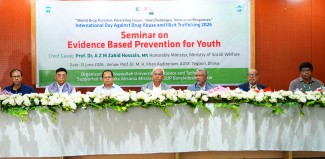
Professor Dr A.Z.M. Zahid Hossain, MP, Minister for Social Welfare and Women and Children Affairs, has called for integrated preventive initiatives to protect young people from the devastating effects of drug use. He stated that drug control efforts should not be limited to law enforcement or fear-based campaigns alone; rather, effective prevention requires evidence-based, integrated and long-term measures.
He made these remarks while addressing, as Chief Guest, the seminar titled ‘Evidence-Based Prevention for Youth’, held on Sunday (21 June) at 11:00 a.m. at the Professor Dr M. H. Khan Auditorium of Ahsanullah University of Science and Technology (AUST) in Tejgaon, Dhaka, marking the observance of the International Day against Drug Abuse and Illicit Trafficking 2026. The seminar was organised by Ahsanullah University of Science and Technology, Dhaka Ahsania Mission and the International Society of Substance Use Professionals (ISSUP) Bangladesh Chapter.
Highlighting the coordinated role of the Government, educational institutions, families and social organisations in building a drug-free society, the Minister said, “To free the country from the scourge of drugs, we must build a social movement involving all sections of society. Only then can we establish a humane and welfare-oriented Bangladesh.” He further stated, “Through the Ministry of Social Welfare and the Ministry of Women and Children Affairs, various initiatives have been undertaken to enhance the skills and capacities of young people through education, training and practical skill development. The national budget has also placed the highest priority on poverty reduction and improving the quality of healthcare services.”
The keynote paper was presented by Iqbal Masud, Director of the Health Sector at Dhaka Ahsania Mission and General Secretary of the ISSUP Bangladesh Chapter. He highlighted the importance of workplace- and school-based prevention programmes in line with the United Nations International Standards on Drug Use Prevention, the Oviedo Convention, and science-based behaviour change models. He stated that replacing punitive approaches with rehabilitation and recovery-oriented services for drug-dependent or at-risk young people is now an urgent necessity. He also emphasised the need for a scientific review and evaluation of the existing prevention activities of the Department of Narcotics Control.
Speaking as Special Guest, Md Hasan Maruf, Director General of the Department of Narcotics Control, said that law enforcement alone is insufficient to address the drug problem. He noted that the Department is currently placing considerable emphasis on scientific research to assess the effectiveness of preventive interventions. He further stated that, in line with international standards, protecting young people from the risks of drug use requires the active participation of non-governmental organisations and educational institutions alongside government initiatives.
As a Special Guest, Dr M. A. Mohit Kamal, Chairman of the ISSUP Bangladesh Chapter, highlighted the importance of identifying adverse childhood experiences in shaping the mental health of young people. Dr S. M. Khalilur Rahman, Vice-President of Dhaka Ahsania Mission, urged young people to stay away from drugs. He stated that the drug problem is not merely a law and order issue, but also a public health concern. Therefore, it is necessary to pilot international programmes through public-private partnerships.
In his presidential remarks, Professor Dr Md Ashraful Haque, Vice-Chancellor of Ahsanullah University of Science and Technology, called for collective efforts to build a drug-free campus and a healthy society.
Representatives from various government and non-government organisations, public health experts, researchers and students attended the seminar.