
Digital Screening for Substance Use: A Scalable Model from Nigeria
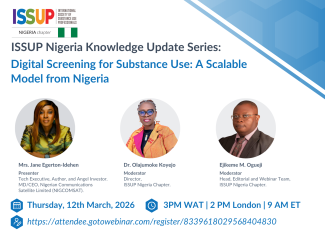
ISSUP Nigeria would like to invite you to the 32nd session of its bi-monthly webinar in the Knowledge Update Series. This webinar will focus on the topic 'Digital Screening for Substance Use: A Scalable Model from Nigeria'.
Date: 12th March 2026
Time: 3:00 PM WAT | 2:00 PM London | 9 AM ET
Substance use disorders remain under identified, particularly in settings where stigma, limited workforce capacity, and restricted access to services delay help seeking until problems become severe. Early identification and brief intervention are proven prevention strategies, yet in many low resource environments screening remains largely confined to facility based models. These approaches depend on trained professionals, physical attendance, and structured clinical environments, which are often inaccessible to those most at risk.
At the same time, expanding digital access creates new opportunities to extend prevention beyond clinic settings. This webinar explores how Nigeria’s Virtual Screening and Brief Intervention Chatbot supports early, confidential, and stigma free substance use screening. Designed as a complement to human services, the tool provides anonymous risk assessment and brief guidance while linking users to appropriate care when needed.
The session highlights how digital innovation can strengthen early detection, expand access in low resource settings, and support more proactive approaches to addiction prevention.
Discussion Topics:
- Can digital tools reduce stigma in substance use prevention?
- How chatbots support early screening before dependence escalates
- Balancing automation with human-centered care
- Adapting digital prevention tools to local culture and language
- Potential for replication across other LMICs (Low- and Middle-Income Countries)
Relevance and Significance:
-
Substance use disorders remain under-detected globally, especially in settings where access to trained professionals is limited and stigma discourages help-seeking. Nigeria’s Virtual Screening and Brief Intervention Chatbot demonstrates how digital health innovation can close this gap by providing timely, confidential, and accessible screening.
-
This initiative aligns strongly with global prevention goals and ISSUP’s mission to promote evidence-based prevention strategies.
Target Audience:
- Public health professionals, addiction counsellors, healthcare providers, policymakers, young people, anyone working in substance use care settings and ISSUP members.
Learning Outcomes:
Following this webinar, participants will be able to:
-
Identify practical ways digital tools can support early substance use screening
-
Apply brief intervention principles to chatbot based delivery models
-
Develop a basic framework for introducing digital screening tools in low resource settings
-
Assess key ethical and contextual considerations in digital prevention design
-
Identify opportunities for cross country collaboration and knowledge exchange
Presenter:
Mrs Jane Egerton-Idehen
Jane Egerton-Idehen is a Tech Executive, Author, and Angel Investor. She is the MD/CEO of Nigerian Communications Satellite Limited (NIGCOMSAT), Nigeria’s leading agency managing the nation’s communications satellite operations.
Before her role at NIGCOMSAT, Jane was Head of Sales for the Middle East and Africa at Meta (formerly Facebook). She also served as the Country Manager in Nigeria and Regional Sales Director for West Africa at Avanti Communications, a UK-based satellite company. Earlier in her career, she spent over 13 years at Ericsson in sales and management roles and worked as a Cluster Lead for Nokia Siemens Networks in West Africa.
With over 17 years of experience in Africa’s telecommunications industry, Jane is recognized for her expertise in technology, stakeholder relationship management, and strategic growth. As one of the few women leading key business areas in tech, she has championed initiatives to support women’s career growth.
Jane is also the author of Be Fearless: Give Yourself Permission to Be You, a book that draws from her extensive career to help women build lasting careers in male-dominated fields like STEM. The book became an Amazon bestseller in multiple categories, including Business Ethics and Knowledge Capital
Moderators:
Dr. Olajumoke Koyeojo
Director, ISSUP Nigeria Chapter
Ejikeme M. Ogueji
Head, Editorial and Webinar Team, ISSUP Nigeria Chapter
References:
-
Aggarwal A, Tam CC, Wu D, Li X, Qiao S. Artificial intelligence based chatbots for promoting health behavioral changes: Systematic review. Journal of Medical Internet Research. 2023;25:e40789. doi:10.2196/40789
-
Alawiye TR. The impact of digital technology on healthcare delivery and patient outcomes. E-Health Telecommunications Systems and Networks. 2024;13:13–22.
-
Cole HA, Prassel HB, Carlson CR. A meta analysis of computer delivered drinking interventions for college students. Journal of Studies on Alcohol and Drugs. 2018;79(5):686–696. doi:10.15288/jsad.2018.79.686
-
Dick S, Whelan E, Davoren MP, Dockray S, Heavin C, Linehan C, et al. Effectiveness of digital interventions for illicit substance misuse harm reduction in third level students: Systematic review. BMC Public Health. 2019;19:1244. doi:10.1186/s12889-019-7583-6
-
Galvão Gomes da Silva J, Kavanagh DJ, Belpaeme T, Taylor L, Beeson K, Andrade J. Experiences of a motivational interview delivered by a robot: Qualitative study. Journal of Medical Internet Research. 2018;20(5):e116. doi:10.2196/jmir.7737
-
Jakovljevic MB, Milovanovic O. Growing burden of non communicable diseases in emerging health markets: The case of BRICS. Frontiers in Public Health. 2015;3:65.
-
Kodali PB. Achieving universal health coverage in low and middle income countries: Challenges post pandemic and beyond. Risk Management and Healthcare Policy. 2023;16:607–621.
-
Ngepah N, Ndzignat Mouteyica AE. Trends in household out of pocket health expenditures in African regional economic communities. Global Health. 2024;20:27.
-
Prosser T, Gee KA, Jones F. Effectiveness of e interventions to reduce alcohol consumption in university students: Meta analysis. Journal of American College Health. 2018;66(4):292–301. doi:10.1080/07448481.2018.1440579
-
Ranabhat CL, Acharya SP, Adhikari C, Kim CB. Universal health coverage evolution, ongoing trends and future challenges: Conceptual and historical review. Frontiers in Public Health. 2023;11:1041459.
-
United Nations Office on Drugs and Crime and World Health Organization. International Standards on Drug Use Prevention.
-
World Health Organization. Universal Health Coverage (UHC). 2023. Available at: https://www.who.int/news-room/fact-sheets/detail/universal-health-coverage-(uhc)
-
World Health Organization Africa. UHC Day: High health care costs in Africa push over 150 million into poverty. 2024. Available at: https://www.afro.who.int/news/uhc-day-high-health-care-costs-africa-continue-push-over-150-million-poverty-new-who-report
Webinars and online events delivered and hosted by the International Society of Substance Use Professionals (ISSUP) are provided for informational purposes only. They are educational in nature and do not constitute medical advice, diagnosis or treatment.