
Medellín Intensifies Tusi Crackdown in Barrio Antioquia
Published: July 24, 2026 | Last Updated: July 24, 2026
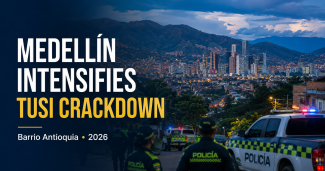
Quick answer: Tusi, often called “pink cocaine,” is a pink-dyed powder that rarely contains real cocaine or the psychedelic 2C-B its name comes from. Most samples are a variable mix of ketamine, MDMA, and caffeine. In 2026, Medellín Mayor Federico “Fico” Gutiérrez linked a wave of tusi-related hospitalizations to the Barrio Antioquia drug trade and launched one of the city’s most aggressive microtrafficking crackdowns to date.
Key takeaways
- “Tusi” (also spelled tussi or tuci) is a marketing name, not a single chemical — the pink color is just food dye.
- Lab testing shows most tusi contains ketamine and MDMA, frequently cut with caffeine; the DEA reports it “rarely contains 2C-B anymore.”
- A 2025 Miami-Dade medical examiner study found ketamine in 100% of tested tusi powders — and 2C-B in none.
- Because every batch is different, users cannot know the dose or the ingredients — the core reason tusi is so dangerous.
- Medellín reported 22 adults hospitalized since February 2026 after using tusi; 5 needed intensive care and 1 required a limb amputation.
- Mayor Fico Gutiérrez has targeted Barrio Antioquia, the city’s historic microtrafficking hub, seizing more than 14 tons of drugs in 2026 — already more than all of 2025.
- Tusi emerged in Colombia and has since spread across Latin America, Europe, and into U.S. nightlife markets.
On this page
- What Is Tusi?
- Why the Name Is Misleading
- What Tusi Actually Contains
- Health Risks
- Tusi in Medellín
- The Barrio Antioquia Crackdown
- Medellín’s Tourism Economy
- Sober Things to Do
- Where to Find Help
- FAQ
What Is Tusi (Pink Cocaine)?
Tusi is a pink-colored powder sold in nightlife and party settings as a premium “designer” drug. Despite the nickname “pink cocaine,” it usually is not cocaine at all. It is a mixture of substances dyed pink with food coloring or colored baking powder, and its contents vary from batch to batch and dealer to dealer.
The U.S. Drug Enforcement Administration describes pink cocaine as “a powdered mixture of substances, which is dyed pink,” noting that “the actual substances included in pink cocaine are not known until a sample is tested.” That unpredictability is the defining feature of the drug.
Why the Name “Tusi” Is Misleading
The name is a source of confusion by design. “Tusi” comes from the phonetic Spanish pronunciation of 2C-B (“two-cee-bee” → “tu-si”), a synthetic psychedelic that circulated in Colombia’s upscale party scene. As genuine 2C-B became scarce and expensive, sellers began substituting cheaper drugs while keeping the trendy pink branding.
The result: a product named after one drug, marketed as another, that typically contains neither. According to the DEA, of roughly 960 pink-powder samples it seized since 2020, only four actually contained 2C-B.
📌 Key insight: A substance sold as “tusi” or “pink cocaine” almost never contains 2C-B or cocaine. The pink color is branding, not chemistry — which is why authorities treat every batch as an unknown mixture until it is lab-tested.
What Tusi Actually Contains
Independent lab analyses tell a consistent story: tusi is mostly ketamine and MDMA, cut with caffeine, and only occasionally contains cocaine. One widely cited analysis of samples in New York City found the following:
| Ingredient | Found in (share of samples) | Drug class |
|---|---|---|
| Ketamine | ~95% | Dissociative anesthetic |
| MDMA | ~63% | Stimulant / empathogen |
| Caffeine | ~53% | Stimulant (cutting agent) |
| Methamphetamine | ~16% | Stimulant |
| Cocaine | ~11% | Stimulant |
Composition varies widely by region and batch; these figures illustrate typical patterns, not a fixed recipe.
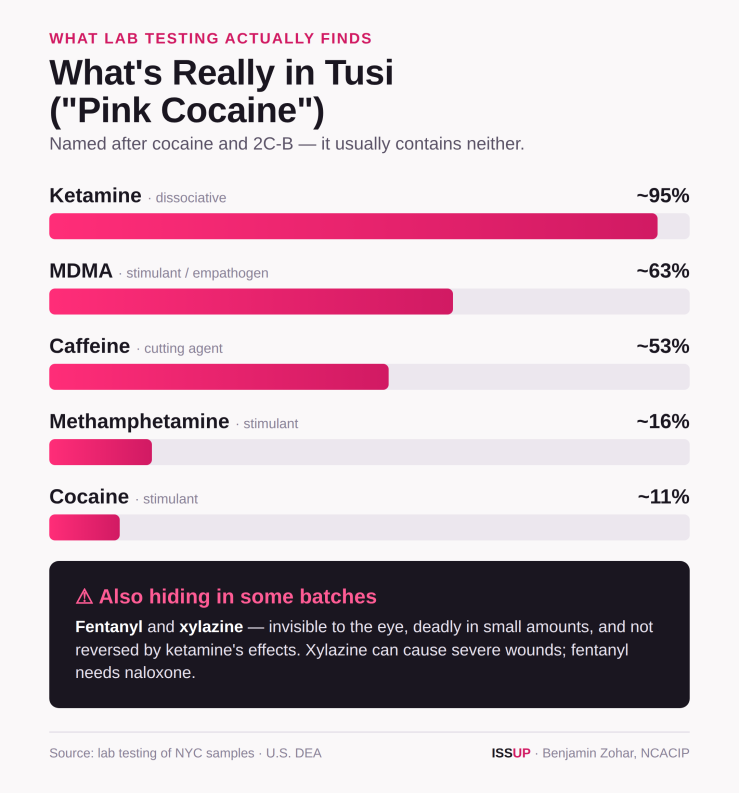
What lab testing actually finds in “pink cocaine” — rarely the drug its name implies. Hidden fentanyl or xylazine make each batch a gamble.
The DEA has separately identified pink-powder mixtures containing ketamine and MDMA; methamphetamine, ketamine, and MDMA; cocaine and fentanyl; and fentanyl combined with xylazine — meaning dangerous adulterants can appear with no warning, even if they are not present in every batch.
What forensic testing confirms: the Miami-Dade case series
The strongest published evidence comes from a 2025 Journal of Forensic Sciences case series by the Miami-Dade County medical examiner — the first study to analytically document what “tusi” powders actually contain. Examining eight fatalities between September 2020 and July 2024, investigators tested 14 powders, mostly pink with a sweet or fruity aroma, found on or near the decedents. The results:
- Ketamine was identified in all 14 powders — every single sample.
- The majority also contained MDMA.
- Only 5 of 14 contained any cocaine.
- None contained 2C-B — and, notably, none contained fentanyl in this series.
- Other substances detected included methamphetamine, MDA, oxycodone, alprazolam, the synthetic cathinone eutylone, and even over-the-counter antihistamines (diphenhydramine, loratadine).
In other words, a drug named after cocaine and 2C-B reliably contained ketamine, usually MDMA, and an unpredictable rotation of everything else — from prescription opioids to allergy medicine. Every decedent had multiple drugs in their system. The authors describe tusi’s variable composition as a genuine complication for death investigation itself.
Myth vs. fact
| Common belief | Reality |
|---|---|
| “Pink cocaine is just cocaine.” | Most tusi contains little or no cocaine — usually ketamine and MDMA. |
| “Tusi is 2C-B.” | True 2C-B is now rare; the name survived, the ingredient did not. |
| “The pink color means it’s pure.” | The pink is only food dye and signals nothing about contents or strength. |
| “It’s a safe party drug.” | Unknown dose and hidden fentanyl/xylazine make each use a gamble. |
Health Risks
Because tusi blends stimulants with a dissociative anesthetic, it stresses the heart and brain from several directions at once. Reported effects include rapid or irregular heartbeat, elevated blood pressure, seizures, and substance-induced psychosis — and because contents vary batch to batch, users cannot judge dose or ingredients. Adulterants such as fentanyl and xylazine, when present, sharply raise the danger, which is the core of the public-health concern behind Medellín’s current enforcement push.
Tusi in Medellín: A 2026 Health Alert
On May 28, 2026, Mayor Federico Gutiérrez publicly warned Medellín residents about tusi after a cluster of poisonings. He stated that traffickers were mixing it with “ketamine, xylazine, caffeine, and other chemicals,” adding that xylazine is “a veterinary product used to sedate horses.”
The human toll he described:
- 22 adults (ages 19–40) treated in city clinics and hospitals since February 2026
- 5 patients admitted to intensive care
- 1 patient who required amputation of a lower limb from vascular complications
Gutiérrez also warned that criminal groups were using cartoon-themed packaging and added flavorings to market synthetic drugs to teenagers — a marketing tactic that lowers the perceived risk for young users.
The Barrio Antioquia Crackdown
Much of Medellín’s street-drug supply is tied to Barrio Antioquia (officially the Trinidad neighborhood in Comuna 15, Guayabal), a district that has been a microtrafficking center since the city’s narco boom of the 1970s and 80s. It remains one of the largest and densest drug-sales zones in the city, organized around numerous “plazas,” or sales points, protected by lookouts who signal when police approach.
In 2026 the city intensified enforcement:
2026 enforcement timeline
| Date | Action | Details |
|---|---|---|
| Feb 2026 onward | Tusi poisoning cluster | 22 adults hospitalized; triggers city health alert |
| May 22, 2026 | 5-ton marijuana seizure | Shipment destined for Barrio Antioquia; supplied by FARC dissidents from Cauca; 5 arrested |
| May 28, 2026 | Mayoral tusi warning | Gutiérrez details ketamine/xylazine mix and youth-targeted packaging |
| Mid-2026 | Barrio Antioquia megaoperation | ~2 more tons of marijuana seized; 5 arrested; marijuana, cocaine, bazuco, ecstasy, tusi, and popper removed from circulation |
Announcing the latest raid, Gutiérrez said the operation “struck the logistical and financial capacity” of the organized crime group operating in Barrio Antioquia and that a judge had ordered the suspects held in pretrial detention. He reported that in 2026 so far, 3,417 people have been arrested for drug manufacturing, trafficking, or possession, and that the city had seized more than 14 tons of drugs — surpassing the total for all of 2025. “Here we give no truce to criminals,” he wrote.
The crackdown is part of a broader Gutiérrez agenda that includes confronting transnational mafias, closing venues used for money laundering and exploitation, and pushing to ban Escobar-themed merchandise and “narco-tourism” — an effort to separate Medellín’s image from its cartel past.
For a closer look at how the drug is sold locally, see our companion report on Tussi (Pink Cocaine) in Medellín: Availability and Delivery Methods, and the Spanish-language guide Tusi (cocaína rosa): qué es, riesgos y dónde obtener ayuda.
Luxury Airbnb Culture and Medellín’s Tourism Economy
It is important to keep the drug story in proportion. Medellín has become one of Latin America’s most visited cities, and the concerns raised by public-health officials center on specific high-intensity nightlife settings — certain bars, clubs, and unregulated party venues — not on the city’s tourism sector as a whole.
In fact, much of Medellín’s hospitality growth points in the opposite direction: professionally managed private accommodations built around security and service. Properties such as BNZ Mansion Medellín in the El Poblado hills operate with gated grounds, registered guests, licensed overnight security, and concierge services, hosting families and private groups visiting the city for its climate, food, and mountain scenery. This managed-villa segment reflects how Medellín’s tourism economy is maturing beyond its old reputation.
Sober Things to Do in Medellín
Medellín’s appeal does not depend on its nightlife. For travelers in recovery — or simply travelers who want their trip to feel good the next morning — the region offers a full itinerary of substance-free experiences:
- Horseback riding in the Andes — guided fincas outside the city offer half-day rides through coffee country and mountain trails.
- Guatapé day trips — climb the 700+ steps of El Peñol rock, then go jet skiing or boating on the reservoir; one of Antioquia’s signature outings.
- In-villa massage and spa services — mobile therapists bring recovery-friendly relaxation directly to private accommodations.
- Wellness and hydration IV therapy — licensed mobile providers such as Drip Colombia deliver vitamin and hydration drips for jet lag, altitude, and general wellness.
- Comuna 13 graffiti tours, the Metrocable, botanical gardens, and coffee-farm tours — daytime culture that showcases the city’s transformation.
A trip built around these experiences — based in a quiet, well-managed home base rather than a party hostel — is the version of Medellín most visitors remember best.
Where to Find Help and Information
Anyone experiencing a medical emergency after drug use should call emergency services (123 in Colombia, 911 in the U.S.) without delay.
For ongoing or escalating use, professional evaluation and evidence-based treatment work. If you are unsure where to start, resources such as Tusi Detox & Inpatient Rehab in Troy, NY and Tussi (Pink Cocaine) at Long Island Rehab offer education on pink cocaine, helpline support, and treatment navigation for individuals and families in New York.
Frequently Asked Questions
Is pink cocaine actually cocaine?
Usually not. Despite the name, most tusi (“pink cocaine”) contains little or no cocaine. Lab testing most often finds ketamine and MDMA, sometimes with caffeine, methamphetamine, or dangerous adulterants like fentanyl and xylazine. The pink color is only dye.
What does tusi stand for?
“Tusi” comes from the Spanish pronunciation of 2C-B (“two-cee-bee”), a synthetic psychedelic. The name stuck even though today’s tusi rarely contains 2C-B. It is essentially a brand name for a variable pink drug mixture.
Why is tusi so dangerous?
Because its ingredients and strength change from batch to batch, users cannot know what — or how much — they are taking. Health authorities in Medellín have also documented batches adulterated with xylazine, a veterinary sedative not approved for human use.
Where did tusi come from?
Tusi emerged in Colombia’s party scene, took its name from the psychedelic 2C-B, and spread as prices fell. By the early 2020s it had reached across Latin America and into Europe’s nightlife markets, and it now appears in U.S. cities as well.
What is Medellín doing about it?
In 2026, Mayor Fico Gutiérrez issued a public health warning about tusi and intensified enforcement against Barrio Antioquia’s drug trade, reporting more than 14 tons of drugs seized and over 3,400 drug-related arrests so far this year.
Is it safe to travel to Medellín?
Millions of visitors travel to Medellín each year without incident. The drug-exposure concerns officials describe are concentrated in specific nightlife settings. Travelers who stay in reputable, professionally managed accommodations and avoid unknown substances substantially reduce their risk, as with any major international destination.
References
- Moore DM, Giachetti AD, Zaney ME, Potoukian RB, Hutchins KD. Tusi but not 2C: A Miami-Dade medical examiner case series highlighting the variable drug composition in colored powder paraphernalia. J Forensic Sci. 2025. doi:10.1111/1556-4029.70012
- U.S. Drug Enforcement Administration — Pink Cocaine
- DEA / Legislative Analysis and Public Policy Association — “Tusi” (Pink Cocaine) Fact Sheet, October 2024
- Semana — Gutiérrez warns on tusi after 22 hospitalized (May 2026)
- El Tiempo — Barrio Antioquia: the dynamics of Medellín’s microtrafficking
- El Tiempo — Five-ton marijuana seizure bound for Barrio Antioquia (May 2026)
About the Author
Benjamin Zohar, NCACIP, is a nationally certified addiction professional writing on substance-use trends, drug policy, and recovery.
Disclaimer: This article is for education and harm reduction only. It is not medical advice and does not endorse the use of any illegal substance. If you or someone you know is struggling with drug use, contact a licensed medical or treatment professional.