
New York City Invests $12 Million in Peer-Led Substance Use Recovery Services
Quick answer: On May 7, 2026, New York City announced a $12 million investment from opioid settlement funds to expand peer-led substance use recovery services across the five boroughs. The initiative is expected to support approximately 500 additional peer specialist positions over four years while expanding training, certification, outreach and community recovery services.
Key Takeaways
- New York City announced $12 million for peer-led substance use recovery services on May 7, 2026.
- The funding comes from opioid settlement funds.
- The City expects the investment to support approximately 500 additional peer specialist positions over four years.
- Funding will support peer certification, scholarships, hiring, outreach and workforce development.
- Seven community organizations were identified to operate funded recovery centers and peer-led outreach programs.
- The initiative is part of a broader New York City strategy addressing overdose prevention, treatment, harm reduction and recovery.
Contents
- What did New York City announce?
- What is a peer recovery specialist?
- Why is NYC investing in peer-led recovery?
- What will the $12 million support?
- Why does lived experience matter?
- Is this funding for detox or residential rehab?
- Does the investment apply outside New York City?
- What does this mean for New Yorkers seeking help?
- Questions to ask about peer recovery services
- Frequently asked questions
What Did New York City Announce?
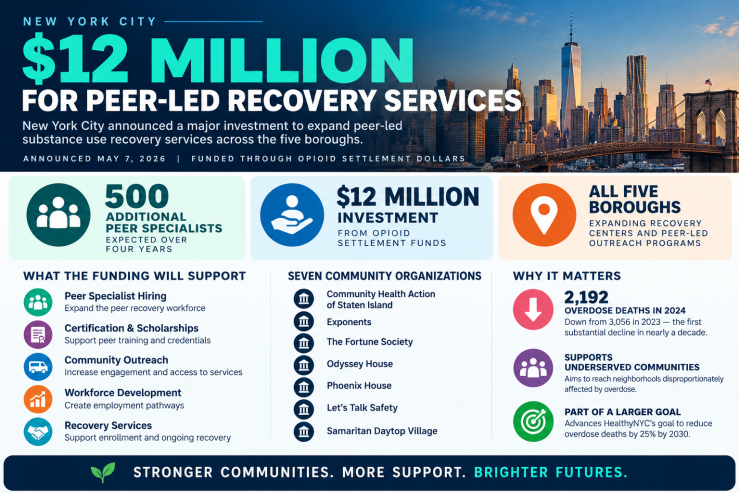
New York City announced a $12 million investment to expand peer-led substance use recovery services across all five boroughs. According to the May 7, 2026 announcement, the funding will support recovery centers, peer-led outreach, workforce development, certification and employment opportunities for people with lived experience of substance use and recovery.
The City said the investment is expected to support approximately 500 additional peer specialist positions over four years.
Which organizations are receiving funding?
The City identified seven community organizations that will operate recovery centers or peer-led outreach programs:
- Community Health Action of Staten Island
- Exponents
- The Fortune Society
- Odyssey House
- Phoenix House
- Let's Talk Safety
- Samaritan Daytop Village
Funding is intended to support staffing, outreach capacity, peer certification, scholarships, workforce development and expanded access to recovery services.
What Is a Peer Recovery Specialist?
A peer recovery specialist is a trained person who uses lived experience of substance use, recovery or related behavioral-health challenges to help others engage with recovery resources and navigate support systems.
Peer specialists may help people:
- connect with treatment and recovery resources;
- understand available community services;
- develop coping and recovery strategies;
- remain engaged with care;
- navigate periods of instability or crisis;
- build trust with treatment and recovery systems; and
- identify practical supports involving housing, employment or other community needs.
Important: Peer recovery support can complement professional addiction treatment, but it does not replace medical care, behavioral-health treatment, psychiatric services or emergency care when those services are needed.
Why Is New York City Investing in Peer-Led Recovery?
The investment is part of New York City's broader response to substance use and overdose. The City's May 2026 announcement reported 2,192 overdose deaths in 2024, compared with 3,056 in 2023, which it described as the first substantial decline in nearly a decade.
The announcement also noted that overdose mortality continues to affect some communities disproportionately, including Black and Latino New Yorkers, residents of high-poverty neighborhoods and adults ages 55 to 64.
The City's HealthyNYC strategy includes a goal of reducing overdose deaths by 25% by 2030. The peer-workforce initiative is one component of a larger strategy that includes prevention, treatment, harm reduction and recovery services.
What Will the $12 Million Support?
The funding is intended to expand both recovery services and the peer workforce that delivers them.
| Investment Area | Purpose |
|---|---|
| Peer specialist hiring | Increase the number of trained peer workers supporting New Yorkers in recovery. |
| Certification | Help people with lived experience obtain recognized peer-recovery credentials. |
| Scholarships | Reduce financial barriers to peer training and certification. |
| Community outreach | Connect more people affected by substance use with available support and services. |
| Mobile outreach | Expand the ability of community organizations to reach people outside traditional service settings. |
| Recovery-service enrollment | Help more New Yorkers connect with community recovery services. |
| Workforce development | Create training and employment pathways for people with lived recovery experience. |
Why Does Lived Experience Matter in Recovery Services?
Peer recovery models are built around the idea that someone who has personally navigated substance use and recovery may be able to establish a different type of trust with another person experiencing similar challenges.
Peer specialists do not function as substitutes for physicians, nurses, therapists or other licensed clinicians. Their role may instead include engagement, navigation, practical support, recovery mentoring and helping people remain connected with appropriate services.
New York City's announcement characterized peers as trusted messengers and highlighted their potential role in improving engagement with treatment and recovery resources.
Peer support and clinical treatment are not the same thing
| Peer Recovery Support | Clinical Treatment |
|---|---|
| Uses lived experience and professional peer training | Delivered by appropriately licensed or credentialed healthcare professionals |
| Can support navigation, engagement and recovery goals | Can provide diagnosis, medical treatment or psychotherapy within professional scope |
| May help connect people with community resources | Provides clinical assessment and treatment planning when indicated |
| Complements professional services | Addresses medical and behavioral-health treatment needs |
Is the $12 Million Creating Detox or Residential Rehab Beds?
The May 7 announcement primarily concerns peer recovery services, outreach and workforce development. It should not be interpreted as an announcement of 500 new detox or residential treatment beds.
Some organizations receiving funds also operate treatment programs, but the stated purpose of this particular investment is to expand the peer workforce, peer-led outreach, training, certification and community recovery services.
Does the Investment Apply Outside New York City?
No. The May 7 initiative applies to programs operating within New York City's five boroughs.
A related regional analysis from Yonk Detox Resource Center explains that Yonkers and Westchester County residents use a different network of local and New York State treatment and recovery resources. The NYC announcement may be relevant as a regional policy development, but it does not mean the $12 million is directly funding peer services in Yonkers or Westchester County.
Read the Yonkers regional analysis of NYC's peer recovery investment.
What Does This Mean for New Yorkers Seeking Addiction Help?
For people seeking treatment or recovery support in New York City, the investment may create additional opportunities to interact with trained peer specialists in recovery centers, outreach programs and other community settings.
As implementation continues, the initiative is intended to increase:
- peer outreach;
- recovery-center capacity;
- peer certification opportunities;
- workforce development;
- community engagement; and
- connections between people seeking help and available recovery services.
The announcement does not guarantee immediate access to a peer specialist in every neighborhood or treatment program. Availability will depend on participating organizations, staffing, location and program implementation.
What Should Families Ask About Peer Recovery Services?
People comparing addiction treatment and recovery programs can ask how peer support fits into the broader care model.
- Does the program employ trained or credentialed peer specialists?
- How are peer specialists supervised?
- Is peer support available during treatment, after treatment or both?
- How do peers coordinate with clinical staff?
- Can peer specialists assist with housing, employment, transportation or community-resource navigation?
- Is participation in peer support voluntary?
- What training or certification is required?
- What happens when someone needs medical or psychiatric care outside a peer specialist's scope?
Frequently Asked Questions
How much is New York City investing in peer-led recovery services?
New York City announced a $12 million investment from opioid settlement funds to expand peer-led substance use recovery services, peer workforce development, outreach and training across the five boroughs.
How many new peer specialists are expected?
The City said the investment is expected to support approximately 500 additional peer specialist positions over four years through participating community organizations.
Where does the $12 million come from?
The funding comes from opioid settlement funds. New York City has been directing settlement dollars toward prevention, treatment, harm reduction, recovery and other substance-use services.
Is peer support the same as addiction treatment?
No. Peer recovery support can complement addiction treatment, but it does not replace medically necessary detoxification, medication treatment, psychotherapy, psychiatric care or other professional healthcare services.
Can peer specialists help someone enter treatment?
Peer specialists may help people understand available resources, navigate treatment systems, build trust and remain engaged with recovery services. Their exact responsibilities depend on the organization, program and scope of the peer role.
Does someone need insurance to receive peer recovery support?
Requirements vary by program. Some community recovery services may be available without traditional insurance billing, while other treatment or behavioral-health services may have separate insurance or eligibility requirements.
Does this investment include employment opportunities?
Yes. Workforce development is a major component of the initiative. The City's announcement describes certification, scholarships, training and direct employment opportunities intended to expand the peer-recovery workforce.
Does this funding apply to Yonkers or Westchester County?
No. The May 7, 2026 announcement concerns peer recovery services within New York City's five boroughs. Yonkers and Westchester County residents access treatment and recovery resources through separate local and state systems.
Related Resources
- NYC Invests $12 Million to Expand Peer-Led Recovery Services: Yonkers and Westchester Context
- NYC Peer-Led Recovery Services Investment: What New Yorkers Should Know
References and Further Reading
- New York City Mayor's Office. Mayor Mamdani Invests $12 Million to Expand Peer-Led Substance-Use Recovery Services Across New York City. May 7, 2026.
- New York City Mayor's Office. Transcript: Mayor Mamdani Invests $12 Million to Expand Peer-Led Substance-Use Recovery Services Across New York City. May 7, 2026.
- New York City Department of Health and Mental Hygiene. Opioid Settlement Funds Report. 2026.
- Yonk Detox Resource Center. NYC Peer Recovery Investment Regional Analysis.
Last updated: September 26, 2026
About the Author
Benjamin Zohar, NCACIP is a Nationally Certified Advanced Clinical Intervention Professional and ISSUP network moderator specializing in addiction intervention, treatment navigation and emerging substance-use risks. His educational work published through ISSUP on counterfeit medications, fentanyl exposure and concentrated 7-hydroxymitragynine has been cited or referenced by GoodRx, The Washington Post, WIRED and Newsweek.
Medical disclaimer: This article is intended for educational and public-health purposes. It does not provide individualized medical advice, diagnosis or treatment recommendations. Peer recovery support does not replace professional medical, psychiatric or emergency care when those services are needed.