
Brixadi vs. Sublocade: Doses, Side Effects, REMS, Half-Life & Key Differences
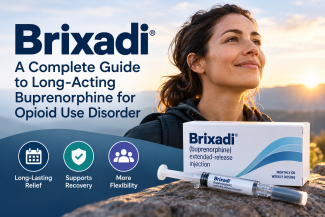
Quick answer: Brixadi and Sublocade are both FDA-approved extended-release buprenorphine injections for moderate to severe opioid use disorder, but they are not the same medication. Brixadi is available in weekly and monthly formulations across seven strengths, while Sublocade is a monthly injection available in 100 mg and 300 mg strengths. Both must be administered by a healthcare professional through restricted REMS distribution programs.
Last updated: September 26, 2026.
Safety note: Brixadi and Sublocade contain buprenorphine. Starting buprenorphine while sufficient fentanyl, heroin, methadone or another full opioid agonist remains active can trigger precipitated withdrawal. Combining buprenorphine with alcohol, benzodiazepines, gabapentinoids, opioids or other central nervous system depressants can also increase the risk of severe sedation and respiratory depression.
Key Takeaways
- Brixadi offers weekly and monthly dosing. Sublocade is a monthly injection.
- Brixadi has seven strengths: 8, 16, 24 and 32 mg weekly; 64, 96 and 128 mg monthly.
- Sublocade has two strengths: 100 mg and 300 mg.
- Neither medication contains naloxone. Both contain buprenorphine only.
- Neither product is universally “stronger.” Their dose numbers are not directly comparable because the depot technologies release buprenorphine differently.
- Both can be initiated after a tolerated transmucosal buprenorphine dose under current FDA labeling, although their initiation pathways differ.
- Both are subject to REMS restrictions and cannot be dispensed directly to patients for self-administration.
- Sublocade has a longer terminal half-life. Brixadi provides a shorter pharmacokinetic tail and more dosing flexibility.
Table of Contents
- Brixadi vs. Sublocade at a Glance
- What Is the Main Difference?
- Is Brixadi Better Than Sublocade?
- Is Brixadi Stronger Than Sublocade?
- What Doses Are Available?
- Can You Start Them the Same Day?
- Do You Have to Completely Detox First?
- What Does REMS Mean?
- Why Can't You Pick Them Up at a Pharmacy?
- Which One Lasts Longer?
- What Are the Side Effects?
- Which One Needs Refrigeration?
- Can You Switch Between Them?
- Myth vs. Fact
- When to Seek Help
- Frequently Asked Questions
- Related Clinical Resources
- References
Brixadi vs. Sublocade at a Glance
Brixadi and Sublocade contain the same active medication, buprenorphine, but use different extended-release delivery systems. The most important differences are dosing frequency, number of strengths, storage requirements, half-life and how quickly treatment can be adjusted.
| Feature | Brixadi | Sublocade |
|---|---|---|
| Active medication | Buprenorphine | Buprenorphine |
| Naloxone | No | No |
| Dosing schedule | Weekly or monthly | Monthly |
| Strengths | 8, 16, 24, 32 mg weekly; 64, 96, 128 mg monthly | 100 mg and 300 mg |
| Administration | Subcutaneous injection by healthcare professional | Subcutaneous injection by healthcare professional |
| Take-home medication | No | No |
| REMS | Yes | Yes |
| Storage | Room temperature | Normally refrigerated |
| Approximate terminal half-life | Weekly: 3–5 days; Monthly: 19–26 days | Approximately 43–60 days |
What Is the Main Difference Between Brixadi and Sublocade?
The biggest difference is dosing flexibility. Brixadi is available as either a weekly or monthly injection, while Sublocade is designed around monthly dosing.
Brixadi offers four weekly strengths and three monthly strengths. That gives clinicians several options when treatment needs to be adjusted more frequently, particularly earlier in treatment.
Sublocade uses a simpler two-strength system and has a substantially longer pharmacokinetic tail, meaning buprenorphine can remain in the body for a longer period after treatment is stopped.
For the broader Brixadi dosing, administration and withdrawal guide, see Brixadi dosing, side effects, administration and treatment information.
Is Brixadi Better Than Sublocade?
Neither Brixadi nor Sublocade is universally better. The more appropriate medication depends on treatment stage, clinical response, dosing preference, access, insurance coverage and the patient's treatment goals.
Brixadi may offer practical advantages when:
- weekly follow-up is useful;
- more dose-strength options are desirable;
- room-temperature storage simplifies clinic operations;
- a shorter-lasting depot is preferred;
- the patient wants to transition from weekly to monthly injections over time.
Sublocade may be attractive when:
- once-monthly treatment is preferred;
- the patient is already stable on Sublocade;
- a longer pharmacokinetic tail is useful;
- the clinic already has established Sublocade ordering and billing systems;
- insurance coverage favors Sublocade.
Those are product characteristics, not evidence that one medication produces a better result for every patient.
Is Brixadi Stronger Than Sublocade?
You cannot determine which medication is “stronger” by comparing the milligram numbers on the syringes. Brixadi and Sublocade use different extended-release technologies and do not have a direct milligram-for-milligram conversion.
For example, 128 mg of Brixadi Monthly should not be interpreted as weaker than 300 mg of Sublocade simply because the printed number is lower.
The more meaningful clinical variables are:
- peak buprenorphine concentration;
- trough concentration;
- dosing interval;
- steady-state exposure;
- clinical suppression of withdrawal and cravings;
- how quickly the medication can be adjusted.
Clinical Pearl: With extended-release buprenorphine, the number printed on the syringe does not tell you the product's clinical “strength.” The release system determines how much buprenorphine reaches the bloodstream over time.
What Doses of Brixadi and Sublocade Are Available?
Brixadi has seven labeled strengths, while Sublocade has two.
- Brixadi Weekly: 8 mg, 16 mg, 24 mg and 32 mg.
- Brixadi Monthly: 64 mg, 96 mg and 128 mg.
- Sublocade: 100 mg and 300 mg.
The larger number of Brixadi strengths may allow more incremental dose adjustments, particularly when using the weekly product. It does not mean Brixadi is inherently more effective.
People experiencing breakthrough cravings or withdrawal while receiving buprenorphine should not change doses themselves. The related guide Signs Your Suboxone Dose Is Too Low (Cravings, Withdrawal & What to Do) explains the symptoms clinicians consider when evaluating inadequate buprenorphine exposure.
Can You Start Sublocade or Brixadi the Same Day?
Both medications now have labeled initiation pathways that can begin after a patient tolerates transmucosal buprenorphine, but the exact sequence differs.
Starting Sublocade
A patient who is not already taking buprenorphine can receive an initial transmucosal buprenorphine dose to confirm tolerability before receiving Sublocade. Current FDA labeling no longer requires every new patient to complete seven days of sublingual buprenorphine first.
This is an important change because many older articles and search results still repeat the former seven-day stabilization requirement.
Starting Brixadi
A patient not currently receiving buprenorphine can begin with a transmucosal buprenorphine test dose and, if it is tolerated, transition to Brixadi Weekly. Brixadi Monthly is for patients who are already being treated with buprenorphine.
Both approaches require clinical assessment because buprenorphine can trigger precipitated withdrawal if sufficient full-opioid agonist effect remains.
Do You Have to Completely Detox Before Starting Sublocade or Brixadi?
No. A person does not have to wait until every opioid has completely left the body, but buprenorphine must be started at an appropriate clinical point.
The key concern is precipitated withdrawal. Buprenorphine binds tightly to opioid receptors and can displace fentanyl, heroin, methadone or another full agonist. If this happens too early, withdrawal can intensify abruptly.
For that reason, clinicians assess withdrawal signs and use a transmucosal buprenorphine dose to confirm tolerability before administering a long-acting injection when required by the product's labeled initiation pathway.
“No complete detox” should therefore not be interpreted as “the injection can be given at any time after opioid use.” Timing remains a clinical decision.
What Does REMS Mean for Brixadi and Sublocade?
REMS stands for Risk Evaluation and Mitigation Strategy. It is an FDA-required safety program used when additional controls are needed to make sure a medication's benefits outweigh specific serious risks.
For Brixadi and Sublocade, the major concern is accidental or intentional intravenous administration of the long-acting depot formulation.
Brixadi's REMS states that the medication must never be dispensed directly to a patient and must be administered by a healthcare professional in a healthcare setting. The goal is specifically to reduce the risk of serious harm or death from intravenous self-administration.
Sublocade operates under a similar restricted-distribution system and is also supplied directly to healthcare providers for administration rather than directly to patients.
Why is intravenous injection dangerous?
These medications are designed to form a long-lasting depot after subcutaneous injection. If the formulation is introduced into a vein instead, depot material can obstruct blood vessels and cause severe local tissue injury, thromboembolic complications, pulmonary embolism or death.
That physical depot risk is the primary reason the injections remain within a controlled healthcare distribution chain.
Why Can't You Pick Up Brixadi or Sublocade at a Regular Pharmacy?
Patients cannot receive Brixadi or Sublocade directly for self-administration because their REMS programs require restricted distribution.
The typical chain of custody is:
- Prescription: the healthcare provider orders the medication.
- Certified distribution: an authorized distributor or REMS-certified specialty pharmacy processes the medication.
- Direct delivery: the medication is delivered to the healthcare provider or administering healthcare setting rather than to the patient.
- In-clinic administration: a healthcare professional administers the injection.
For Brixadi specifically, a prescriber does not necessarily need individual REMS certification when obtaining medication for a named patient's appointment through a certified pharmacy. A healthcare setting that stocks Brixadi directly from a distributor must be certified in the Brixadi REMS.
So a “specialty pharmacy” may be involved in the process, but the patient still does not pick the injection up and take it home.
Which Lasts Longer: Brixadi or Sublocade?
Sublocade has the longer terminal half-life. Brixadi Weekly has an approximate half-life of 3–5 days, Brixadi Monthly approximately 19–26 days, and Sublocade approximately 43–60 days.
This matters because the medications continue releasing buprenorphine even after the patient stops receiving injections.
A longer pharmacokinetic tail can provide continued exposure between appointments, but it also means:
- medication changes can take longer to affect total exposure;
- withdrawal after discontinuation may be delayed;
- buprenorphine may remain detectable for months;
- surgeons and anesthesia teams need to know about recent injections.
For comparison with daily transmucosal buprenorphine, see How Long Does Suboxone Stay in Your System?.
What Are the Side Effects of Brixadi vs. Sublocade?
The side-effect profiles overlap because both medications contain buprenorphine, although their injection-site reactions and pharmacokinetic profiles are not identical.
Possible adverse effects include:
- injection-site pain;
- redness or itching;
- constipation;
- headache;
- nausea;
- fatigue or sedation;
- liver-related abnormalities;
- respiratory depression when combined with other depressants.
Patients should contact their treating clinic for an injection site that becomes increasingly painful, hot, draining, ulcerated or markedly swollen.
Both products can also be associated with delayed withdrawal after discontinuation because buprenorphine continues to be released from the depot.
Does Sublocade Have to Be Refrigerated? What About Brixadi?
Brixadi is stored at controlled room temperature, while Sublocade is normally refrigerated.
Brixadi is stored at approximately 20–25°C (68–77°F), with permitted excursions specified in its labeling.
Sublocade is ordinarily refrigerated at 2–8°C (36–46°F), although the product can remain at room temperature for a limited period under the conditions specified in the prescribing information.
This difference matters operationally for clinics, but storage convenience alone should not determine which medication a patient receives.
Can You Switch From Sublocade to Brixadi?
Yes, switching between long-acting buprenorphine products may be clinically appropriate, but there is no universal milligram-for-milligram conversion.
A clinician may consider:
- time since the most recent injection;
- the previous dose;
- current withdrawal or craving symptoms;
- residual buprenorphine exposure;
- other medications;
- liver function;
- insurance and formulary coverage;
- whether weekly or monthly visits are preferred.
Sublocade's prolonged half-life is particularly important because meaningful buprenorphine exposure can persist well after the last injection.
Can You Switch From Brixadi to Sublocade?
Yes, when clinically appropriate, but the transition should be planned by the prescriber. Brixadi also continues releasing buprenorphine after the injection, so timing cannot be determined by comparing the printed milligram numbers alone.
Brixadi vs. Sublocade: Myth vs. Fact
| Myth | Fact |
|---|---|
| Sublocade always requires seven days of Suboxone first. | Current FDA labeling allows initiation after a tolerated transmucosal buprenorphine dose with appropriate clinical observation. |
| Brixadi is weaker because its dose numbers are lower. | The products use different depot technologies and are not milligram-for-milligram equivalents. |
| Brixadi is injectable Suboxone. | Brixadi contains buprenorphine only; Suboxone contains buprenorphine plus naloxone. |
| You can pick either injection up from a regular pharmacy. | Both medications use restricted REMS distribution and are administered by healthcare professionals. |
| REMS means the medication is unsafe when properly administered. | The REMS specifically controls distribution and administration to reduce the serious risk associated with improper intravenous use. |
When to Seek Medical Help
Call 911 for slowed or stopped breathing, inability to wake, blue or gray lips, seizures, severe confusion or loss of consciousness. Give naloxone during a suspected opioid overdose if it is available and seek emergency medical care.
Contact the prescribing clinic promptly for severe sedation, significant withdrawal symptoms, worsening cravings, jaundice, dark urine or an injection site that becomes hot, draining, ulcerated or increasingly painful.
For related treatment-navigation information, see How Long Island Families Can Find Safe, Licensed Addiction Treatment.
Frequently Asked Questions About Brixadi vs. Sublocade
Is Brixadi the same as Sublocade?
No. Both are extended-release buprenorphine injections for opioid use disorder, but Brixadi has weekly and monthly formulations with seven strengths, while Sublocade is monthly and available in 100 mg and 300 mg strengths.
Does Brixadi contain naloxone?
No. Brixadi contains buprenorphine only. Sublocade also contains buprenorphine without naloxone. Suboxone differs because it contains both buprenorphine and naloxone.
Can Brixadi be started without taking Suboxone for a week?
Brixadi can be initiated in a patient not already receiving buprenorphine after a tolerated transmucosal buprenorphine test dose, using the Brixadi Weekly pathway. Brixadi Monthly is intended for patients already receiving buprenorphine.
Can Sublocade be started without seven days of Suboxone?
Yes. Current FDA labeling allows Sublocade initiation after a patient tolerates an initial transmucosal buprenorphine dose and is appropriately observed. Older information requiring seven days of prior stabilization is outdated.
Does Sublocade last longer than Brixadi?
Sublocade has a substantially longer terminal half-life than either Brixadi formulation. That means residual buprenorphine exposure can remain for longer after Sublocade treatment ends.
Which has more dosing flexibility?
Brixadi. It has both weekly and monthly formulations and seven labeled strengths. Sublocade uses 100 mg and 300 mg monthly injections.
Can either medication be self-injected?
No. Both Brixadi and Sublocade are administered by healthcare professionals through restricted distribution systems. Patients do not receive either product to take home and inject themselves.
Can you switch from Sublocade to Brixadi?
Yes, clinicians may switch between formulations when clinically appropriate, but there is no universal dose conversion. Timing, prior dose, residual buprenorphine exposure and the patient's symptoms must be considered.
Related Clinical Resources
- Brixadi Dosing, Side Effects, Administration & Clinical Guide
- How Long Does Suboxone Stay in Your System?
- Signs Your Suboxone Dose Is Too Low (Cravings, Withdrawal & What to Do)
- Does Suboxone Help Kratom / 7-OH Withdrawal? A New York–Focused Answer
- Does Suboxone Help With Kratom Dependence?
- 7-Hydroxymitragynine (7-OH) and Kratom Withdrawal: Clinical Insights and Buprenorphine-Based Management
- Integrated Recovery & Intervention Education Network (IRIEN)
Source Verification
The dosing, induction, administration, pharmacokinetic, storage and REMS information in this article is based primarily on current FDA-approved prescribing information and official REMS materials for Brixadi and Sublocade. Current FDA materials were prioritized over older search-result summaries when labeling had changed.
References
- U.S. Food and Drug Administration. BRIXADI (buprenorphine extended-release) injection: Prescribing Information.
- U.S. Food and Drug Administration. SUBLOCADE (buprenorphine extended-release) injection: Prescribing Information.
- U.S. Food and Drug Administration. Information About Medications for Opioid Use Disorder.
- U.S. Food and Drug Administration. FDA Approves New Buprenorphine Treatment Option for Opioid Use Disorder.
- BRIXADI REMS. BRIXADI Risk Evaluation and Mitigation Strategy.
- SUBLOCADE REMS. SUBLOCADE Risk Evaluation and Mitigation Strategy.
- Substance Abuse and Mental Health Services Administration. Buprenorphine Treatment Information.
Last updated: September 26, 2026.
About the Author
Benjamin Zohar, NCACIP is a Nationally Certified Advanced Clinical Intervention Professional and ISSUP network moderator specializing in addiction intervention, treatment navigation and emerging substance-use risks. His educational work published through ISSUP on counterfeit medications, fentanyl exposure and concentrated 7-hydroxymitragynine has been cited or referenced by GoodRx, The Washington Post, WIRED and Newsweek.
Medical review: Brandon McNally, RN reviewed this article for clinical accuracy, medication-safety context, opioid-withdrawal considerations and consistency with current prescribing information for Sublocade and Vivitrol.
Medical disclaimer: This article is intended for educational and public-health purposes. It does not provide individualized medical advice, diagnosis or a tapering schedule. Do not start, stop, switch or alter a prescription medication without consulting a qualified healthcare professional. Call emergency services for seizures, difficulty breathing, loss of consciousness, severe confusion or other life-threatening symptoms.