
Sublocade vs. Vivitrol: Buprenorphine vs. Naltrexone, Detox, Side Effects & Key Differences
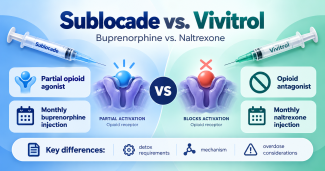
Quick answer: Sublocade and Vivitrol are both long-acting injections used in opioid use disorder treatment, but they work in fundamentally different ways. Sublocade contains buprenorphine, a partial opioid agonist that suppresses withdrawal and cravings while occupying opioid receptors. Vivitrol contains naltrexone, an opioid antagonist that blocks opioid receptors and requires an opioid-free period before treatment can begin.
Last updated: September 26, 2026.
Safety note: Vivitrol can cause severe precipitated withdrawal if it is administered before a person has been opioid-free for an adequate period. Sublocade can also precipitate withdrawal if buprenorphine is started while sufficient full-opioid agonist activity remains. Starting, stopping or switching either medication should be supervised by a qualified clinician.
Key Takeaways
- Sublocade contains buprenorphine, a partial opioid agonist.
- Vivitrol contains naltrexone, a full opioid antagonist.
- Sublocade can suppress opioid withdrawal and cravings because buprenorphine partially activates the mu-opioid receptor.
- Vivitrol does not activate opioid receptors. It blocks them.
- Vivitrol requires an opioid-free period before initiation. Current prescribing information recommends at least 7–10 days for people previously dependent on short-acting opioids, with longer vulnerability possible after buprenorphine or methadone.
- Sublocade is administered subcutaneously. Vivitrol is a deep intramuscular gluteal injection.
- Sublocade is a Schedule III controlled substance. Vivitrol/naltrexone is not a controlled substance.
- Vivitrol is also FDA-approved for alcohol dependence. Sublocade is used for opioid use disorder.
Table of Contents
- Sublocade vs. Vivitrol at a Glance
- What Is the Main Difference?
- How Do They Work?
- Which Is Better?
- Do You Have to Detox First?
- How Long Must You Be Opioid-Free for Vivitrol?
- Which One Prevents Withdrawal?
- Which One Blocks Opioids?
- How Are the Injections Given?
- Are They Controlled Substances?
- Can Vivitrol Treat Alcohol Use Disorder?
- Side Effects
- Overdose Risk and Loss of Tolerance
- What Happens if You Need Opioid Pain Medication?
- Can You Switch Between Them?
- What Does Research Show?
- Myth vs. Fact
- When to Seek Help
- Frequently Asked Questions
- Related Clinical Resources
- References
Sublocade vs. Vivitrol at a Glance
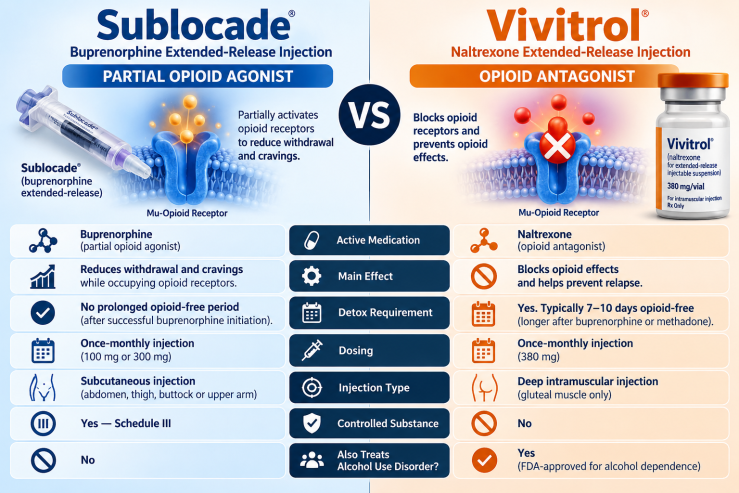
Sublocade maintains controlled buprenorphine activity at opioid receptors, while Vivitrol blocks opioid receptors with naltrexone. That difference changes almost every practical part of treatment, including induction, withdrawal management and what happens if opioids are taken during treatment.
| Feature | Sublocade | Vivitrol |
|---|---|---|
| Active medication | Buprenorphine | Naltrexone |
| Drug action | Partial opioid agonist | Opioid antagonist |
| Main OUD role | Suppresses withdrawal and cravings while providing receptor occupancy | Blocks opioid effects after detoxification |
| Opioid-free period before starting | No prolonged opioid-free period after successful buprenorphine initiation | Yes |
| Typical frequency | Monthly | Every 4 weeks / monthly |
| Injection route | Subcutaneous | Deep intramuscular gluteal |
| Strengths | 100 mg and 300 mg | 380 mg |
| Controlled substance | Yes — Schedule III | No |
| Also approved for alcohol dependence | No | Yes |
| REMS restricted distribution | Yes | No comparable depot REMS program |
What Is the Main Difference Between Sublocade and Vivitrol?
The main difference is receptor activity. Sublocade contains buprenorphine, which partially activates the mu-opioid receptor. Vivitrol contains naltrexone, which blocks opioid receptors without activating them.
This means Sublocade can directly suppress opioid withdrawal and cravings while maintaining controlled opioid-receptor activity. Vivitrol cannot treat active opioid withdrawal because it provides no opioid agonist activity.
Instead, Vivitrol is used after opioid detoxification to help prevent relapse by blocking opioid effects.
This mechanism difference is more important than the fact that both medications are monthly injections.
How Do Sublocade and Vivitrol Work?
Sublocade partially activates opioid receptors; Vivitrol blocks them.
How Sublocade works
Sublocade releases buprenorphine gradually from a depot under the skin. Buprenorphine has high affinity for the mu-opioid receptor but only partially activates it.
This can:
- reduce opioid withdrawal;
- reduce cravings;
- occupy receptors that full opioids would otherwise bind to;
- reduce the subjective effects of other opioids.
For a comparison with another long-acting buprenorphine injection, see the related Brixadi vs. Sublocade clinical guide.
How Vivitrol works
Vivitrol contains extended-release naltrexone. Naltrexone is an opioid antagonist, meaning it binds to opioid receptors without activating them.
It therefore:
- does not produce an opioid effect;
- does not treat opioid withdrawal directly;
- blocks or reduces the effects of opioid agonists;
- can help prevent relapse after detoxification.
Clinical Pearl: A partial agonist and an antagonist may both reduce opioid use, but they get there through opposite receptor strategies. Buprenorphine stabilizes opioid receptors. Naltrexone blocks them.
Is Sublocade Better Than Vivitrol?
Neither medication is universally better. The most important practical difference is whether a patient can safely and successfully complete the opioid-free period required before Vivitrol.
Sublocade may fit a patient who:
- needs buprenorphine to control withdrawal or cravings;
- cannot comfortably complete an extended opioid-free interval;
- has already responded well to buprenorphine;
- wants a long-acting alternative to daily buprenorphine.
Vivitrol may fit a patient who:
- has already completed opioid detoxification;
- wants a non-opioid medication;
- does not want to remain on an opioid agonist or partial agonist;
- also has alcohol use disorder and naltrexone is clinically appropriate;
- can reliably return for monthly injections.
The decision should account for withdrawal status, prior treatment response, overdose history, liver health, other medications, pain-treatment needs and patient preference.
Do You Have to Detox Before Sublocade or Vivitrol?
Vivitrol generally requires completion of opioid detoxification first; Sublocade does not require the same prolonged opioid-free interval.
Before Sublocade, a patient must first tolerate transmucosal buprenorphine under the current labeled initiation pathway or already be receiving buprenorphine.
Vivitrol is fundamentally different. Because naltrexone is a pure opioid antagonist, administering it to someone who remains physically dependent on opioids can abruptly displace opioid agonist activity and cause severe precipitated withdrawal.
This is why treatment entry can be easier with buprenorphine-based medication for some patients.
How Long Must You Be Opioid-Free Before Vivitrol?
Current Vivitrol prescribing information recommends an opioid-free interval of at least 7–10 days for people previously dependent on short-acting opioids.
Patients transitioning from longer-acting opioid treatments such as buprenorphine or methadone may remain vulnerable to precipitated withdrawal for longer.
The appropriate waiting period depends on factors including:
- the opioid previously used;
- how long and how heavily it was used;
- whether methadone or buprenorphine was involved;
- withdrawal signs;
- clinical assessment;
- urine toxicology or a naloxone challenge when appropriate.
No test can completely guarantee that precipitated withdrawal will not occur. The decision to administer Vivitrol should therefore be clinical rather than based solely on a calendar.
Which Medication Treats Opioid Withdrawal: Sublocade or Vivitrol?
Sublocade's active medication, buprenorphine, can suppress opioid withdrawal; Vivitrol cannot.
Buprenorphine partially activates opioid receptors and can stabilize a person who is physically dependent on opioids once induction is appropriately timed.
Naltrexone does not activate opioid receptors. Giving Vivitrol too early can therefore make withdrawal dramatically worse rather than treating it.
That distinction is critical for patients transitioning directly from fentanyl, heroin, methadone or another opioid.
For related buprenorphine dosing concerns, see Signs Your Suboxone Dose Is Too Low (Cravings, Withdrawal & What to Do).
Does Sublocade or Vivitrol Block Opioids Better?
Both can reduce the effects of other opioids, but they do so differently.
Vivitrol is specifically an opioid antagonist. It occupies opioid receptors and prevents opioid agonists from activating them normally.
Sublocade contains high-affinity buprenorphine, which occupies opioid receptors strongly and can blunt the effects of full agonists while still partially activating the receptor itself.
Neither medication should be treated as protection against overdose.
Attempting to overcome either medication's opioid blockade by using very large amounts of fentanyl, heroin or prescription opioids can be dangerous or fatal.
How Are Sublocade and Vivitrol Injections Given?
Sublocade is injected under the skin; Vivitrol is injected deeply into a gluteal muscle.
Sublocade
Sublocade is administered subcutaneously by a healthcare professional. Current labeling allows injection into approved areas including the abdomen, thigh, buttock or back of the upper arm.
The medication forms a long-lasting buprenorphine depot after injection.
Vivitrol
Vivitrol is supplied as 380 mg of extended-release naltrexone and is administered as a deep intramuscular gluteal injection every four weeks or once monthly.
Injection sides are alternated between the buttocks.
Are Sublocade and Vivitrol Controlled Substances?
Sublocade is a Schedule III controlled substance; Vivitrol is not a controlled substance.
Buprenorphine has opioid agonist activity and is regulated under the Controlled Substances Act.
Naltrexone has no opioid agonist activity, does not produce opioid euphoria and is not scheduled as a controlled substance.
This is one reason some patients specifically ask about Vivitrol when they prefer a non-opioid medication option.
Can Vivitrol Treat Alcohol Use Disorder Too?
Yes. Vivitrol is FDA-approved for both alcohol dependence and prevention of relapse to opioid dependence after detoxification.
Sublocade is an opioid use disorder medication and is not approved to treat alcohol use disorder.
This can make Vivitrol clinically relevant for some patients with co-occurring alcohol and opioid problems, although treatment planning still depends on the individual's current opioid exposure and ability to complete the opioid-free period.
Sublocade vs. Vivitrol Side Effects
The medications have different mechanisms, so their risk profiles also differ.
Potential Sublocade concerns
- constipation;
- headache;
- nausea;
- injection-site reactions;
- sedation;
- respiratory depression, especially with other CNS depressants;
- physical dependence;
- delayed withdrawal after discontinuation;
- liver-related abnormalities.
Potential Vivitrol concerns
- injection-site reactions;
- nausea;
- headache;
- liver injury or elevated liver enzymes;
- precipitated withdrawal if administered too soon after opioids;
- reduced opioid tolerance and overdose vulnerability after blockade wanes;
- difficulty using opioid analgesics for acute pain.
Vivitrol injection-site reactions can occasionally be severe and may require medical or surgical evaluation.
Which Has More Overdose Risk: Sublocade or Vivitrol?
The overdose risks are different rather than directly comparable.
Sublocade contains an opioid medication. Serious respiratory depression can occur, particularly when buprenorphine is combined with benzodiazepines, alcohol, gabapentinoids or other sedating substances.
Vivitrol itself does not cause opioid respiratory depression, but treatment creates another risk: opioid tolerance decreases while receptors are blocked.
A person may become especially vulnerable to overdose:
- near the end of a Vivitrol dosing interval;
- after missing an injection;
- after stopping Vivitrol;
- if attempting to override the opioid blockade with large opioid doses.
Patients and families should have access to naloxone regardless of which OUD medication is used.
What Happens if You Need Opioid Pain Medication?
Vivitrol can make opioid pain treatment particularly difficult because naltrexone actively blocks opioid receptors.
Emergency and surgical teams need to know when a patient has received Vivitrol. Non-opioid analgesia and regional anesthesia may be preferred when appropriate.
If opioids are absolutely necessary, the patient may require closely monitored care by clinicians experienced in managing opioid-antagonist blockade.
Sublocade also complicates acute pain treatment because buprenorphine binds tightly to opioid receptors and remains in the body for an extended period.
Neither medication should be omitted from a medication history before surgery, trauma treatment or emergency care.
Can You Switch From Sublocade to Vivitrol?
Yes, but switching from Sublocade to Vivitrol requires special caution because Vivitrol must not be given while clinically significant buprenorphine activity remains.
Sublocade has a very long terminal half-life and may remain measurable for many months after treatment ends.
The transition therefore cannot be handled with a simple number of days after the last injection.
A clinician may consider:
- time since the last Sublocade dose;
- withdrawal symptoms;
- residual buprenorphine exposure;
- urine drug testing;
- clinical examination;
- a naloxone challenge when appropriate.
Vivitrol labeling specifically notes that patients transitioning from buprenorphine or methadone may remain vulnerable to precipitated withdrawal for as long as two weeks or longer depending on clinical circumstances.
Can You Switch From Vivitrol to Sublocade?
A patient can transition from Vivitrol to buprenorphine treatment when clinically appropriate, but the timing should be individualized.
Because naltrexone blocks opioid receptors, buprenorphine may have reduced effect while significant antagonist activity remains. Treatment should be planned by a clinician rather than by attempting to “break through” the Vivitrol blockade.
What Does Research Say About Naltrexone vs. Buprenorphine?
The strongest randomized comparison studied extended-release naltrexone against daily buprenorphine/naloxone, not Sublocade specifically.
In the NIDA-funded X:BOT trial, starting extended-release naltrexone proved more difficult because participants first had to complete detoxification and the opioid-free induction period.
Fewer patients successfully initiated extended-release naltrexone than buprenorphine/naloxone. Much of the difference in overall relapse outcomes was associated with those early induction failures.
Among participants who successfully started their assigned medication, relapse outcomes were similar.
Important evidence distinction: X:BOT does not prove that Sublocade is superior or equivalent to Vivitrol. It compared monthly extended-release naltrexone with daily sublingual buprenorphine/naloxone. The study is useful primarily for understanding the antagonist-versus-buprenorphine treatment-entry problem.
Sublocade vs. Vivitrol: Myth vs. Fact
| Myth | Fact |
|---|---|
| Vivitrol and Sublocade are basically the same monthly shot. | They use completely different medications and opposite opioid-receptor mechanisms. |
| Vivitrol treats active opioid withdrawal. | It does not. Giving Vivitrol while opioid dependence remains can precipitate severe withdrawal. |
| You must be opioid-free for weeks before Sublocade. | Sublocade uses a buprenorphine initiation pathway and does not require the same prolonged opioid-free interval as Vivitrol. |
| Vivitrol is an opioid. | Naltrexone is an opioid antagonist and is not a controlled substance. |
| Vivitrol makes opioid overdose impossible. | No. Attempts to overcome the blockade and reduced tolerance after treatment can increase overdose risk. |
| Sublocade and Vivitrol have been proven equal in a direct head-to-head trial. | The major X:BOT trial compared extended-release naltrexone with daily buprenorphine/naloxone, not Sublocade. |
When to Seek Medical Help
Call emergency services for slowed or stopped breathing, inability to wake, blue or gray lips, seizures, severe confusion or suspected overdose. Administer naloxone when opioid overdose is suspected if it is available.
Contact a clinician promptly for severe or prolonged withdrawal, jaundice, dark urine, worsening depression, significant injection-site swelling or drainage, or difficulty controlling opioid cravings.
People considering either medication should receive an individualized assessment rather than choosing based only on whether the medication is an opioid or non-opioid treatment.
Frequently Asked Questions About Sublocade vs. Vivitrol
Is Vivitrol the same as Sublocade?
No. Sublocade contains buprenorphine, a partial opioid agonist. Vivitrol contains naltrexone, an opioid antagonist. Both may be used in opioid use disorder treatment, but their mechanisms and initiation requirements are very different.
Is Vivitrol an opioid?
No. Vivitrol contains naltrexone, which blocks opioid receptors rather than activating them. Naltrexone is not classified as a controlled substance.
Does Sublocade contain naloxone?
No. Sublocade contains buprenorphine only. Suboxone contains buprenorphine plus naloxone. Vivitrol contains neither; its active medication is naltrexone.
Can you start Vivitrol while still using opioids?
Generally no. Patients should be opioid-free before receiving Vivitrol because naltrexone can trigger severe precipitated withdrawal in someone who remains physically dependent on opioids.
How long do you have to be clean before Vivitrol?
The prescribing information recommends a minimum opioid-free period of 7–10 days for people previously dependent on short-acting opioids. Longer intervals may be necessary after methadone or buprenorphine.
Can Vivitrol treat alcohol addiction?
Yes. Vivitrol is FDA-approved for alcohol dependence as well as prevention of relapse to opioid dependence following detoxification.
Does Sublocade require detox?
Sublocade does not require the same extended opioid-free period as Vivitrol. Patients must first tolerate buprenorphine under the approved initiation pathway so that the medication is not introduced while full-opioid agonist activity could trigger precipitated withdrawal.
Which injection is monthly?
Both are generally administered monthly. Sublocade is a monthly subcutaneous buprenorphine injection. Vivitrol is a 380 mg deep intramuscular injection given every four weeks or once monthly.
Which medication has withdrawal when you stop it?
Sublocade contains buprenorphine and can produce physical dependence, so withdrawal may eventually occur after discontinuation as depot levels fall. Vivitrol does not create opioid physical dependence, although stopping it removes opioid blockade and may leave a person vulnerable to relapse and overdose.
Can you take opioids while on Vivitrol?
Vivitrol blocks opioid receptors, so ordinary opioid effects may be markedly reduced. Trying to overcome that blockade with larger opioid doses is dangerous and can lead to fatal overdose.
Related Clinical Resources
- Brixadi vs. Sublocade: Doses, Side Effects, REMS, Half-Life & Key Differences — comparison of the two long-acting buprenorphine injections.
- Brixadi Dosing, Side Effects, Administration & Clinical Guide
- How Long Does Suboxone Stay in Your System?
- Signs Your Suboxone Dose Is Too Low (Cravings, Withdrawal & What to Do)
- Does Suboxone Help Kratom / 7-OH Withdrawal? A New York–Focused Answer
- Does Suboxone Help With Kratom Dependence?
- 7-Hydroxymitragynine (7-OH) and Kratom Withdrawal: Clinical Insights and Buprenorphine-Based Management
Source Verification
Medication mechanism, dosing, route of administration, opioid-free requirements and safety information in this article were checked against current U.S. prescribing information for Sublocade and Vivitrol. Evidence comparing antagonist treatment with buprenorphine treatment is described according to the actual medication formulations studied and should not be interpreted as a direct Sublocade-versus-Vivitrol randomized trial.
References
- U.S. Food and Drug Administration. SUBLOCADE (buprenorphine extended-release) injection: Prescribing Information .
- U.S. Food and Drug Administration. VIVITROL (naltrexone for extended-release injectable suspension): Prescribing Information .
- U.S. Food and Drug Administration. Information About Medications for Opioid Use Disorder .
- Substance Abuse and Mental Health Services Administration. Medications for Substance Use Disorders .
- National Institute on Drug Abuse. Medications to Treat Opioid Use Disorder .
- Lee JD, Nunes EV Jr, Novo P, et al. Comparative effectiveness of extended-release naltrexone versus buprenorphine-naloxone for opioid relapse prevention (X:BOT) . The Lancet. 2018.
Last updated: September 26, 2026.
About the Author
Benjamin Zohar, NCACIP is a Nationally Certified Advanced Clinical Intervention Professional and ISSUP network moderator specializing in addiction intervention, treatment navigation and emerging substance-use risks. His educational work published through ISSUP on counterfeit medications, fentanyl exposure and concentrated 7-hydroxymitragynine has been cited or referenced by GoodRx, The Washington Post, WIRED and Newsweek.
Medical review: Brandon McNally, RN reviewed this article for clinical accuracy, medication-safety context, opioid-withdrawal considerations and consistency with current prescribing information for Sublocade and Vivitrol.
Medical disclaimer: This article is intended for educational and public-health purposes. It does not provide individualized medical advice, diagnosis or a tapering schedule. Do not start, stop, switch or alter a prescription medication without consulting a qualified healthcare professional. Call emergency services for seizures, difficulty breathing, loss of consciousness, severe confusion or other life-threatening symptoms.