
The Road After Prison: Care, Recovery and Safer Communities with Michael Chaple Pt.3
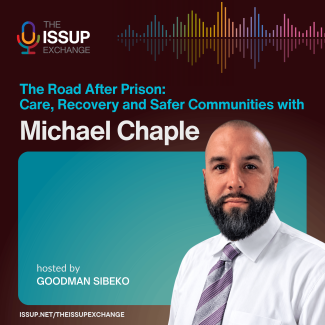
In this third episode, Professor Goodman Sibeko and Michael Chaple look at what happens when re-entry support exists but the systems around it do not work together. Michael shares his experience of the barriers that can limit successful reintegration, from gaps in resources and competing priorities to organisations working in isolation.
They discuss the importance of bringing the right partners together, defining responsibility, and adapting approaches to different communities. The conversation also considers the distinct challenges facing rural and urban areas and why understanding local needs, resources, and gaps is a vital first step towards building a stronger re-entry system.
Featured Voices
Host – A/Prof. Goodman Sibeko
ISSUP Global Scientific Advisor.
Head of Addiction Psychiatry, University of Cape Town.
LinkedIn: goodmansibeko
Twitter/X: @profgsibeko
Guest – Michael Chaple
Michael Chaple is an internationally recognised expert in correctional behavioural health, implementation science and justice-health systems integration. His work has focused on strengthening substance use and mental health services in correctional settings and improving continuity of care as people return to the community. Learn More>>
Time Stamps
Professor Goodman Sibeko (00:00)
Hello and welcome to this third episode of The Road After Prison, Care, Recovery, and Safer Communities with Michael Chaple. A strong intervention can still fail when it sits inside a fragmented system. Lasting improvement depends on whether corrections, healthcare, probation, community organizations and other partners can connect their work around the person making the transition. So today we're gonna explore why coordination tends to be difficult, what makes cross-sector partnerships work and how context changes that challenge, and then what implementation science really then teaches us about sustainable change. Michael, thank you so much for joining us once again.
Michael Chaple (00:39)
Thank you again for having me.
Professor Goodman Sibeko (00:41)
Why is it, Michael, that well-designed programs sometimes struggle to produce long-lasting impact?
Michael Chaple (00:47)
I think that there are many re-entry programs that are well-intended in their design, but not necessarily well-designed with regard to implementation. And there are a lot of reasons for this. I mean, probably first and foremost, there are extensive systemic barriers to comprehensive re-entry planning because there requires the involvement of so many partners. So, for example, a common thing that I've seen in my work is housing instability is a major issue in many communities who simply lack the range of housing resources needed to accommodate everyone upon re-entry. So some might lack, like, short-term transitional options, others might lack more permanent options following transitional housing. Individuals with criminal records are restricted from certain housing. For example, in the United States, public housing authorities can be very restrictive. Given the importance of housing stability, these gaps can significantly undermine successful reintegration, right?
And that's just one example. There are many of those. I can give you them in every domain. But also the lack of provision of rehabilitative services while incarcerated, coupled with minimal re-entry coordination prior to release, means that most re-entry programs initiate essentially following release, which significantly reduces engagement among those individuals re-entering the community and hampers the ability of any of these providers, whatever service you're providing, to gain any traction. Many re-entry programs are relying upon grants to deliver certain services, which presents challenges for sustainability when those grant funds disappear. Re-entry needs are complex and must be coordinated across a range of stakeholders. I mean, dozens and dozens of stakeholders in the community. Oftentimes, not everyone that needs to be at the table has, in fact, taken a seat at the table.
This means that well-intended players struggle to be able to maximize the support they have. There are gaps, there are resource gaps. And then because of that, re-entry programs are often very narrowly constructed. Right. And they reflect a one-size-fits-all approach more than that rather than a tailored, comprehensive one. So it's really, really a big undertaking in terms of the amount of involvement and planning that is required.
Professor Goodman Sibeko (02:49)
So, Michael, I think what's come across from our previous episodes and from what you've just said to us now is really the importance of coordination and of a systematized approach. What would you say distinguishes an instance where an intervention can be viewed as isolated compared to one where you could call it an integrated re-entry system? What would be the distinguishing factor?
Michael Chaple (03:13)
It's similar to what I described in the sense that a comprehensive approach to re-entry requires the involvement of dozens of community stakeholders. And just to give you an idea, we're talking about corrections administrators, whether we're institutional or community corrections, local law enforcement, judges, legal teams, behavioral health providers, housing authorities, department of social services, local businesses, chambers of commerce, workforce development boards, peer navigators, recovery services, on and on and on, right? And that's just probably half of who you need to have at the table. So in my experience, it's rare that there's participation from all the necessarily necessary stakeholders. Further, even when there is participation across a good number of these partners, coordination can be a real struggle as there are competing interests and demands in terms of agency missions, as well as resource limitations.
So truly integrated systems would incorporate all of these partners in a manner that effectively coordinates responsibility for re-entry services across all these systems of care. Instead, what you typically get is an isolated intervention that's implemented in a particular setting with a minimal amount of partners, and thereby limits that approach to those services and resources that are represented at the table, with significant gaps still existing.
Professor Goodman Sibeko (04:29)
So having said that, in your view, is it the chicken or the egg? What's the greater problem? Is it lack of service provision at all, or is it fragmentation between services that already exist?
Michael Chaple (04:40)
Yeah, I think it's safe to say there's always going to be service gaps, right? Whether that's because certain services are underrepresented in a particular community, or the service exists, but the stakeholders just aren't at the table, for example. But I would say that by and large, it's almost always fragmentation as the greater barrier. There are many where you have, like I said, all of these stakeholders, some of which have not bought into this even being their responsibility in the first place. Others not understanding what they can contribute, not coming to the table. And in reality, most of the time, it's not being able to coordinate across the range of services that exist. I can't tell you how many times we've provided technical assistance in communities around re-entry initiatives, and the large breakthrough was getting two providers or two stakeholders to not only recognize each other's existence, but actually start to have hard conversations about how they can contribute to the effort together.
And so I think more often than not, especially in larger urban areas, we see this very commonly, where you have all the resources, you have all the services, there's just not significant awareness of what exists. And even when there is, conversations aren't being had. Communication is not happening. Everyone's sort of, like, bogged down. And we can understand this, we can all understand this. We're bogged down in sort of our lane, right? Doing what it is that we need to do on a day-to-day basis.
Professor Goodman Sibeko (06:04)
So Mike, we spoke about the, you know, the need for stakeholders to all share this interest in the client's well-being and in their best interest. And we've also sort of discussed the funding challenges that play a role. And one could also talk about the fact that there's often competition for a finite pie of funding. And I also sort of wonder whether the fragmentation might be part of the result of this. Is there any other reason or would you like to expand on that in terms of why do you think coordination might be harder than creating a new program altogether?
Michael Chaple (06:37)
Yeah, I mean, the reality is that creating a new program, if you're gonna do it right, is actually quite difficult and will require the same coordination that you would have liked to be doing in the first place. But also the fact is that you can create a shell of a program, a program, like I said, that maybe isn't as comprehensive as it needs to be, but that's a lot easier sometimes to get something off the ground and to say that you're being responsive to a challenge, right? We all want to respond.
We want to do something. And the reality is that coordination takes, can't put a number on it, but I've seen communities working on it for years to get people to the table. Once you're entrenched and you've got buy-in and you've got people around, you can get some real momentum, but it takes time. And so communities often opt to create new programs rather than pursue enhanced coordination among existing agencies because they can sort of get going quicker. But you end up with the same result. You end up with what I just described before, where you have a program that's operating in a silo with the involvement of some stakeholders and not enough.
And ultimately, you need to promote more coordination and more communication between partners the same way you would have to start, if that makes any sense. And so it's really sort of like six in one, half a dozen in another, and coordination is always going to be necessary if you want to have, you know, a different, if you want to have a comprehensive response to a very complex problem. But, you know, you have agencies that have operated in their own silos historically. You have conflicting institutional missions that can limit motivation for collaboration. You have organizations that answer to different governing bodies. And sometimes those regulations clash. You have issues around privacy laws, fragmented funding that people, you alluded to this.
You can kind of be competing for that, right? If you're gonna collaborate, then you may be sort of giving up your position in terms of being funding worthy, right? And effective coordination, the biggest thing I think, though, is that effective coordination requires ownership. When you have 15 large government and other community agencies that are trying to communicate, coordinate, and collaborate around an issue like this, if you don't have ownership somewhere, somehow, cross-agency, you're just gonna be spinning your wheels eternally. And I really find that that's often the biggest issue. Who owns the process, at least in terms of keeping the process moving, right? And that sort of thing. I think that's often been the biggest challenge.
Professor Goodman Sibeko (09:03)
It sounds to me like we're also talking about clarifying roles, right? And understanding which component, which partner is going to be responsible for ensuring the quality of and the effectiveness of. So keeping that in mind, how can partners then go about clarifying roles, sharing information, building trust across all of these professional cultures? I mean, you spoke about those conflicting missions.
Michael Chaple (09:25)
Yeah, I mean, there are many things that are required to make these partnerships successful. Like I said, there are a lot of barriers, a lot of organizational challenge. You know, there is what I would consider a foundational factor that I've repeatedly seen absent in many re-entry initiatives. And a lot of that is what you spoke to. All the stakeholders involved must be able to see first their respective roles and responsibilities clearly. And I don't necessarily mean that relative to the other organizations that are participating. I mean that they see that they belong at that table and that they have a responsibility and they have a role towards the solution.
Right? Like, when I think about re-entry, many times, for example, working with housing providers, they have regs, you know. They may not allow, for example, anyone with a criminal record to get Section 8 housing in the United States. Well, that's the rule. That's the regulation. We have nothing to offer here. Right? Just that sort of belief that you have a role and you have a responsibility and there's something that you can do. And I think in many ways, Corrections has long resisted their role and responsibility toward rehabilitation, specifically as it pertains to behavioral health care, but more broadly, even in terms of re-entry planning.
Right. And medical providers have struggled to accept their role and responsibility with regard to substance use disorders. They're not trained to do it. They don't want to prescribe medications for opioid use disorders. There's a lot of resistance, right? Community behavioral health providers can't facilitate successful re-entry alone, and it's not just about treatment. So once all potential partners recognize and buy into their respective roles, conversations can ensue that then begin to explore what's the collective response? How are we gonna share these roles and responsibilities? How are we gonna maximize our output, giving everything that we bring to the table? And what specifically are we responsible for doing?
Professor Goodman Sibeko (11:11)
That's great. So, you know, in continuing along that thread, you spoke earlier about the difference really between urban and the rural context. You know, how do these challenges between rural and urban and remote communities, how do those play out? What are the differences that we see?
Michael Chaple (11:29)
Yeah, I mean, I would say the main difference, broadly stated, is that rural communities generally have to tackle re-entry challenges with fewer resources and more significant barriers, right? We know that in rural areas, specialty services are limited as there are provider shortages, right? It's hard to get social workers, it's hard to get psychiatrists, it's hard to get other types of disciplines and professionals in smaller rural areas. We know this for a long time now.
Transportation is often a challenge as the services that are available may be at a distance because there are fewer. So you have to travel further to get there. But you may also not have transportation at all, regardless of how long you have to travel. And there's not public transportation in most rural areas, right? Stigma is a huge challenge in rural areas as it pertains to both criminal involvement and behavioral health disorders, right? Privacy is limited in rural areas. Everybody knows everybody.
If your car is parked in front of the rehab center, people are gonna know. Right. Those types of things. Employment options could be more limited in general, but also that sort of everybody-knows-everybody thing where local employers can discriminate against those who they may know have a criminal record. Right? Urban areas conversely tend to be more resource-rich in terms of having the jobs, having the housing options, having the treatment centers, having the professionals. There's more anonymity to a degree in the way that I just described it in rural areas. However, this turns back to what we were just discussing. They tend to struggle in urban areas related to the fragmentation of services, right? Because they have so much, but they don't coordinate anything. So which I would almost argue.
It's a little easier to design re-entry in smaller communities where you know what you have and you can coordinate up to the best of your ability rather than trying to coordinate a highly fragmented system of care across multiple players that aren't even bought into the process. So I mean, I wouldn't give up on either avenue, but it's an interesting thought.
Professor Goodman Sibeko (13:28)
That really speaks to, you know, it's an easy segue into what I was gonna ask you next in terms of what can some of these lower-resource jurisdictions learn from the higher-resource systems, but without trying to copy a structure that doesn't fit in their context or within their pocket.
Michael Chaple (13:44)
Right. Yeah, I don't ever think, I mean, I think there are always lessons to be learned, but I don't ever think strict replication is the goal, right? I have never seen two re-entry programs in the United States designed the same way. And I wouldn't expect to see that anywhere else. So we differ greatly here with regard to the resources that we can leverage to meet re-entry needs. Worked with probably 50 different communities, have come to the table, always citing very specifically different needs.
The goal, whether here or internationally, is to design a program that leverages the resources available to ensure maximum benefit. Whatever is available. Sometimes we can create, sometimes we can be creative, but I think it's safe to say that regardless of location, the needs of someone re-entering the community after a period of incarceration are fairly common, right? That is, many of these individuals may need treatment, housing, employment, health care, benefits, social support, et cetera.
Developing first and foremost a comprehensive understanding of what these needs are is essential. We don't even do a good enough job of this. We often have a one-size-fits-all approach where we say these are the things that we're gonna do for you, whether they fit or not, whether you need them or not, because this is what we do. And then what we should do is identify strengths, right? What do we have access to? You know, I'm not an international expert in any particular community.
I have some experience, but, you know, the housing struggles we have here may not be an issue. Health insurance, right, may not be the same somewhere else. We have a lot of challenges around health insurance here. So identify your strengths and then your service gaps. What's the unmet need? And then design a program that can be best leveraged to meet these needs as best as possible. You can't, you know, you can't do anything that you can't do, like I've said before.
And keep in mind, what's interesting about this is that as many people may know, the United States incarcerates or convicts, has justice involvement at a far greater rate than any other country in the world. And so volume in and of itself could be impactful here. We're releasing 500,000 people annually from state prisons, and about 8 million cycle through our jails annually.
So we've got massive volume to deal with, and if that's not the case in other places and the resources are strong, you might not have the same challenges. It's very particular.
Professor Goodman Sibeko (16:04)
Michael, if you were advising a country, I know you say you're not an international expert, but we're gonna make you one for this last question. If you were advising a country that was starting to strengthen its re-entry system today, what would you recommend it, where should they start?
Michael Chaple (16:19)
Think system mapping. Speaking similar to what I just said, I would call it system mapping, would be a critical foundation to any re-entry effort. So this would consist of a clear understanding of the needs of the re-entry population, right? Who is it that's re-entering the community and what is it that they need, followed by a clear understanding of the resources that are available to meet these needs. We talk about this with our communities here.
You have domains, right? You have different domains, treatment, housing, employment. What are your community resources in each of these domains? What are the needs of the population that's being released? Are there other foundational needs, you know, whether it's basic needs or ID or whatever the case may be? And you gotta map it and match it and see what you have, see what your strengths are, see what your gaps are, but you really gotta think about it like laying it out from the beginning, go all the way back to the beginning.
And see what you have and then see where you have ability to fill in what you don't have. And the reality is, is that every re-entry program I've ever seen operates with deficiencies.
Professor Goodman Sibeko (17:20)
You gotta know what you have before you do something with it. Michael, thank you for reminding us that sustainable change depends not only on selecting effective interventions, but also on good system mapping, building the relationships, workflows, and feedback systems that really allow those interventions to work effectively together. In our next episode, we will look at what success then looks like. We'll move beyond recidivism alone to consider treatment, engagement, recovery, housing, employment, relationships, quality of life, and the wider benefits of safer, healthier communities. We hope you'll join us for this next and final episode. Thank you, Michael.
Michael Chaple (17:57)
Thank you.
Professor Goodman Sibeko (17:59)
Thank you for spending this time with us. We hope you enjoy that as much as we do. Be sure to hop on over to our website, isop.net, where you'll find information on how to sign up for free membership. Take care and catch you on the next one.
About the ISSUP Exchange
The ISSUP Exchange podcast series explores the evolution of responses to the challenges of substance use—from research and training to ethics, quality standards and evidence-based practice. We connect the dots so you can see the big picture.
Explore more episodes and join the ISSUP podcast community here>>>
About ISSUP
ISSUP is a global network that unites, connects, and shares knowledge across the substance use prevention, treatment, and recovery support workforce. Our mission is to make our members’ work as effective as possible—by providing access to training, resources, and a vibrant professional community.