

Prevalence, sex differences, disability burden, and temporal trends of substance use disorders across twenty-two Arab countries, 2019–2023: a secondary analysis of the Global Burden of Disease Study 2023
Substance Use Disorders Across 22 Arab Countries: New Research Reveals Important Regional Differences and a Distinctive Gender Pattern
Research feature | Public Health, Psychiatry and Addiction Medicine
A comprehensive analysis published in The Lancet Regional Health – Eastern Mediterranean offers important new insights into the prevalence, disability burden, and changing patterns of substance use disorders across 22 Arab League countries. Drawing on estimates from the Global Burden of Disease (GBD) Study 2023, the research highlights a complex regional picture: although the overall prevalence of substance use disorders remains substantially below global estimates, important differences exist between countries, substance categories, and sexes.
The study, titled “Prevalence, sex differences, disability burden, and temporal trends of substance use disorders across twenty-two Arab countries, 2019–2023: a secondary analysis of the Global Burden of Disease Study 2023,” was conducted by Qassem, Muneer, and colleagues and published on 8 October 2026.
One of its most striking findings is that estimated opioid use disorder prevalence was higher among women than men in 19 of the 22 Arab countries, contrasting with the male-dominant pattern observed globally. This finding raises important questions about regional epidemiology, treatment accessibility, and the need for sex-responsive addiction services.
A comprehensive assessment of substance use disorders in the Arab world
Substance use disorders represent a significant public health challenge worldwide, contributing to disability, premature mortality, and substantial social and economic consequences.
Across the Arab world, understanding the true extent of these disorders has historically been complicated by differences in national surveillance systems, sociocultural attitudes, legal frameworks, and access to treatment.
The research addresses an important evidence gap by systematically examining substance use disorders across all 22 Arab League member states using a consistent analytical framework.
The investigators analysed age-standardised prevalence, disability-adjusted life years (DALYs), and mortality estimates from 2019 to 2023. Their assessment covered alcohol, opioids, cannabis, amphetamines, cocaine, and other drug use disorders.
Importantly, the study compared regional findings with global estimates, providing a clearer understanding of where the Arab world differs from international patterns.
Overall prevalence remains below global levels
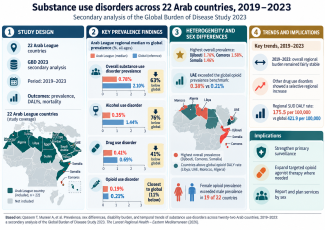
The analysis found that the regional median age-standardised prevalence of substance use disorders in 2023 was 0.78%, compared with a global estimate of 2.10%.
This represents a difference of approximately 63%.
Age-standardised prevalence, 2023
Arab League median
Global estimate
0%0.6%1.2%1.8%2.4%Overall SUDAlcoholDrug useOpioid
Arab League values represent unweighted medians across 22 countries; global values are GBD estimates.
Source: Qassem et al., GBD Study 2023 secondary analysis. Values are age-standardised prevalence estimates.
Alcohol use disorders demonstrated the greatest regional difference, with a median prevalence of 0.35%, compared with 1.44% globally—approximately 76% lower.
Drug use disorders showed a smaller difference, with a regional prevalence of 0.41%, compared with 0.69% globally.
However, opioid use disorders presented a markedly different picture. Regional prevalence was estimated at 0.19%, compared with 0.21% globally, placing the regional estimate just 11% below the international benchmark.
These findings suggest that lower overall substance use disorder prevalence should not be interpreted as evidence of uniformly low addiction-related health needs.
Significant variation between Arab countries
One of the study's major contributions is its demonstration of substantial differences in substance use disorder prevalence across the Arab region.
Djibouti recorded the highest overall estimated prevalence at 1.76%, followed by Comoros at 1.58% and Somalia at 1.46%.
By contrast, Mauritania, Yemen, and Sudan were among the countries with the lowest estimated prevalence.
The United Arab Emirates demonstrated a distinctive profile, particularly regarding drug and opioid use disorders.
Its estimated opioid use disorder prevalence reached 0.38%, compared with the global estimate of 0.21%. The UAE's estimated prevalence was therefore notably above the global benchmark.
Lebanon, Libya, and Tunisia also recorded opioid prevalence point estimates above the global value, although their uncertainty intervals overlapped the global interval.
Such differences underscore the importance of developing national strategies that respond to country-specific epidemiological profiles rather than relying exclusively on regional averages.
An unexpected finding: Higher opioid disorder prevalence among women
Perhaps the most notable observation was the sex-specific pattern of opioid use disorders.
While the global burden of substance use disorders generally remains higher among men, the researchers found that estimated opioid use disorder prevalence among women exceeded that among men in 19 of the 22 Arab League countries.
The regional median prevalence was approximately 0.23% among women and 0.16% among men.
This contrasts with the global pattern, where estimated opioid use disorder prevalence was slightly higher among men.
The study does not establish the reasons behind this difference. However, it highlights an important area for further investigation.
Potential explanations require careful examination through country-specific epidemiological research, including studies addressing prescription opioid exposure, healthcare access, patterns of substance use, and differences in detection and reporting.
From a clinical and public health perspective, these findings reinforce the importance of ensuring that addiction treatment services are accessible and responsive to women's needs.
They also challenge assumptions that opioid-related problems predominantly affect men in every geographical setting.
Disability burden reveals additional public health concerns
Beyond prevalence, the researchers assessed disability-adjusted life years, a measure that captures years of healthy life lost due to disability and premature mortality.
The regional median age-standardised DALY rate for substance use disorders was approximately 175.5 per 100,000 population, compared with 421.9 globally.
Although the regional estimate was approximately 58% lower than the global benchmark, opioid-related disability revealed important exceptions.
Four countries recorded opioid use disorder DALY rates above the global point estimate:
-
Libya: 183.9 per 100,000
-
United Arab Emirates: 180.9 per 100,000
-
Morocco: 167.2 per 100,000
-
Algeria: 161.5 per 100,000
The global opioid use disorder DALY rate was approximately 153.7 per 100,000. The uncertainty intervals for these four countries overlapped the global interval, meaning the comparisons should be interpreted cautiously.
Nevertheless, the findings demonstrate that a relatively low overall prevalence of substance use disorders can coexist with substantial opioid-related disability in specific countries.
This distinction is particularly relevant for healthcare resource allocation, as prevalence alone may not adequately reflect the severity of addiction-related health consequences.
Trends from 2019 to 2023: Relative stability with emerging concerns
The study also examined temporal changes over the five-year period.
Overall, the regional burden of substance use disorders remained relatively stable, with most country-level changes being modest.
However, the researchers identified selective increases in other drug use disorders, alongside heterogeneous trends in opioid and other substance categories.
Some countries demonstrated increases in particular disorders, while others recorded declines.
The United Arab Emirates, for example, showed declining estimated prevalence in several categories, including drug and opioid use disorders.
These variations suggest that regional substance use patterns are not static and that emerging trends may differ considerably between countries.
Because the temporal analysis covered only five annual observations, the researchers appropriately emphasised descriptive interpretation rather than strong conclusions about long-term trends.
Implications for addiction treatment and public health policy
The findings carry several important implications for healthcare systems across the Arab region.
First, they reinforce the need to strengthen national epidemiological surveillance. In many countries, particularly those affected by conflict or limited healthcare infrastructure, reliable population-level data remain scarce.
Second, the findings support expanding access to evidence-based opioid use disorder treatment, including opioid agonist therapy where appropriate and consistent with national healthcare frameworks.
Third, the distinctive sex differences identified in opioid use disorders suggest that addiction services should incorporate sex-disaggregated monitoring and treatment planning.
Healthcare systems may benefit from examining barriers to treatment among women and ensuring that services provide confidential, accessible, and culturally appropriate care.
Finally, the research highlights the importance of considering both prevalence and disability burden when establishing public health priorities.
Countries with relatively modest prevalence estimates may nevertheless experience considerable addiction-related disability, requiring targeted clinical and preventive interventions.
Understanding the limitations
The researchers acknowledged several important limitations.
The analysis relied on modelled GBD 2023 estimates rather than newly collected, nationally representative epidemiological surveys conducted uniformly across the 22 countries.
The quality and availability of primary data differ substantially between countries, and estimates for data-sparse settings may depend more heavily on statistical modelling and regional information.
Furthermore, social stigma, legal restrictions, and underreporting may affect the measurement of substance use disorders.
Consequently, the findings should not be interpreted as definitive measurements of the true prevalence of addiction in every country.
Instead, they provide a valuable comparative framework for identifying patterns, highlighting potential service gaps, and guiding further epidemiological investigation.
Conclusion: Moving towards evidence-based addiction policy
This research represents an important contribution to understanding substance use disorders across the Arab world.
Its findings demonstrate that although overall estimated prevalence remains considerably below global levels, the regional picture is far from uniform.
The relatively small difference between regional and global opioid use disorder prevalence, the elevated opioid-related disability burden in selected countries, and the unexpectedly higher estimated opioid prevalence among women in most Arab League states all warrant further attention.
Most importantly, the study highlights the need to move beyond broad regional generalisations towards more precise, country-specific, and sex-responsive public health strategies.
Strengthening surveillance, improving access to evidence-based treatment, and addressing gaps in epidemiological knowledge will be essential for developing effective and sustainable responses to substance use disorders across the region.
The central message is clear: a lower estimated regional prevalence does not eliminate the need for targeted addiction prevention, treatment, and research.
Reference: Qassem T, Muneer A, Al Ghaferi H, et al. Prevalence, sex differences, disability burden, and temporal trends of substance use disorders across twenty-two Arab countries, 2019–2023: a secondary analysis of the Global Burden of Disease Study 2023. The Lancet Regional Health – Eastern Mediterranean. 2026;1:100002. https://doi.org/10.1016/j.laneme.2026.100002.


