


Search
 Treatment
The range of medical, psychological, and social services designed to help individuals reduce or stop substance use and manage substance use disorders. Treatment may include assessment, counselling and behavioural therapies, medication-assisted treatment, withdrawal management, and support for co-occurring mental or physical health conditions. Effective treatment is typically person-centred and evidence-informed, and may be provided in outpatient, community, or residential settings. Treatment aims to improve health and functioning, reduce substance-related harms, and support individuals in moving toward recovery and long-term wellbeing.



College Drinking: Prevention Perspectives
A recent video produced by Substance Abuse and Mental Health Service Administration highlights the harmful consequences of underage and excessive alcohol consumption, and provides evidence-based strategies that can be used in a university...
Media Guide for Journalists
The National Institute on Drug Abuse (NIDA) has released a new guide for journalists in the field of drug abuse and treatment. The purpose of this guide is to provide journalists with fast and user-friendly access to the latest scientific...

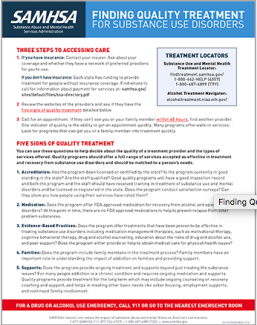
Quality Treatment for Substance Use Disorders
It is important that people wishing to access treatment for substance use disorder are informed about the quality of care they will receive.
A new fact sheet has been developed by the Substance Abuse and Mental Health Services...
Opioid Treatment Resources
Emergency departments are often the first point of contact for individuals who have overdosed or suffering from the effects of opioids. Despite the vital role practitioners within this service provide, there has been, up until now, little...
Teaching Teens about Drugs
The National Institute on Drug Abuse has released a series of lesson plans and suggested activities that can be used within the classroom with teenagers. The aims of the lesson plans are to educate young people, in an engaging and fun way...
Effectiveness Bank Matrix Cell: Crime-Reducing Drug Treatment Systems
Last of the 25 cells of the Drug Treatment Matrix explores research on how local treatment systems can protect the community – treatment in itself, and treatment offered or imposed by law enforcement authorities. The task is to meld...
Alcohol Consumption and the Risk of Dementia
It is believed that the number of people living with dementia will triple by 2050. There is yet no cure for the disease therefore prevention is key. There are several modifiable lifestyle risk factors that are thought to be associated with...
World Mental Health Day 2018
The World Health Organization defines mental health as “a state of well-being in which every individual realizes his or her own potential, can cope with the normal stresses of life, can work productively and fruitfully, and is able to make...

Talking Pot with Youth
The Canadian Centre on Substance Use and Addiction (CCSA) has released a new resource for parents, teachers and other youth allies to help them prepare to have open, non-judgemental discussions with youths about cannabis. The Talking Pot...
Communication Toolkit to Promote Low Risk Alcohol Drinking
The Canadian Centre on Substance Use and Addiction has released the revised Low Risk Alcohol Drinking Guidelines Communication Toolkit to promote healthy attitude towards alcohol consumption. The guidelines, which are particularly geared...
How Cocaine Cues Get Planted in the Brain
Individuals suffering from substance use disorders develop strong associations between the drug’s stimulating effect and environmental cues that act as reminders of the experience, which can lead to relapse.
A recent study has proposed a...
Low Self-Esteem Connected to Greater Risk for Opioid Use
It has been suggested that individuals with low self-esteem are more likely to choose maladaptive coping behaviors, such as abuse of opioids, when faced with life stressors.
In a recent study conducted in New York, over 1000 adults, of...
Daily Use of Marijuana among Non-College Young Adults at all Time High
A recent survey produced by the National Institute on Drug Abuse (NIDA) has analysed trends in substance use between young adults, aged 19-22, attending college and not attending college in the US.
Results show that the prevalence of...
Role of research-practice-policy partnerships in optimizing prevention science and the use of research evidence: Mphatlalatsane: Promotion of Cognitive Development, HIV Testing and Treatment Support, and Nutrition Education in Rural Lesotho
This abstract was presented at the 2018 Society for Prevention Research Annual Meeting which was held May 29 – June 1, 2018 in Washington, DC, US.
Sarah Skeen University of Stellenbosch
Mark Tomlinson Stellenbosch University; Marguerite...
Role of research-practice-policy partnerships in optimizing prevention science and the use of research evidence: Integration of a Parenting Program within a Conditional Cash Transfer System for Low-Income Filipino Families with Children Ages 2 to 6
This abstract was presented at the 2018 Society for Prevention Research Annual Meeting which was held May 29 – June 1, 2018 in Washington, DC, US.
Jamie Lachman University of Oxford
Liane Pena Alampay Ateneo de Manila University; Maria...
Research, Policy, and Practice: ‘Why Do I Have to Miss so Much School?’ Clinic Experiences of South African Adolescents Living with HIV
This abstract was presented at the 2018 Society for Prevention Research Annual Meeting which was held May 29 – June 1, 2018 in Washington, DC, US.
Tiarney Ritchwood Medical University of South Carolina
Asantewa Oduro Desmond Tutu HIV...
Promoting equity and decreasing disparities through optimizing prevention science: ‘My Best Friends and My Worst Enemies’: Understanding the Roles of Families in Retaining South African Adolescents Living with HIV in Care
This abstract was presented at the 2018 Society for Prevention Research Annual Meeting which was held May 29 – June 1, 2018 in Washington, DC, US.
Tiarney Ritchwood Medical University of South Carolina
Noluthando Ntlapo Desmond Tutu HIV...
Promoting equity and decreasing disparities through optimizing prevention science: Cultural Adaptations of Psychotherapy: Therapists’ Applications of Conceptual Models with Asians and Asian Americans
This abstract was presented at the 2018 Society for Prevention Research Annual Meeting which was held May 29 – June 1, 2018 in Washington, DC, US.
Gordon N. Hall University of Oregon
Introduction: Although conceptual models of cultural...
NIDA International SPR Poster Session: Feasibility and Acceptability of a Suicide Prevention Protocol in the Context of an International Clinical Trial for Mental Health and Substance Abuse
This abstract was presented at the 2018 Society for Prevention Research Annual Meeting which was held May 29 – June 1, 2018 in Washington, DC, US.
Kiara Alvarez Massachusetts General Hospital
Trinidad Rodriguez Massachusetts General...
NIDA International SPR Poster Session: Barriers and Facilitators to Treatment Seeking for Alcohol Use Among Men in Kenya
This abstract was presented at the 2018 Society for Prevention Research Annual Meeting which was held May 29 – June 1, 2018 in Washington, DC, US.
Puja Patel Duke University
Eve S. Puffer Duke University
Introduction: Substance use...