

Search
 Psychoactive Substances
Psychoactive substances are natural or synthetic substances that act on the central nervous system and alter mental processes such as mood, perception, cognition, consciousness, and behaviour. These substances may be legally prescribed medications (e.g., pain medications or sedatives), legally available substances such as alcohol or caffeine, or controlled or illicit drugs. Psychoactive substances can be used for medical, social, cultural, or recreational purposes, but some carry risks of misuse, dependence, and health or social harms when used in harmful ways.
Non-opioid prescription misuse
This presentation explored the who, how and why of non-opioid prescription drug misuse focusing on antipsychotics, stimulants and pregabalin.
While much is known about the prevalence and associated harms of prescription opioid and...
Effects of extended-release buprenorphine treatment for opioid dependence
In this webinar, findings were reported from the CoLAB qualitative study, which aimed to examine the multiple social, material and temporal effects of extended-release buprenorphine depot (BUP-XR) treatment in clients’ lives, among a group...
Responding to the use of anabolic androgenic steroids
Three international experts discussed anabolic androgenic steroids – illicit or prescription-only drugs that are manufactured to mimic the effects of the male hormone testosterone, and that are sometimes taken to increase muscle mass and...
Adfam Research Report: Families and friends negatively affected by gambling - Policy & Recommendations
Description: This report sets out Adfam's findings from a range of research activities including four specific gambling-related surveys, peer support training and round-table events.
It looks at the effects of gambling on families as well...

European Commission adopts measures to control two harmful new drugs amidst health concerns and surge in supply
Today, the European Commission has adopted measures to control two harmful new psychoactive substances (NPS) across the EU. The substances in question — 3-methylmethcathinone (3-MMC) and 3-chloromethcathinone (3-CMC) — are both synthetic...
Sociodemographic and family factors related to the use of psychoactive substances in adolescents
This article presents an analysis of the sociodemographic and family factors related to the use of psychoactive substances in adolescents in the tenth year of a public school in the Canton of Montes de Oca. The approach was quantitative...
COVID 19—impact on substance use treatment utilisation and provision in South Africa
Background
The coronavirus disease 2019 (COVID-19) pandemic has affected persons suffering from substance use disorders (SUDs) all around the world. The purpose of this study was to investigate changes in the number of SUD treatment...
Join us at the COMMISSION ON NARCOTIC DRUGS this week!
Dear friends and colleagues,
The Commission on Narcotic Drugs is starting very soon! In fact, tomorrow, Monday, 14 March 2022.
Once again, all sessions, as well as the side events, are to be held online due to the pandemic. The good...
An observational prospective cohort study of naloxone use at witnessed overdoses, Kazakhstan, Kyrgyzstan, Tajikistan, Ukraine
Abstract
Objective
To determine whether participation in the United Nations Office on Drugs and Crime (UNODC) and the World Health Organization’s (WHO) Stop Overdose Safely (S-O-S) take-home naloxone training project in Kazakhstan...
The relationship between craving and insular morphometry in regular cocaine users: Does sex matter?
Abstract
While it has been suggested that cocaine use and relapse in women is more strongly related to stress-relief craving, whereas cocaine use in men is more strongly related to reward craving, the neural mechanisms that underlie these...
Anomalies in global network connectivity associated with early recovery from alcohol dependence: A network transcranial magnetic stimulation and electroencephalography study
Abstract
Although previous research in alcohol dependent populations identified alterations within local structures of the addiction ‘reward’ circuitry, there is limited research into global features of this network, especially in early...
Sulphated dehydroepiandrosterone serum levels are reduced in women with alcohol use disorder and correlate negatively with craving: A sex-separated cross-sectional and longitudinal study
Abstract
Previous studies have established a role of sex hormones in alcohol use disorder (AUD).Only few clinical investigations with low numbers of patients with AUD have focused on the sulphated form of dehydroepiandrosterone (DHEA-S)...
Sex differences in acute cannabis effects revisited: Results from two randomized, controlled trials
Abstract
Some evidence suggests that males and females may differ in their responses to acute cannabis effects, including subjective drug effects and behavioural effects, and cannabinoid pharmacokinetics. This is significant given current...
Multimodal MRI data fusion reveals distinct structural, functional and neurochemical correlates of heavy cannabis use
Abstract
Heavy cannabis use (HCU) is frequently associated with a plethora of cognitive, psychopathological and sensorimotor phenomena. Although HCU is frequent, specific patterns of abnormal brain structure and function underlying HCU in...
From binge eating to binge drinking: A new and robust paradigm for assessing binge ethanol self-administration in male rats
Abstract
Animal models of alcohol (ethanol) self-administration are crucial to dissect the neurobiological mechanisms underlying alcohol dependence, yet only a few of these induce pharmacologically relevant levels of alcohol consumption...
Overcoming the pains of recovery: The management of negative recovery capital during addiction recovery pathways
Abstract:
Pains experienced as a result of negative recovery capital are often thought to stimulate motivations for positive behavioural change, usually through a ‘rock bottom’ type moment. Whilst recovery capital and barriers to recovery...

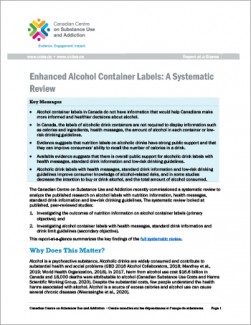
Enhanced Alcohol Container Labels: A Systematic Review (Report at a Glance)
To investigate how alcohol container labels can be used to build public awareness, the Canadian Centre on Substance Use and Addiction commissioned Enhanced Alcohol Container Labels: A Systematic Review and developed a summary of the report...
Risk of Opioid Overdose Associated With Concomitant Use of Oxycodone and Selective Serotonin Reuptake Inhibitors
Abstract
Importance Some selective serotonin reuptake inhibitors (SSRIs) inhibit the enzymes responsible for the metabolism of oxycodone, a potent prescription opioid. The clinical consequences of this interaction on the risk of opioid...
The prevalence and pattern of cannabis use among patients attending a methadone treatment clinic in Nairobi, Kenya
Cannabis is the most widely used illegal substance in the world, with a global prevalence of 4% among people aged 15 to 64 years and a recent trend of growing use. Cannabis usage can have negative health consequences, such as impaired...
Barriers to support for people experiencing problem substance use and homelessness: Reading list
The second webinar in our series on homelessness and substances use was presented by Dr Hannah Carver who focused on the different barriers that people experience when trying to access support and the evidence base for different...