

Search
Justice and Diversion
Programmes that redirect individuals with substance use disorders away from the traditional criminal justice system into community-based treatment and support services, reducing incarceration rates. e.g., drug courts, deflection schemes.


Addressing the recruitment of young people into criminal drugs networks
This report examines how and why young people are recruited into criminal drug networks across Europe. It highlights the range of factors that can increase vulnerability to recruitment, including social and economic disadvantage, peer...
2026 National Drug Control Strategy - The White House
The 2026 National Drug Control Strategy outlines a comprehensive roadmap to reduce illicit drug use and protect communities across the United States. It prioritizes stopping the flow of drugs and precursor chemicals at all borders through...
Global Organized Crime Index 2025 - Europe Overview
The 2025 Global Organized Crime Index shows that overall crime levels in Europe remain stable, and the region continues to rank among the least affected globally. However, this stability hides a more complex reality, with criminal markets...
Policy Brief: Scam Centres – Combating a Global Phenomenon
Short Summary
Scam centres are a fast-growing global organized crime threat, generating over $1 trillion in losses in 2024. They use technology and psychological manipulation to target victims worldwide, supported by global criminal...
Advancing Advocacy: ISSUP Philippine Chapter's March 2026 Activities
March 2026 has been a productive month for the ISSUP Philippine Chapter, with representatives participating in various events. Each activity reflects the Chapter's continued commitment to working together with government agencies and non...
A Reading List on Responding to Drug-Related Offending through Science-Based Policy and Practice
As justice systems increasingly shift their focus from punishment to rehabilitation, it becomes essential to understand the complex relationship between substance use, criminal behaviour, and treatment, particularly among individuals whose involvement with the system stems from substance use.

ISSUP Bangladesh Chapter Launch Ceremony
ISSUP Bangladesh presents the launch of the ISSUP Bangladesh Chapter. Organised in collaboration with Dhaka Ahsania Mission, the ceremony will bring together national and international experts, policymakers, youth leaders, and development partners working in substance use prevention, treatment, and recovery support.
Safety Starts Early: Drug Use Prevention and Violence Prevention as Public Security Investments
ISSUP Global presents a webinar on Safety Starts Early: Drug Use Prevention and Violence Prevention as Public Security Investments.
Reducing Drug‑Use–Related Offenses Through Health‑Centered Approaches
ISSUP Global, in collaboration with Proyecto Hombre, presents a webinar on Reducing Drug-Use–Related Offenses Through Health-Centered Approaches.
Navigating opioid use disorder treatment for pregnant and parenting people: composite narratives for policy action
Opioid use during pregnancy and the postpartum period is increasing in the United States, yet many pregnant and parenting people face serious barriers to accessing effective treatment and supportive services. These barriers arise from...

A CSO PERSPECTIVE: Drug and substance abuse in Uganda Emerging trends,Human rights implications
Due to the rising incidence of narcotics-related cases and associated crime, there is an urgent need to expand and strengthen alternatives to criminal activity. This concern was emphasized by Dr. Rogers Kasirye during the 28th UHRC Annual...
Treatment and Care for People with Drug Use Disorders in Contact with the Criminal Justice System
The UNODC and WHO report Treatment and care for people with drug use disorders in contact with the criminal justice system: Alternatives to conviction or punishment examines how health-centred, evidence-based responses can be integrated...
Day 1, 16:00 - 17:30, Plenary 4: Reducing Drug Related Crimes in the Community
Panel Presented at Indonesia 2025 on the 17th of September 2025
Moderator: Imelda Indriyani
Presentations:
Mirza Hapsari Massarapa: Reducing Drug-Related Crime: A Comprehensive Approach from the Indonesian Directorate General of...
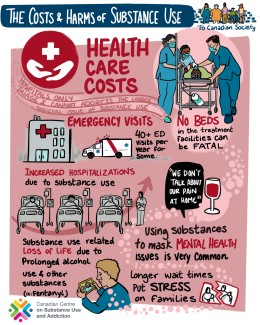
Personal Impacts of Substance Use
The Canadian Centre on Substance Use and Addiction (CCSA) transforms complex data into insights that reflect real human experiences. Every aspect of the Canadian Substance Use Cost and Harms (CSUCH) project represents individuals with lived...
Becoming a Member of the Prevention Club: Development of Interdisciplinary Prevention Terminology
Introduction
Prevention science is interdisciplinary, drawing upon multiple fields of research and practice to develop integrated knowledge. A challenge facing the field is the proliferation of different terms with the same meaning, and of...
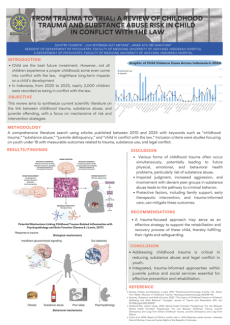
From Trauma to Trial: A Review of Childhood Trauma and Substance Abuse Risk in Child in Conflict with the Law
| Introduction. Child in conflict with the law often present with complex psychosocial backgrounds, prominently featuring histories of childhood trauma. Emerging evidence suggests a strong correlation between early traumatic... |
Drug Treatment Courts: An Evidence-Based Review with Recommendations for Improvement
This policy brief by the Canadian Centre on Substance Use and Addiction critically evaluates the role and effectiveness of Drug Treatment Courts (DTCs) in Canada. DTCs are intended to divert individuals with substance use disorders (SUDs)...
NIJ’s Courts Research: Examining Alternatives to Incarceration for Veterans and Other Policy Innovation
This article presents key studies from the National Institute of Justice’s (NIJ) Courts Research Portfolio that examine pretrial, prosecution, and sentencing policies promoting alternatives to incarceration, such as Veterans Treatment...
Exploring the Impact of Technical Violations on Probation Revocations in the Context of Drug Court
ABSTRACT
Prior research indicates a large number of drug court participants commit technical violations, subsequently increasing the likelihood of revocation. However, there is limited research investigating the potential heterogeneous...
Probation clients’ barriers to access and use of opioid use disorder medications
ABSTRACT
Background
There is a gap between evidence-based treatment with medications for opioid use disorders (OUDs) and current practices of probation departments who supervise individuals with OUDs. Many probationers with OUDs cannot...