Cognitive Behavioural Therapy (CBT) in the Treatment of Substance Use Disorders Webinar Series Part I - Principles, and Practice Examples from a Sri Lankan Context
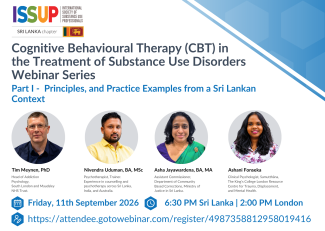
ISSUP Sri Lanka, ISSUP Indonesia and ISSUP Kazakhstan, welcome you to a joint initiative on Cognitive Behavioural Therapy (CBT) in the Treatment of Substance Use Disorders.
Date: Friday, 11th September 2026
Time: 6:30 PM Sri Lanka | 2:00 PM London
This is a three-part webinar that will explore the application of Cognitive Behavioural Therapy (CBT) in the treatment of substance use disorders across diverse populations and settings in Asia. Drawing on experiences from Sri Lanka, Indonesia and Kazakhstan, the series will examine core CBT principles and their adaptation to different cultural, clinical, community, institutional and humanitarian contexts. Particular attention will be given to co-occurring mental health conditions, methamphetamine and new psychoactive substance use, incarcerated populations, migrants and displaced populations, and the practical implementation of evidence-informed approaches in different service settings.
Part 1 - Principles, and Practice Examples from a Sri Lankan Context
This webinar will introduce the role of Cognitive Behavioural Therapy (CBT) in the treatment of substance use disorders, highlighting its practical application in a range of treatment settings. Participants will gain an overview of key CBT-based interventions, including Motivational Interviewing (MI), Cognitive Therapy, Relapse Prevention, Contingency Management, and the Community Reinforcement Approach (CRA).
The session will also explore how CBT can be used to address common co-occurring mental health conditions, including anxiety, depression, and post-traumatic stress disorder (PTSD), emphasising the importance of integrated care. In addition, participants will learn how CBT strategies can help reduce both internalised and societal stigma, supporting recovery and social reintegration.
The webinar will be complemented by practical examples from the Sri Lankan context presented by two experienced co-facilitators: a counselling psychologist specialising in CBT and a senior official from the Department of Community Based Corrections with extensive experience in community-based rehabilitation of individuals with substance use disorders. Their presentations will demonstrate how evidence-backed CBT approaches can be effectively adapted and implemented within local clinical and community settings.
Intended audience:
- Addiction psychiatrists and psychologists
- CBT practitioners
- Mental health professionals working in SUD treatment (psychiatrists, general practitioners, nurses)
- Public health professionals
- Social workers and rehabilitation counsellors
Learning Outcomes:
At the end of the webinar, participants will be able to:
-
Explain the rationale for culture-sensitive CBT in SUD
-
Describe the core components and structure of CBT program in SUD
-
Apply effective CBT techniques for managing craving, identifying trigger, developing self-efficacy, and cognitive restructuring
-
Adapt feasible CBT in low-resource or institutional settings (e.g. prisons)
-
Recognize limitation of CBT interventions
-
Explore CBT-informed and trauma-sensitive psychosocial support approaches used in humanitarian and migration settings
-
Application of CBT for common co-occurring conditions such as PTSD, anxiety, depression.
Presenters:
Tim Meynen, PhD – Head of Addiction Psychology (South London and Maudsley NHS Trust
Dr Tim Meynen is Head of Addiction Psychology at South London and Maudsley NHS Foundation Trust and Clinical Director on the Doctorate in Clinical Psychology at King’s College London. A Chartered Consultant Clinical Psychologist, his work focuses on evidence-based treatments for substance use disorders and comorbid mental health conditions, particularly cognitive-behavioural and memory-focused therapies. He has published widely on addiction, including Memory-Focused Cognitive Therapy, PTSD–SUD comorbidity, and substance use in psychosis and autism. Tim supervises doctoral research, delivers national clinical training, serves on the BPS Faculty of Addictions committee, and contributes to UK alcohol treatment guidelines.
Nivendra Uduman, BA, MSc, MCBT – Psychotherapist, Trainer
Mr Nivendra Uduman is a psychologist with over 10 years of experience in counselling and psychotherapy across Sri Lanka, India, and Australia. He specialises in evidence-based approaches, including Cognitive Behaviour Therapy (CBT) and Acceptance and Commitment Therapy (ACT), supporting individuals through trauma, distress, and life transitions. He previously served at Samutthāna – The King’s College London Resource Centre for Trauma, Displacement, and Mental Health, contributing to mental health capacity-building in Sri Lanka. Currently, he is a visiting psychologist at two leading medical centres in Colombo and delivers tailored well-being programmes for corporate and organisational clients.
Asha Jayawardena, BA, MA, MPM – Assistant Commissioner (Department of Community Based Corrections, Ministry of Justice)
Ms Asha Jayawardena is the Assistant Commissioner at the Department of Community Based Corrections, which is attached to the Ministry of Justice in Sri Lanka. She has more than 26 years’ experience as a Community Based Corrections Professional in the Criminal Justice Setting. In addition, Ms Asha was a recipient of the Hubert H. Humphrey Fellowship in 2013 from Fullbright Scholarship, USA and the ICCE Fellowship in 2016 from Colombo Plan.
Throughout her career, she has strived towards the vision of the Department of Community Based Corrections, which is, creating a citizen free of wrongdoing. In addition, Ms Asha is one of the pioneer members and the first female officer of the Department. Furthermore, she is a Visiting Lecturer for the public and private sector and has hands-on experience both locally and internationally.
Moderator:
Ashani Fonseka- Samutthāna – The King’s College London Resource Centre for Trauma, Displacement, and Mental Health
Ashani Fonseka is a Clinical Psychologist with over five years of experience in government hospitals and private practice. She provides psychotherapy to diverse populations using evidence-based approaches, including Cognitive Behaviour Therapy (CBT), Dialectical Behaviour Therapy (DBT), and mindfulness-based interventions. Since 2024, she has served as a Clinical Psychologist at Samutthāna – The King’s College London Resource Centre for Trauma, Displacement, and Mental Health, where she contributes to training, clinical services, and programme development.
References:
-
Beyond Prison: Why Sri Lanka Must Rethink Drug Addiction-July 30th, 2026
-
Beyond blame and shame: Empathy-based health communication for substance misuse in Sri Lanka V K I U Alwis, S M A N Samaranayake, A Baminiwatta :SL J Psychiatry 2025; 16(2): 59-61, Available at: DOI: https://doi.org/10.4038/sljpsyc.v16i2.8650
-
Beck A.T., Wright, F.D., Newman, C.F., & Liese, B.S. (1993). Cognitive Therapy of Substance Abuse. London. Guildford Press
-
Department of Health and Social Care. (2025). Clinical guidelines for alcohol treatment. London: DHSC. Retrieved from GOV.UK (updated April 2026).
-
Marlatt, G.A. & Gordon, J.R. (1985) Relapse Prevention: Maintenance Strategies in the Treatment of Addictive Behaviours. New York. Guildford Press.
-
Mitcheson L, Maslin J, Meynen T, Morrison T, Hill R, Wanigaratne S. (2010). Applied Cognitive Behavioural Approaches to the Treatment of Addiction: A Practical Treatment Guide. Oxford: Wiley-Blackwell.
-
Moos, R. H., (2007). Theory-based active ingredients of effective treatments for substance use disorders. Drug and Alcohol Dependence. Volume 88, Issues 2–3, 11 May 2007, Pages 109-121. https://doi.org/10.1016/j.drugalcdep.2006.10.010
-
Wanigartne, S., Wallace, W.et al (1990). Relapse Prevention for Addictive Behaviours: A manual for Therapists.Oxford. Blackwell
-
Jayawardena, H. A. A. (2022). Applicability of evidence-based treatment program for drug offenders under the community-based corrections. International Symposium for Drug-Related Studies, National Dangerous Drugs Control Board. https://www.nddcb.gov.lk
-
Marlatt GA, Donovan DM. Relapse Prevention: maintenance strategies in the treatment of addictive behaviors. New York: Guilford.
-
Wanigaratne SD, Pullin J, Wallace W, Keaney F, Farmer R. (1990). Relapse Prevention for Addictive Behaviours: A Manual for Therapists. Oxford: Blackwell.
-
Wanigaratne S, Keaney F. (2011) Relapse Prevention in the 21st Century. In Hill R, Harris J, editors. The Principles and Practice of Group Work in Addictions. London: Routledge.
Webinars and online events delivered and hosted by the International Society of Substance Use Professionals (ISSUP) are provided for informational purposes only. They are educational in nature and do not constitute medical advice, diagnosis or treatment.