
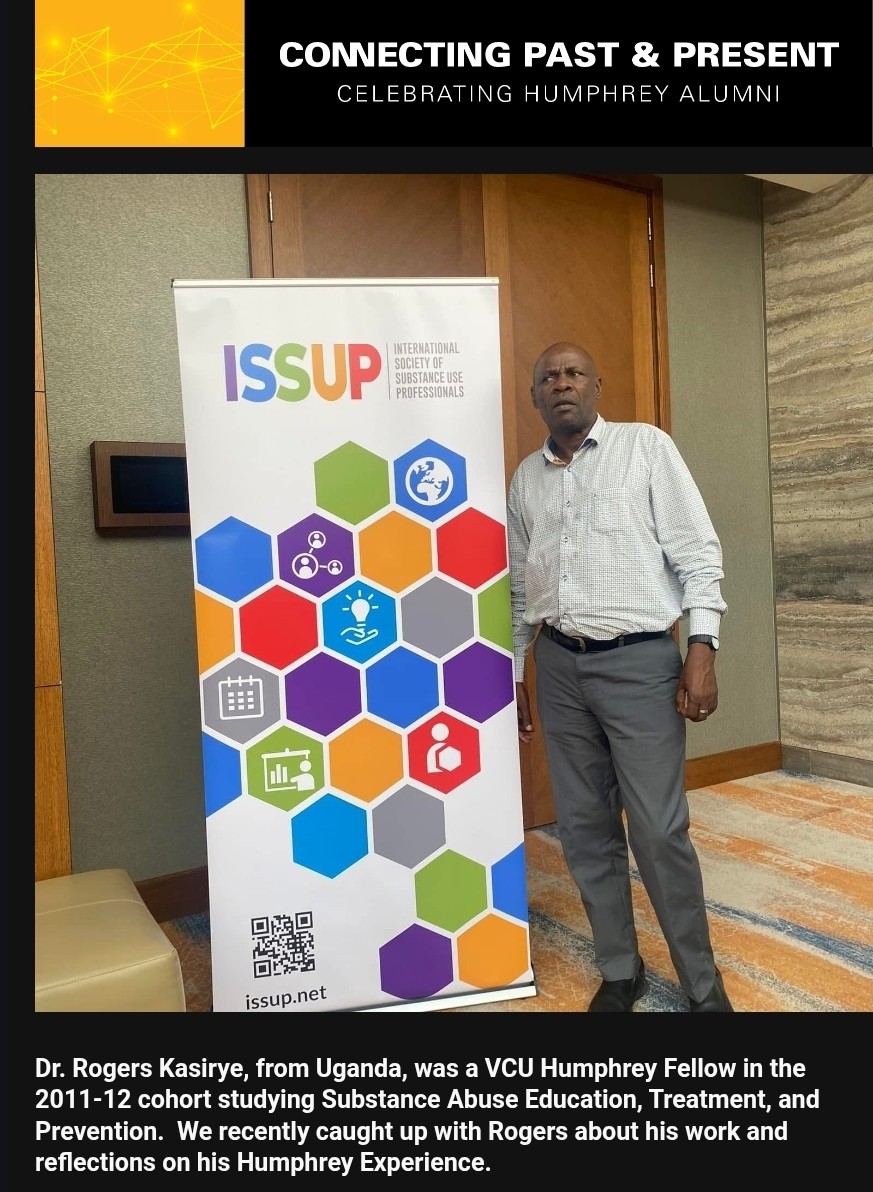
Dr. Kasirye was recently featured as a notable alum of the distinguished Humphrey Fellowship Program here at VCU (2011–2012) in the VCU Humphrey news letter for 2025-2026. This is a great recognition, and it speaks volumes about his longstanding commitment to advancing innovative, community-driven programs with far-reaching impact across Uganda and beyond. See the interview in the newsletter below.
VCU: Thank you for talking with us. Tell us a bit about your current position and your work in Uganda, particularly since completing the fellowship.
Rogers: I am a highly distinguished social work professional and researcher, and Executive Director of the Uganda Youth Development Link (UYDEL), with over 30 years of experience working with vulnerable youth across Uganda and Sub-Saharan Africa. I have contributed to advances in public health, substance use prevention, youth empowerment and evidence-based policy development since completing the fellowship. One accomplishment of which I am especially proud is that I completed my Ph.D. in 2023 at Makerere University.
Following the Humphrey Fellowship, I deepened my research and academic collaborations, most notably with Prof. Monica Swahn, who is now Dean of VCU’s School of Public Health, producing pioneering work on substance abuse, alcohol marketing, mental health, and risk behaviors among youth in urban slum communities. These studies have provided some of the most reliable data on adolescent vulnerabilities in Kampala and have directly informed national-level engagements with the Ministries of Health, Trade, Gender, and Youth, as well as parliamentary committees responsible for alcohol control and child protection. This research has influenced key policy reforms, including ongoing alcohol legislation efforts and programming for prevention among highly at-risk youth populations.
I have continued to serve as a consultant to several United Nations (UN) agencies, including the World Health Organization (WHO), the United Nations Office on Drugs and Crime (UNODC), the United Nations International Children’s Emergency Fund (UNICEF) and the International Labor Organization (ILO). In my capacity as a consultant, I provide technical guidance on drug prevention, HIV/AIDS, trafficking in persons, sexual exploitation, and youth justice. My expertise has positioned me as one of the region’s most knowledgeable voices on adolescent risk behaviors, rehabilitation, and community-based prevention systems.
I also serve as a Global Master Trainer for the University Prevention Curriculum (UPC). As a Master Trainer I participated extensively in the review of all UPC training series and have supported capacity-building across Africa. I have contributed to the development of substance-use policy documents for the African Union and I currently serve as President of the International Society of Substance Use Professionals (ISSUP) Uganda Chapter, as well as Vice President of the World Federation Against Drugs (WFAD) for the Africa Region. In these roles, I promote evidence-based prevention, practitioner training, and youth-focused policy reform across the continent.
As Executive Director of UYDEL, I successfully mobilized more than USD 3 million in grants to expand youth empowerment, vocational training, psychosocial support, and crime-prevention interventions. My leadership has strengthened UYDEL’s national footprint, supporting thousands of vulnerable young people through rehabilitation, safe spaces, and skills training. In 2024, I co-led a major Collaborative Alumni Project under the U.S. Department of State and IIE, conducting a rapid Knowledge, Attitudes, and Practices (KAP) assessment on synthetic drug use in Uganda, Nigeria, and Togo. Working with four other Humphrey Fellows, the team carried out focus groups, interviews, and structured surveys with 105 respondents, including youth, health workers, teachers, pharmacists, and substance-use survivors. The study revealed high awareness of synthetic drugs but alarming levels of use—54% of respondents—particularly stimulants such as methamphetamine, tramadol, MDMA, and codeine syrup. The findings highlight an urgent need for expanded public health research, capacity-building for health and enforcement personnel, and improved prevention and treatment frameworks for emerging synthetic drugs in Africa.

VCU: Describe how completing the Humphrey Fellowship program has impacted your work. What were some key elements of the program that you found most useful?
Rogers: I believe that my career continues to reflect the core values of the Humphrey Fellowship—leadership, innovation, international collaboration, and a lifelong commitment to strengthening communities and improving public health outcomes for young people.
VCU: What advice would you give to our current cohort of fellows?
Rogers: I would suggest leveraging VCU’s research labs to gather local data on substance use trends; building partnerships with local NGOs, health ministries, and community leaders for policy advocacy; designing culturally-adapted prevention and treatment programs using evidence-based frameworks; and sharing findings at Humphrey alumni events and publishing briefs to influence national policy.
VCU: Is there anything else you would like to add?
Rogers: The fellowship is a door for a mentorship network, so connect with VCU faculty and alumni mentors, as they often open doors to internships, research collaborations, and job offers. The fellowship is a great opportunity to develop cross-cultural skills; working with diverse peers prepares you to navigate global health systems and policy forums. It also is important to be able to show your impact: turn project data and other ideas into conference posters or policy briefs. This also will enable you to boost your resume and credibility.