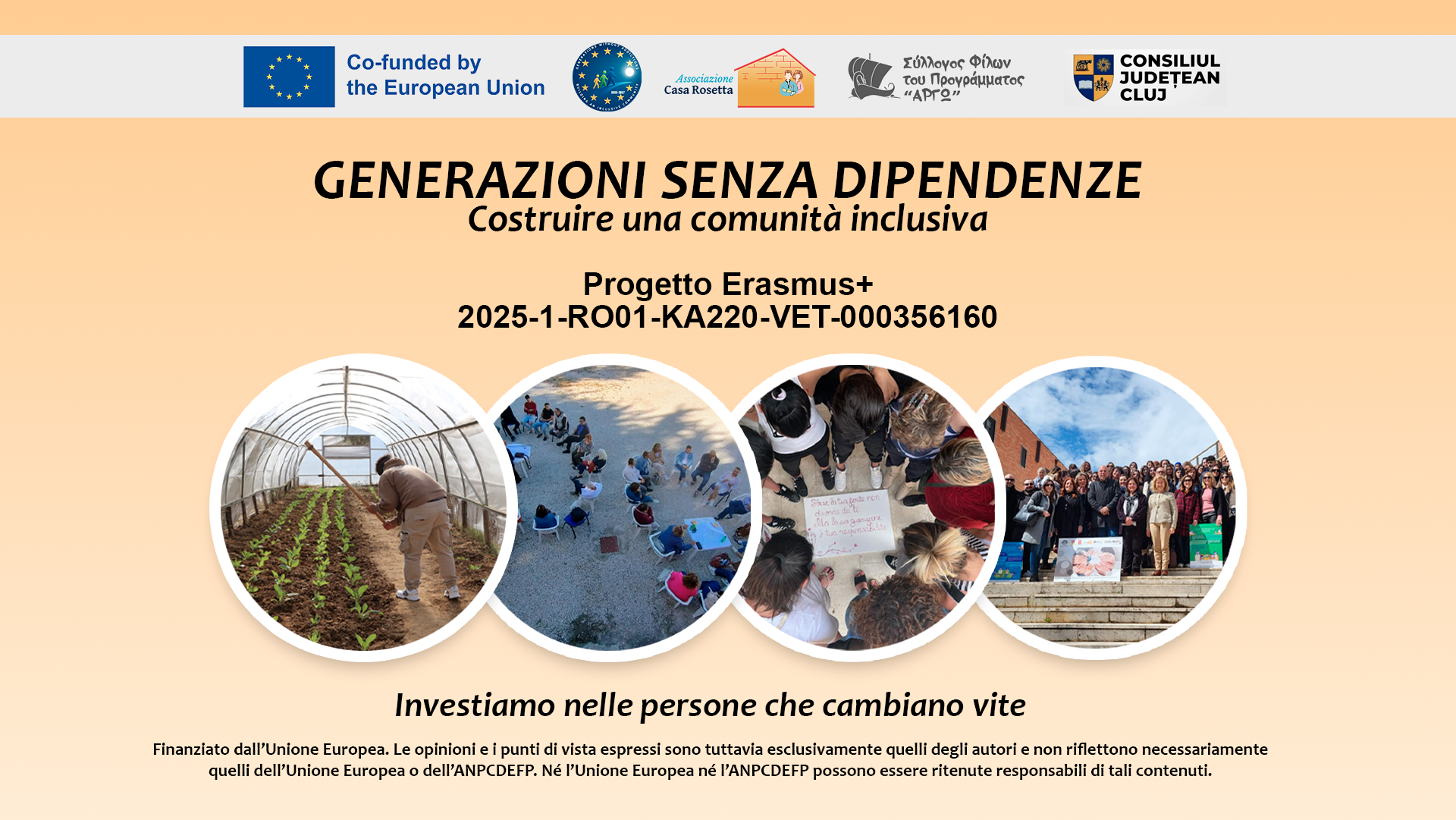
The Associazione Casa Famiglia Rosetta, the host organisation for the ISSUP Italy Chapter, are pleased to announce the launch of the ‘Generations Without Addiction – Building an Inclusive Community’ project.
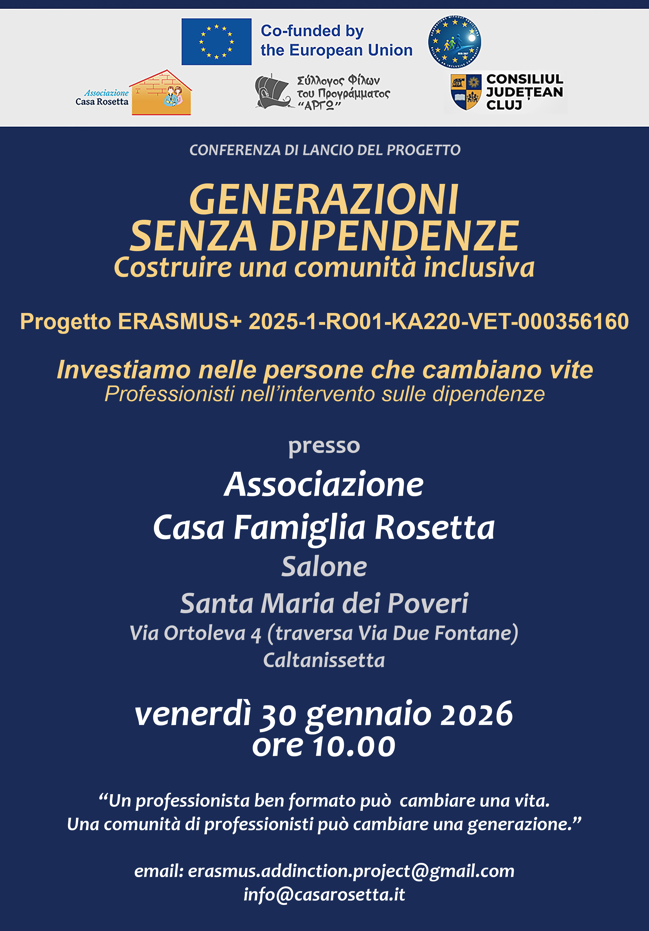
The project is the result of a co-design process involving European partners, with Romania as the lead country and Greece and Italy as partner countries. The official launch of the project was presented by the Romanian project lead, the Cluj County Directorate of Social Assistance and Child Protection, in Cluj-Napoca on January 23. The Italian launch will take place on January 30 at the headquarters of the Casa Rosetta Association in Caltanissetta, while Greek launch hosted by partner ARGO Friends Association - Alternative Therapeutic Program, will be held on February 13 in Thessaloniki.
The Project
The Erasmus+ project “Generations Without Addictions: Building an Inclusive Community” arise from a shared need to strengthen and innovate prevention, treatment, and recovery services for pathological addictions in Romania, Italy and Greece. Despite differences in welfare and healthcare systems, these countries face common challenges related to the growing prevalence of addictions and the complexity of social reintegration pathways.
Pathological addictions represent an increasing challenge for European social and healthcare systems, affecting not only on individual health but also on social cohesion, labour market inclusion, and overall community well-being.
In recent years, both substance-related and behavioural addictions have become more complex, impacting diverse population groups and requiring multidisciplinary responses. While valuable experiences and well-established practices exist at local and national levels, this expertise often remains fragmented and insufficiently shared at the transnational level. As a result, opportunities to learn from innovative approaches already tested elsewhere and to adapt them to different socio-cultural contexts remain limited.
Partnership
In Romania, Italy and Greece, prevention, treatment, and recovery services face similar issues: the complexity of the needs of people with substance use disorders and other addictions; the need to strengthen the professional skills; the importance of improving the quality of the therapeutic relationship, and the urgency of developing more effective, inclusive, and sustainable social reintegration pathways.
Although operating within different regulatory and organisational frameworks, the three countries share significant experience in therapeutic communities and specialised services. However, these experiences often remain confined to the local contexts, limiting dialogue, mutual learning, and the transferability of the most effective practices at the European level.
Project Rationale
Within this framework, the project is conceived as a structured space for European cooperation, aimed at the systematic exchange of good practices among organisations working in the field of addictions. The partnership between Romania, Italy and Greece enables the comparison of intervention models, enhancing the specific strengths of each country and transforming them into shared resources.
The project rationale is based on the idea that improving recovery services requires:
- strengthening the professional competences of practitioners;
- testing innovative therapeutic and social reintegration approaches;
- building a stable and lasting network of cooperation among organisations and professionals.
Through training activities, the development of a shared intervention plan, the production of materials, and opportunities for dialogue at local and international levels, the project promotes mutual learning with a tangible impact on the quality of services quality in all partner countries.
By bringing together different intervention models, therapeutic approaches, and complementary professional expertise, the partneship represents a significant added value. Through joint training, the piloting of an innovative intervention plan, and the definition of experiences across the three contexts, the project aims to strengthen practitioners’ operational capacities and promote an integrated vision of recovery that combines therapeutic, social, and employment dimensions.
Added Value and Importance of the Project
The project’s relevance lies in its ability to transform the exchange of good practices into an operational tool for service improvement. The knowledge shared and defined through the Guide to Good Practices and dissemination materials will contribute to making addiction recovery interventions more effective, accessible, and sustainable.
Moreover, the project strengthens the European dimension of action in the field of addictions by promoting a shared vision based on social inclusion, human dignity, and cooperation among different systems. In this way, “Generations Without Addictions” is positioned not only as an exchange project, but also as a catalyst for change for services and communities involved, contributing to the development of a shared European culture of addiction recovery.
In conclusion, “Generations Without Addictions” represents a strategic intervention that leverages European cooperation as a driver of innovation, fostering more effective, professional, and socially inclusive services for people with pathological addictions.
What Does the Project Aim to Achieve?
To develop the competences and skills of the target group in order to improve the therapeutic relationship with people with substance use disorders and other pathological addictions within 24 months.
To strengthen addiction prevention and treatment services through the diversification and expansion of specialised interventions, as well as the implementation of innovative treatment and social reintegration programmes.
What Results and Impacts Are Expected?
The project is expected to successfully implement an innovative intervention plan, improve therapeutic practices, and strengthen recovery approaches. Key results include the development of a Guide to Good Practices, professional materials illustrating recovery methods, and dissemination conferences at local and international levels. In addition, the project will foster collaboration among stakeholders and professionals, raise awareness, and contribute to the development of addiction-related services in the partner countries.
Gallery