Democratising Evidence with David Patton Pt. 3: Participatory Research in Practice
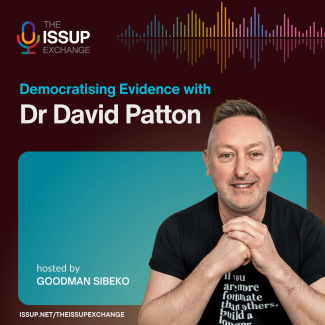
In episode three , Professor Goodman Sibeko and Dr David Patton move from theory to practice, exploring how lived experience can be meaningfully embedded throughout the research process. Drawing on examples from participatory projects, David explains how approaches such as PhotoVoice create space for communities to shape research questions, generate knowledge, and influence how findings are understood and shared.
The conversation examines how participatory research differs from traditional qualitative methods, the ethical considerations involved in working alongside communities, and why equity, shared decision-making, and authentic collaboration are essential to meaningful participation. David also reflects on how these approaches are beginning to influence services and policy, while challenging established ideas about power, expertise, and knowledge production.
Featured Voices
Host – A/Prof. Goodman Sibeko
ISSUP Global Scientific Advisor.
Head of Addiction Psychiatry, University of Cape Town.
LinkedIn: goodmansibeko
Twitter/X: @profgsibeko
Guest – Dr David Patton
Dr David Patton is an Associate Professor in Criminology at the University of Derby whose work focuses on lived experience, participatory research, recovery, and social justice. He leads international initiatives that amplify lived experience voices, including Recovery Atlas and New Central Media, and has over 25 years of experience in higher education.
Time Stamps
Professor Goodman Sibeko (00:00)
Hello again and welcome to episode three of this special ISSUP podcast series called democratizing evidence, where we're looking at lived experience and the future of addiction science with my good friend David Patton. Today we move from theory into practice, and we'll look at how lived experience can be actively incorporated into research, service design and policy through participatory and creative methods. David, wonderful to have you back again. Welcome.
Dr. David Patton (00:26)
Great to see you again, Goodman.
Professor Goodman Sibeko (00:28)
David, think a good starting question might be, how does one define participatory research?
Dr. David Patton (00:33)
Yeah, good question. So, the clues in the title. Participation. And I think one of the red flags is if you only see the participants in the findings, then you know it's not genuine participation. Okay. So genuine participation is where the community, the sample are included at every single stage of the research and knowledge production process, right from the outset of the agenda setting, research questions, the study design itself, as well as the data collection, data analysis, write-up and dissemination. So, it's authentic participation. And central to that is that the hierarchy is collapsed and it's not about one person leading the rest of the people along the journey, but we we're all people going on the same journey together from our different vantage points.
And we've all got a different role and responsibility to bring the plurality of those perspectives into this participatory project.
Professor Goodman Sibeko (01:31)
That's great, David. And if our listeners want to know more about how we talk about collapsing the hierarchy and creating genuine engagement and having genuine curiosity, please go back, take a listen to the second episode, and maybe you can come back after that. Because I think we really went into some really great discussion points around what it means for scientists, seasoned researchers, to actually engage with communities and respect their perspectives.
I think having said that, you've got some examples that really demonstrate what this looks like. So maybe you could tell us about the approaches such as Photovoice and other participatory research examples that come to mind.
Dr. David Patton (02:07)
Yeah, for sure. Yeah. so, I did a global kind of photo voice project, spoke about it briefly in the previous episode. but that started off with two colleagues, Dr. Mulkanizek and Professor David Best. And we started off in England and Wales, just visiting recovery communities, because we're aware that these communities hold such vast knowledge, but they don't always realize that they're sitting on a gold mine of knowledge.
So, we wanted to release that and leverage that knowledge. So, we're very much aware that as academics, we love kind of surveys and focus groups and interviews and the written form of knowledge, but there are so many different ways in which knowledge is imbued and embodied and communicated. So, we decided to visit these recovery communities and train people who were previously in addiction, who are now in recovery, in any stage of recovery as well. and we wanted to ask them what works in addiction recovery, because who better to ask than the very people who've lived it and come through the other side. So, what we did is that we kind of talk them through the photo voice methodology, what it is, how it's conducted, historically how it's been used. And it's fantastic because what happens is that, you know, whoever the academics are, and the community leaders, the community themselves, all come together with a shared curiosity to find out an answer to a research question. And together you agree that question. So, it's not the academics coming with a question, but agreeing and allowing that question to emerge through open discussion and dialogue. So, but once that question is then set, and in this case, it was what has worked in addiction recovery.
People in recovery then went away and took photographs of images of people, of places, of concepts, feelings, whatever it was to them that had worked in addiction recovery. So, there was no limits to what could be brought back in, if you like. Oftentimes I think that words limit the knowledge base.
Because it's confined to that form of expression. Whereas with a photograph, you're getting mood and atmosphere, and you know, they say a photo can conveys a thousand words. And that was certainly true. And so, what they brought back were things that we could never have, as academics, created a question for as part of a survey or an interview. So, we were really kind of fortunate that we'd let the flood we'd open the floodgates to new types of answers coming back to that question, which if we'd have asked it in a survey, we would never have got. And so, you know, people came back with pictures of like water and nature and animals and family members. And you know, one person had taken a photograph of a handbag, and she wrote underneath it, she said, in in recovery I can treat myself. And that was such a beautiful kind of expression of self-care and the difference between the addiction phase versus recovery. And one person had done a montage; he'd done a clock face in the middle. And around the clock, at different time points, at 12 o'clock was an empty keyring. And at the start of his recovery, he said, I'd lost all of the keys to my life. I'd lost the keys to my home because my marriage had split. I'd lost the keys to my office because I'd lost my job.
I'd lost the keys to my car because I couldn't keep up the loan repayments, so on and so forth. And then as you moved around the clock face, the first key was added at three o'clock. And he said, you know, after three years of being in recovery, my marriage was restored. At five o'clock, there were two keys on the key ring because he'd got a job back. Six o'clock, he'd got the car back because he could now afford to buy the car. And by the time you got back around to 11, 12 o'clock.
He had a full bunch of keys. And there was just a brilliant visual montage of explaining the regenerative process of recovery. Again, that probably verbally he would never have articulated, but in pictorial form, it was there and so beautiful to kind of see. what I've really loved as well is just kind of how the role of spirituality has been expressed in video in photographs.
And again, people can feel a bit uncomfortable talking about those sorts of experiences with academics because you know if this is science and is religion or spirituality allowed in such conversations? Is that what he's looking for in his question? But I think because they went off as researchers with that form of empowerment, coming back with their data, feeding the data back to their community because part of the photo voice process.
Is that it's multi-stage with the community. So, yes, after you've generated the research questions and then the researchers go out and gather the data, we then come back as a community. And so, we share the findings amongst each other. And so, there's a shared learning. So, the people who were in early recovery who've not heard about other tools and forms of recovery are now hearing from other people in their community about what's worked for them.
So, it was capacity building and empowering for the whole community as we shared the findings together, not as a report, not as an academic journal article, but as an embodied relational form of knowledge exchange with each other. So, the whole dynamic to participatory research is very different. You know, and we have written it up. And if people want to have a look at the evidence base, if you go to switchboardstudio.org, under evidence, you can have a look. There's lots of different countries from Serbia to Brazil, England and Wales, Spain, Canada. So, it really is a global submission. And I'm just in the process now of having the mother language versions installed and updated onto the platform as well. So, it's multilingual, not just dominated by English, as tends to be the case. So that's one ⁓ particular example.
Professor Goodman Sibeko (07:52)
That's think David, just the reflection that, know, the photos certainly, I mean, I'm huge on photos, as my team will know, it's a really great anchor. And there's permanent object that one can keep referring back to remind themselves of their journey. You know, when you talk about motivational interviewing, it's talking about mapping your journey and think and having something that reminds you of where you want to go is just really so valuable. And also serving potentially as an externalizer in spaces where folks might either be shy or not feel confident to share or express themselves. And I think, you know, when you talk about engaging with the community, having that visual reference, it's just really so meaningful for, you know, accessibility of that content. And so how does this sort of come up in the other participatory methods that you want to share with us, that these concepts?
Dr. David Patton (08:40)
Yeah. well, I think that you get you get outside of the constraints of traditional forms of knowledge production. And I think there's a liberation when you're outside of the hierarchy for people to feel genuinely empowered to shape the project. So, where you end up going is somewhere completely different. And you know, I remember with the NIHR project that I spoke about in the previous episode, but it was difficult at times because we were having fortnightly community meetings. So, it's very time intensive, which is another factor why I think a lot of people don't do it, because it does require a lot more to time for from everybody involved in it. but it was hard because there's this expectation as an academic, even though I all of my practices against it, that original training is still hard to fight it. That you know.
Supposed to lead it, steer it, and navigate it and make sure it's going towards something and an output. And whenever I found, you know, on a bad day that I kind of leant towards that leaning, that it wouldn't flow and it wouldn't go obviously in the right direction. And when I learned to just stay grounded and allow whatever emerged from the community to be, and so some meetings, you kind of came away and go, okay, what did we create? what did we produce? Actually, it wasn't obvious and it wasn't tangible. But I think what would have been worse is if you got somebody who then takes over and tries to be critical of that because I think what it was what it was as a minimum was a safe space where everyone felt honoured and heard. So that the next time you come back, like there's this obsession of performative, productive outcomes because of capitalism.
And it's like in any relationship, friendships or romantic relationships, if you always try and perform and produce, then I think the relationship is a little bit off. That you do have those moments of just being together. And it doesn't say that that's not a valuable time. And it's the same with projects. Yeah. You know, you have to let go of the reins and allow the community to go where it wants to go. and as a result of that, I think that what happened, the messy middle of the project, I guess is what I'm talking about, just to reference to the listener. what happened is that they came back with something that we couldn't have anticipated, that they brought into the space, into the room, into the project, 23 different artifacts of knowledge that we hadn't anticipated. A whole kind of range of different expressions of knowledge from song, poetry, pottery, graffiti.
Yeah, which was just phenomenal, and I and I think it really challenged me into the confines of what is knowledge and how can it be expressed. So, it was really a fantastic experience.
Professor Goodman Sibeko (11:19)
guess my next question becomes, David, how does this data, this knowledge differ from qualitative data per se? I know one could argue that if there's co-creation, you could argue that the qualitative component is co-created and that it's a bit of both, but is there delineation? Because one talks about how this can enhance quantitative, but is it different?
Dr. David Patton (11:42)
Yeah, well I think it is. I think that so traditionally qualitative forms of data collection involve interviewing and focus groups. And so, there's that hierarchy of the researcher and the researched that y you know, if you're the in the sample that you are the subject of my research and I've set the question so I come into the space with the interview questions, with the focus group questions, and you're here to answer my questions. Right.
Whereas in this participatory form of research, as I said, we generate them together. And even partway through the project, it can change and grow and evolve in participatory forms. Whereas with the qualitative data, what we're confined with is also ethical approval. Yeah. So, before I can interview you qualitatively or do a focus group with you, you and I know to get approval from the university to do this research.
I've got to show them my questions, and they've got to approve of them. And you can't really deviate from those set established questions that you've got approval for. Whereas with participatory action research, if new directions emerge part way through the project, there is then the permission to pursue and go in a different direction. So, it's much more responsive to the community.
Professor Goodman Sibeko (12:53)
I think you raise a point here, David, that makes me wonder about the ethical considerations. know, human research ethics is there to make sure that we protect communities, we don't harm communities, and that we don't introduce complexities into communities that wouldn't have been there had we not stepped in. Should there be similar safeguards for these conversations? Because one could argue that even if it's a free association conversation where people have a space to share,
There's still a responsibility on some level to ensure safety. What are the things we should think about there?
Dr. David Patton (13:23)
Yeah, yeah. And it's interesting, isn't it? Because I think that the ethics committee's is heralded as being that quality assurance safeguarding kind of element. And in lots of respects, you can see how it is. But then you've got to acknowledge, hang on a minute, these ethical committees have been approving extractive deficit-based research for decades. And you know, you can say that knowledge production is increasing and getting ever faster.
But the levels of harms that our communities are f still facing and the lack of change that we're getting frustrated that we're not seeing is testament to the fact that clearly the ethical safeguards that we're saying are ethical and safeguards clearly are not. Because we're not seeing increased levels of justice occurring as a result of these approved forms of knowledge projects. We're not seeing that occur. Why is that?
And so, if we know if this if these ethical committees are approving knowledge that works and is releasing knowledge that is creating best practice or better practice, why is it not working for the population groups that we're saying is best practice for? You know, I hear even in the last month ethical committees that have approved co production studies.
Whereby the academic members of staff are getting paid a salary, but the people with lived experience are not getting paid monetarily, but with vouchers. Why? Because they're risk assessing people with lived experience as being riskier. Now, you know, how would you feel, Goodman, if your employer kind of turned around tomorrow and said, sorry, you know, we're gonna pay you in vouchers because we don't know what you might do with the money after you finish this project with us.
Well, how do they know what I'm doing with my money? You know, I could shoot cocaine up my nose every evening if I if I chose to. I I've never used drugs, but you get my point. Because I'm a qualified academic, it's therefore assumed that I'm not doing dodgy things with my income. But who has the right to tell me? But because I'm the academic and not someone with the label of lived experience, we can tell people with lived experience what they can and can't do.
Professor Goodman Sibeko (15:25)
think David, you raise a very important question about equity in this this consideration of bringing shared lived experience fully into the fold. And I guess as you continue to flesh out your thoughts, if you could also make maybe sort of bring in, in addition to this, because remuneration, you generally will play a significant role in your submission of ethics documents, because you want to demonstrate how you've remunerated, and what was the reason for that and you have safeguarded etc. is what additional ethical considerations should then come into play when you're working with people with lived experience. yeah, follow your train of thought. Please just think about that as well.
Dr. David Patton (16:00)
Yeah, no, sure. And I think yeah, so I'll pivot from kind of, you know, if hard data and the science and the projects that are being ethically approved is so superior, then why are the outcomes so poor, oftentimes, for the populations with which we're working, especially in my area as a criminologist. but I think in terms of like good practices, nobody's ever been paid vouchers by on any project that I've been involved in ever. And with new central media, the books that we've kind of produced, 100% of the profits goes directly to the authors. And so myself as editor and other people that have worked on those books, nobody's ever charged a fee that has taken away from the profits that have gone to people with lived experience. So, for me, equity is at the heart of it. So yeah, equal pay is absolutely putting your money where your mouth is.
There's no point talking about the collapse of hierarchy during the way in which you're conducting the meetings if you're being paid and the people will live to experience on the project are getting paid in vouchers. So, we're oftentimes when you're working, people lived experience. There's a whole gamut, there's a whole range who are coming on board, some of whom will have had traumatic life experiences, some of whom may also be neurodiverse, as with any professional as well. That's the other thing that always makes me laugh with this that there's this assumption that you know the academics have never had traumatic childhoods, are not neurodiverse and have other kind of complicated issues going on in their life. Whereas we need to be really sensitive when we're working with people with lived experience because they've got trauma and there's often neurodiversity issues. And so, you know, we've got to be sensitive around that, and we've got to be trauma informed, and you know, and we assume that the professionals with which we're working are excluded from all of that, which of course they're not. So, for me, inclusive and equitable practice should be the standard, regardless of who we're working with, because when we're doing these things, putting in extra measures to cater to people with experiences, what you're doing is you're going, you're special and you need treating differently to how I treat my colleagues over here, because I'm not doing these extra treatments or trainings with them. And that's completely wrong. Right. So, yes, there should be a training and an empowerment and capacity building, but that's for everybody. And it's an acknowledgement that we're all coming to this thing from different vantage points. And so, we all need that sensitivity.
An acknowledgement of our different experiences and how we're bringing and showing up to this space and how we might need to consider each regardless of professional, lived experience, because those two terms are not exclusive, are they?
Professor Goodman Sibeko (18:36)
So, think David, a lot of what you're sharing now is also about how does the outcomes of the research impact on communities and how do the findings reflect what they needed to know in order to move themselves forward and how do we share that? One question that comes to mind is, what is the impact in terms of the policy space? Do you have any examples perhaps of where participation has influenced on service design?
And I guess tied to that is when you start incorporating lived experience into those more formal structures beyond just CABs, does the lived experience risk losing its identity in that context?
Dr. David Patton (19:17)
Yeah, really good. And I think that we've got to acknowledge that, you know, going back to some of the historical origins that I mentioned in the first episode around coloniality, that the institutions and the structures and the services, mainstream funded services, are often entrenched in those colonial logics and paradigms and lenses. So, their practices are hardwired back to those logics.
And so, change, therefore, is slow and frustrating. And oftentimes you hear people say, you know, I've been in this field for decades, and they're questioning after all of these decades what's actually changed or is changing. And so, I think that what we're seeing in the in the UK context as a minimum is that lived experience and the need to co-produce work with lived experiences there for the treatment sector, for example, now, there's a requirement in every local authority in every municipality. There's a requirement for the treatment service, that central league funded service by the government to work with a lived experience recovery organization. So that's changing. That's a policy change that's come about as a result of including previous lived experience knowledges challenging power. Although, yeah, see, I've just been triggered again on challenging power.
Here's the thing, and this is central to the work that I do. You know that that phrase, let's speak truth to power. We assume that power is held in governments at the United Nations, so on and so forth, be by people with qualifications. And I think what I'm trying to say is power is everywhere, power is lived, and we need to change the lens and the direction in which we're looking as to where power exists. That's at the heart.
Of what I hope the listeners are hearing through these conversations as well. So, yeah, we are starting to see it. But I think also the last thing I'd say on this question is that right now, if you are in the field and you're feeling frustrated at the slowness of change, I think a lot of people don't know that there are different ways to produce knowledge, to run services, to not do interventions, but create communities that are healing and transformative and regenerative.
And so, I think the invitation right now is to create an alternative table to use that metaphor so that you can showcase and highlight, look, there is a different way to run projects and organizations and to do research. And here's one example, and here's another one. I think in the UK, inclusive recovery cities are one example of that, where you're seeing genuine co-production, not just the dominance of centralized services, but everybody, multiple pathways across a city. I think new central media is an example of that. Yeah, we' we're seeing them spring up. Lero's is a lived experience recovery organization's which we have recognized as entities in the UK is another example. So, we are seeing change.
Professor Goodman Sibeko (22:05)
On that incredible note, David, thank you so much for sharing these insights with us on this episode of the series. I think we've seen how lived experience and indeed, you've mentioned now, alternative ways in general of generating knowledge, we have to keep an open mind that there's actually alternative ways of generating knowledge, alternative designs for the table, and maybe reviewing what is power and how do we interface with a revised definition of power that actually moves us forward. then understanding how all of this can not only inform but also understand data research and practice and transform it. So, in our next episode, we're gonna look ahead to the future. We'll look at how lived experience can be embedded more systematically. Ironically, we're talking about systematic embedding, David, when we're talking about also redesigning the system, by looking at how this is embedded into standards that guide prevention, treatment, recovery, and indeed policy. David, thanks for joining us in this episode and looking forward to chatting with you some more in the last episode.
Dr. David Patton (23:05)
No, it's been a pleasure, Goodman. Thank you.
Professor Goodman Sibeko (23:07)
Thank you for spending this time with us. We hope you enjoy that as much as we do. Be sure to hop on over to our website, isop.net, where you'll find information on how to sign up for free membership. Take care and catch you on the next one.
About the ISSUP Exchange
The ISSUP Exchange podcast series explores the evolution of responses to the challenges of substance use—from research and training to ethics, quality standards and evidence-based practice. We connect the dots so you can see the big picture.
Explore more episodes and join the ISSUP podcast community here>>>
About ISSUP
ISSUP is a global network that unites, connects, and shares knowledge across the substance use prevention, treatment, and recovery support workforce. Our mission is to make our members’ work as effective as possible—by providing access to training, resources, and a vibrant professional community.