
Building Safer Communities: The Role of Community Policing in Substance Use, Violence and Crime Prevention in Uganda
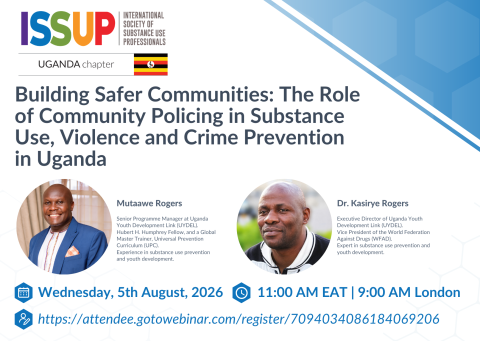
ISSUP Uganda would like to invite you to its webinar, " Building Safer Communities: The Role of Community Policing in Substance Use, Violence and Crime Prevention in Uganda"
Date: 5th August 2026
Time: 11:00 AM EAT | 9:00 AM London
Substance Use and crime continue to pose significant social, public health, and security challenges worldwide, disproportionately affecting children, young people, families, and communities. Addressing these challenges requires a shift from reactive enforcement to proactive, community-centred prevention approaches that foster trust, collaboration, and shared responsibility among law enforcement agencies, local authorities, civil society, and community members.
This webinar will explore how community policing can serve as an effective strategy for preventing Substance Use and reducing crime by strengthening partnerships, promoting early intervention, and addressing the underlying social and environmental factors that contribute to risky behaviours and criminal activity. The discussion will examine how communities can work alongside police, schools, health services, youth organizations, and local leaders to create safer, healthier, and more resilient communities.
Key discussion topics will include:
- The principles and value of community policing in promoting public safety and preventing crime.
- The relationship between Substance Use, youth vulnerability, and criminal behaviour.
- Evidence-based prevention strategies that reduce risk factors and strengthen protective factors for children, adolescents, and young adults.
- The importance of multi-sectoral partnerships involving law enforcement, local governments, education, health, social services, and civil society.
- Good practices and lessons learned from community-based initiatives that have successfully reduced drug-related harms and improved community safety.
- Opportunities for integrating prevention, youth engagement, and community participation into local crime prevention strategies.
The webinar will feature expert presentations, practical case studies, and a moderated panel discussion with practitioners from law enforcement, prevention, and community development sectors. Participants will also have opportunities to engage through interactive question-and-answer sessions, experience sharing, and discussions on practical solutions that can be adapted to their local contexts.
This webinar is particularly relevant for law enforcement officers, policymakers, local government officials, civil society organizations, educators, health professionals, youth practitioners, researchers, and community leaders seeking effective and sustainable approaches to addressing Substance Use and crime. By fostering dialogue and knowledge exchange, the webinar aims to strengthen participants' understanding of community policing as a cornerstone of prevention and inspire collaborative action towards safer, healthier, and more resilient communities.
Target Audience:
- Law enforcement agencies and community policing officers.
- Policymakers and government officials responsible for public safety, justice, health, youth, and social development.
- Local government leaders and community development practitioners.
Learning Outcomes:
Following this webinar, participants will be able to:
-
Understand the role of community policing as a proactive, evidence-based approach to preventing Substance Use and reducing crime through community engagement and partnership.
-
Examine the relationship between Substance Use and crime, including the social, economic, and public health factors that increase vulnerability, particularly among children, adolescents, and young people.
-
Identify evidence-based prevention strategies that strengthen protective factors, reduce risk factors, and promote safer, healthier, and more resilient communities.
-
Recognize the importance of multi-sectoral collaboration among law enforcement, local governments, health services, education institutions, civil society organizations, and community leaders in addressing drug-related challenges and crime prevention.
-
Promote knowledge exchange and networking by providing a platform for participants to share experiences, discuss challenges, and explore innovative solutions for strengthening community safety.
Presenter:
Mutaawe Rogers
Senior Programme Manager
Uganda Youth Development Link
Mutaawe Rogers is a social worker, researcher, and international substance use prevention specialist with over 20 years of experience in designing, implementing, and evaluating evidence-based programmes on drug use prevention, community safety, youth development, and crime prevention. He currently serves as Senior Programme Manager at UYDEL, where he leads multi-sectoral programmes in partnership with UNODC, UNICEF, CADCA, and other international organizations.
Rogers is a Global Master Trainer for the Universal Prevention Curriculum (UPC) under the Colombo Plan and has delivered international training programmes on evidence-based substance use prevention in Uganda, Zambia, Lesotho, Liberia, the United Arab Emirates, India, Sri Lanka, and Thailand. His expertise includes community-based prevention systems, school-based prevention, workplace prevention interventions, and prevention workforce development.
He is currently pursuing a Master of Social Work at Makerere University and is a Hubert H. Humphrey Fellow (Virginia Commonwealth University, USA), where he specialized in substance use prevention, treatment, policy, and programme evaluation. His professional interests include community policing, evidence-based drug prevention, crime prevention, youth empowerment, and strengthening community resilience through multi-sectoral partnerships.
Moderators:
Dr. Kasirye Rogers
Executive Director
Uganda Youth Development Link
Dr. Rogers Kasirye is the Executive Director of Uganda Youth Development Link (UYDEL) and a leading African specialist in youth development, substance-use prevention, child protection and social justice. With more than 30 years of experience, he has designed, implemented and evaluated programmes addressing drug and alcohol misuse, human trafficking, mental health, HIV prevention, sexual and reproductive health, youth crime and the protection of vulnerable children.
He holds a PhD in Social Work from Makerere University. He is also a U.S. Fulbright–Humphrey Fellow of Virginia Commonwealth University. Dr. Kasirye has served as a technical consultant and adviser to UNODC, WHO, UNICEF, UNDP, ILO and the Government of Uganda. He is a Global Master Trainer in the Universal. He is currently serving as vice president of World federation against drugs (WFAD). Dr. Kasirye is a Global Master Trainer for the Universal Prevention Curriculum (UPC) under the Colombo Plan and has contributed to several peer-reviewed publications. His leadership and advocacy have received national, regional and international recognition.
References:
-
Uganda Youth Development Link (2025): A Youth and Juvenile Crime Report, 2017-2014
-
Uganda Alcohol Policy Alliance. (2026). Baseline study for the UAPA 2026-2028 project: Strengthening alcohol harm control in Uganda through evidence-based policies and legislation at national and sub-national levels.
-
United Nations Office on Drugs and Crime (UNODC). (2021). Handbook on Youth Participation in Drug Prevention Work. Vienna: UNODC.
-
United Nations Office on Drugs and Crime (UNODC). (2024). World Drug Report 2024. Vienna: UNODC.
-
United Nations Office on Drugs and Crime (UNODC) & World Health Organization (WHO). (2018). International Standards on Drug Use Prevention (Second Updated Edition). Vienna: UNODC and Geneva: WHO.
-
United Nations Economic and Social Council (ECOSOC). (2002). Guidelines for the Prevention of Crime (Resolution 2002/13). New York: United Nations.
-
World Health Organization (WHO). (2024). Global Status Report on Alcohol and Health, Treatment and Prevention of Substance Use Disorders. Geneva: WHO.
-
Skogan, W. G. (2006). The Promise of Community Policing. In D. Weisburd & A. Braga (Eds.), Police Innovation: Contrasting Perspectives. Cambridge University Press.
-
Braga, A. A., & Weisburd, D. (Eds.). (2022). Police Innovation: Contrasting Perspectives (2nd Edition). Cambridge University Press.
Webinars and online events delivered and hosted by the International Society of Substance Use Professionals (ISSUP) are provided for informational purposes only. They are educational in nature and do not constitute medical advice, diagnosis or treatment.
- ISSUP members can join Networks to comment – Sign in or become a member